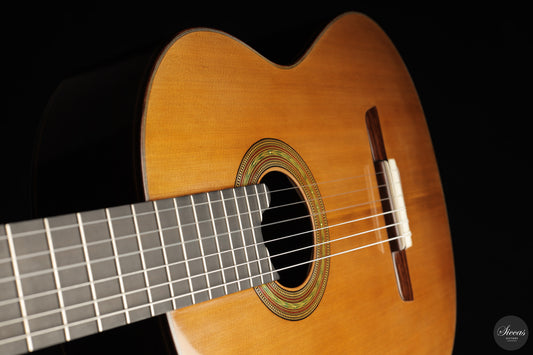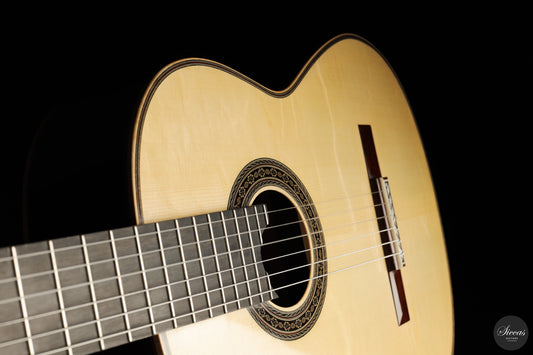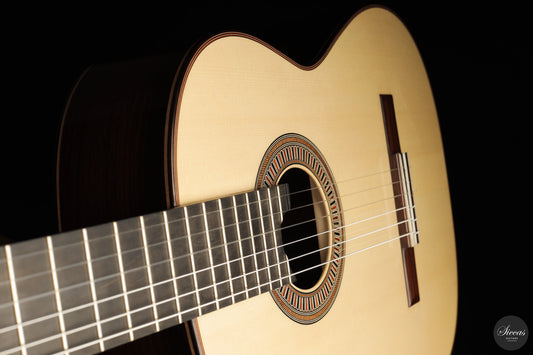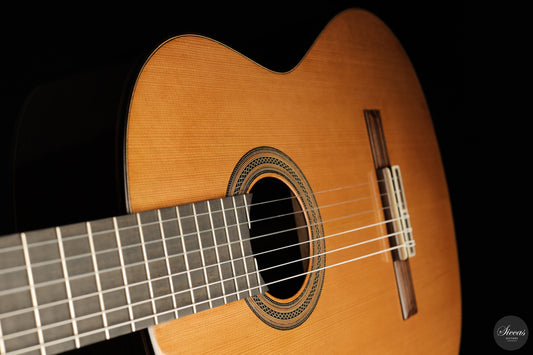

José Ramírez de Galarreta y Planell, the founder of the dynasty, was born in Madrid in 1858. At the age of twelve he began an apprenticeship in the workshop of his master Francisco González, whose guitar shop was located on the Carrera de San Jerónimo in Madrid.
The Foundation of a Legacy: Madrid, 1882
Between 1880 and 1882, José Ramírez I established his own workshop in the Madrid Rastro, marking the beginning of his independent career as a guitar maker. In 1890 he moved to Calle Concepción Jerónima 2, where his descendants continued the craft until 1995. Today the shop is located at Calle de la Paz 8, close to the original premises.
The Madrid of the late nineteenth century was fertile ground for lutherie. The city's thriving flamenco culture, its concert halls, and its position as the capital of Spain all created sustained demand for quality instruments. It was into this environment that José Ramírez I launched what would become the most enduring guitar-making dynasty in history — a family firm that has now spanned five generations and more than 140 years of continuous production.
Teacher, Master, and Central Figure of the Madrid School
Once independent, José Ramírez I became the teacher of his younger brother Manuel Ramírez and later of his son José Ramírez II. He also trained several other makers, including Antonio Viudes, Rafael Casana, Alfonso Benito, Antonio Gómez, Julián Gómez Ramírez and Enrique García. García later opened his own workshop in Barcelona, where he became the teacher of Francisco Simplicio.
This chain of transmission is remarkable: through García and Simplicio, the influence of José Ramírez I reached makers whose work is still celebrated today. The Madrid School of Guitar Making — rooted in the legacy of Antonio de Torres — found in José Ramírez I its most prominent master during the late nineteenth and early twentieth centuries. His workshop functioned not only as a production house but as an academy, shaping the next generation of Spanish luthiers.
The Ramírez Brothers
The relationship between José Ramírez I and his brother Manuel Ramírez is one of the most significant in guitar history. José taught Manuel the craft, and Manuel went on to become equally celebrated — eventually becoming the maker of the instrument given to a young Andrés Segovia, an event that helped define the sound of the classical guitar in the twentieth century. The two brothers' workshops operated in Madrid simultaneously for a period, representing two branches of what was effectively the same tradition.
The Guitarra de Tablao: Innovating for Flamenco
José Ramírez I became a central figure of the Madrid School of Guitar Makers, emerging as the most prominent master of his time in the tradition established by Antonio de Torres. Flamenco guitarists sought his expertise to address the limited sound projection of instruments then available, which struggled to be heard in tablaos and singing cafés.
In response to this practical demand, he created the "Guitarra de Tablao" — a model designed specifically to project in the loud, energetic environment of flamenco performance spaces. This was not a minor refinement but a considered redesign, addressing the acoustic requirements of flamenco as a performance art. The Guitarra de Tablao served as the foundation for later developments by his brother Manuel and eventually contributed to the principles of the modern flamenco guitar adopted by subsequent generations of makers.
This intersection of concert demand and craft innovation is a defining characteristic of the Ramírez approach. For those interested in the broader distinction between flamenco and classical instruments, our guide on acoustic vs. classical guitar explores the tonal and structural differences in depth. You can also browse our current selection of flamenco guitars to see how this tradition continues today.
The Barrios Connection
One historical curiosity is that a Ramírez guitar owned by Agustín Barrios, now exhibited in the Cabildo of Paraguay, was built using the same plantilla as the Guitarra de Tablao. Barrios — one of the most gifted and celebrated guitarists and composers of the early twentieth century — was known for performing on instruments of exceptional quality. The fact that he owned a Ramírez built on this specific template underscores both the reach of José Ramírez I's influence and the esteem in which his instruments were held by performing artists of the era.
For a deeper look at Barrios as a composer and guitarist, see our dedicated article on Agustín Barrios and the classical guitar.
The Ramírez Dynasty After José Ramírez I
José Ramírez I died in 1923, but the workshop he founded continued uninterrupted. His son José Ramírez II took over the firm, followed by José Ramírez III — under whose direction the workshop became internationally renowned, supplying instruments to many of the greatest classical guitarists of the twentieth century. The dynasty has continued with José Ramírez IV and subsequently Amalia Ramírez, who has led the firm into the twenty-first century.
Each generation has added to and reinterpreted the founding tradition without abandoning it. The workshop's address has changed, and the tools and materials have evolved, but the commitment to handmade construction, tonal refinement, and the Madrid School tradition established by José Ramírez I remains the firm's defining characteristic. You can explore the full current range of instruments from this lineage in our José Ramírez collection.
Historical Significance
To understand José Ramírez I solely as a craftsman is to underestimate his role. He was also a transmitter of knowledge — a master whose workshop produced not only guitars but other masters. The network of luthiers trained directly or indirectly under him shaped Spanish guitar making for generations. His instruments, his innovations for the flamenco context, and his role in sustaining and extending the Torres tradition place him among the most consequential figures in the history of the classical guitar.
For players and collectors seeking instruments that stand within this tradition, the Ramírez name remains one of the most trusted in the world. Whether you are exploring the great repertoire of classical guitar or looking for an instrument to begin your own journey, understanding the makers behind the instruments enriches every aspect of engagement with this music.