

Friederike Linscheid
-
Luthier: Friederike Linscheid
-
Luthier: Friederike Linscheid
-
Luthier: Friederike Linscheid
-
Luthier: Friederike Linscheid
-
Luthier: Friederike Linscheid
-
Luthier: Friederike Linscheid
-
Luthier: Friederike Linscheid
-
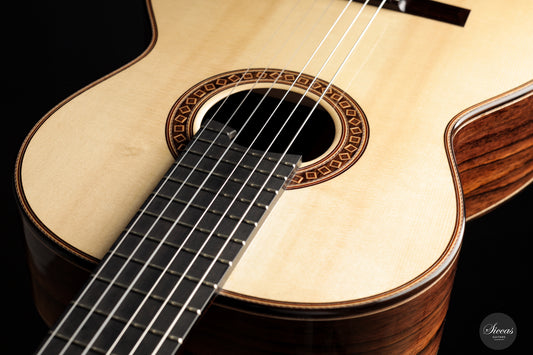
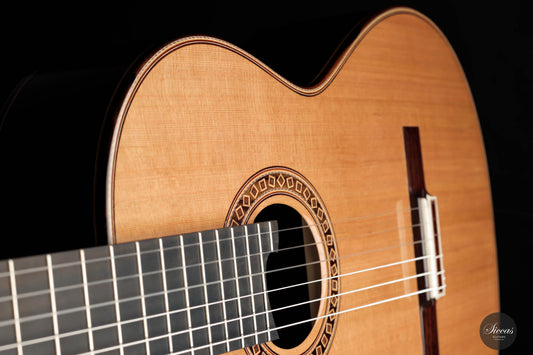
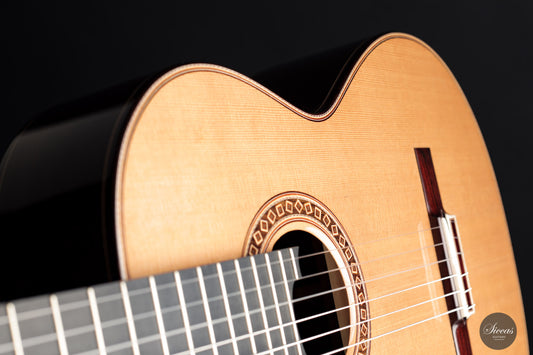
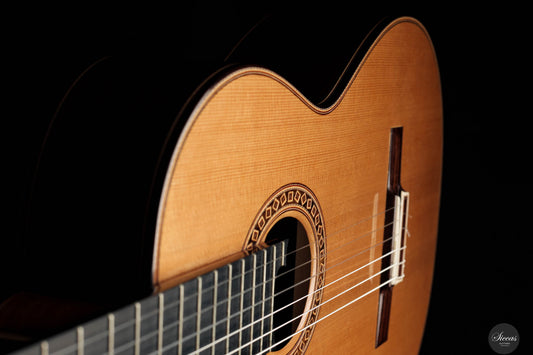
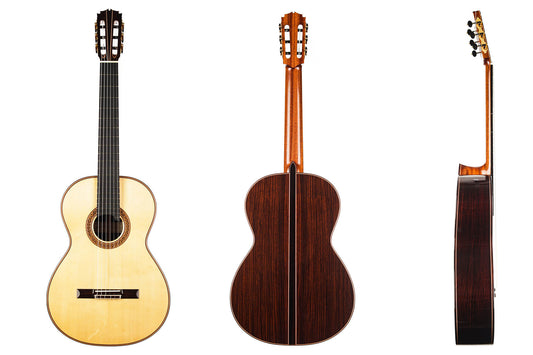
Friederike Linscheid - 2026 Doubletop
Price on requestReservedLuthier: Friederike LinscheidConstruction Type: Double-Top Guitars








Ask us - right here.
Enrico, our AI team member, replies around the clock.
Instant reply · free · no obligation Rather use WhatsApp
Frequently Asked Questions About Classical Guitars
How do I choose the right classical guitar for my level?
Choosing the right classical guitar depends on your playing level, musical goals, and budget. Beginners benefit from studio-model guitars from renowned workshops, while advanced players and professionals often choose a handmade master guitar. We are happy to advise you personally and can send detailed sound samples and videos on request.
What is the difference between a master guitar and a studio guitar?
Master guitars are built entirely by hand in the workshop of a single luthier, using only high-quality, well-aged tonewoods. Studio guitars are made in small series, often under the supervision of the master luthier, and offer excellent value for students and ambitious amateur players.
Can I try a classical guitar at home for 14 days?
Yes — every guitar you purchase from us comes with a 14-day home approval period. This complimentary trial applies worldwide to all orders, whether you are in Germany, Europe, the USA, Asia or anywhere else. We ship your instrument fully insured in a high-quality case so you can play it under your own acoustic conditions. If the guitar is not the right one for you, simply send it back and receive a full refund of the purchase price.
Can I try a classical guitar before purchasing?
Absolutely. You are warmly invited to visit our showroom in Karlsruhe, Germany, and test the instruments at your leisure. We are happy to schedule a personal appointment. If a visit is not possible, we send detailed videos and sound samples, and offer extensive consultation by phone or video call.
What payment methods and financing options do you offer?
We accept bank transfer, PayPal, major credit cards, and Klarna. For high-value instruments, we offer individual installment plans on request. Please contact us directly — we will find a suitable solution for every budget.
How do I properly care for my classical guitar?
A classical guitar requires constant humidity between 45 and 55 percent. Store the instrument in its case with a humidifier, avoid direct sunlight and large temperature fluctuations. Change the strings regularly and clean the guitar with a soft microfiber cloth.
You may also be interested Friederike Linscheid
Friederike Linscheid – Guitar Maker
In building my concert guitars, my goal is to give them a consistent expression while allowing each one to develop its own personality. For me, this arises from an inner harmony between the instrument’s sound and its visual appearance.
Both aspects are shaped by the selection of materials and forms, which I determine based on acoustic, structural, and aesthetic criteria. When choosing the tonally influential soundboard material in particular, I use physical measurements alongside traditional techniques such as bending and tapping.
The sound of my guitars is suitable for the stage—powerful, with wide projection, rich tonal colors, warm basses, and a singing treble.
To create strong visual unity, I use a reduced color palette and repeated material and design elements. I offer my guitars in both a modern and a more traditionally influenced design. Structurally, the instruments are nearly identical and differ mainly in the rosettes and slightly modified outlines.
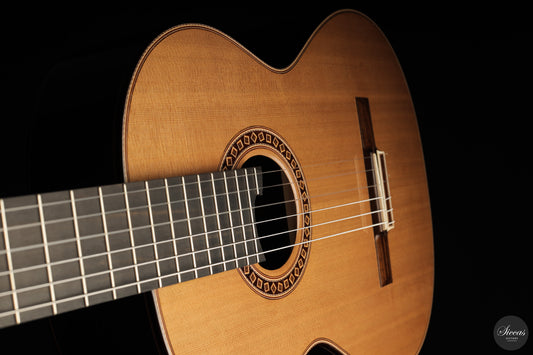
The fundamental construction follows the classical Spanish guitar tradition. The bracing system of the soundboard is based on the concept of Robert Bouchet but executed much more delicately. Subtle structural and visual details go beyond conventional boundaries. For example, the soundboard drops on the treble side above the soundhole, as the raised fingerboard improves playability and sound projection in the high treble. The relatively narrow outline results in a slightly smaller soundboard area, reducing the mass of the vibrating surface and contributing to quick response. To balance this, I increase the body volume with high sides, giving the basses their deep character. The sides are doubled but remain thin, which benefits sustain without adding unnecessary weight. All instruments feature a hand-polished shellac finish.