

Vladimir Druzhinin
-
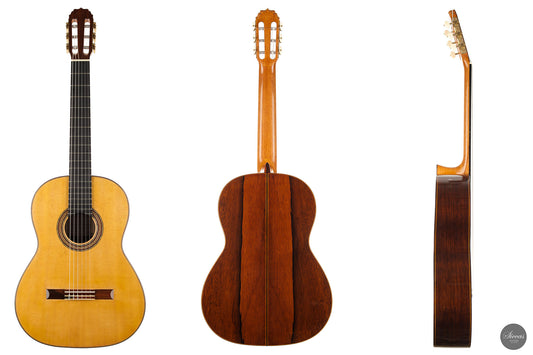
Luthier: Vladimir Druzhinin
-
Luthier: Vladimir Druzhinin


Ask us - right here.
Enrico, our AI team member, replies around the clock.
Instant reply · free · no obligation Rather use WhatsApp
Frequently Asked Questions About Classical Guitars
How do I choose the right classical guitar for my level?
Choosing the right classical guitar depends on your playing level, musical goals, and budget. Beginners benefit from studio-model guitars from renowned workshops, while advanced players and professionals often choose a handmade master guitar. We are happy to advise you personally and can send detailed sound samples and videos on request.
What is the difference between a master guitar and a studio guitar?
Master guitars are built entirely by hand in the workshop of a single luthier, using only high-quality, well-aged tonewoods. Studio guitars are made in small series, often under the supervision of the master luthier, and offer excellent value for students and ambitious amateur players.
Can I try a classical guitar at home for 14 days?
Yes — every guitar you purchase from us comes with a 14-day home approval period. This complimentary trial applies worldwide to all orders, whether you are in Germany, Europe, the USA, Asia or anywhere else. We ship your instrument fully insured in a high-quality case so you can play it under your own acoustic conditions. If the guitar is not the right one for you, simply send it back and receive a full refund of the purchase price.
Can I try a classical guitar before purchasing?
Absolutely. You are warmly invited to visit our showroom in Karlsruhe, Germany, and test the instruments at your leisure. We are happy to schedule a personal appointment. If a visit is not possible, we send detailed videos and sound samples, and offer extensive consultation by phone or video call.
What payment methods and financing options do you offer?
We accept bank transfer, PayPal, major credit cards, and Klarna. For high-value instruments, we offer individual installment plans on request. Please contact us directly — we will find a suitable solution for every budget.
How do I properly care for my classical guitar?
A classical guitar requires constant humidity between 45 and 55 percent. Store the instrument in its case with a humidifier, avoid direct sunlight and large temperature fluctuations. Change the strings regularly and clean the guitar with a soft microfiber cloth.
You may also be interested Vladimir Druzhinin
Vladimir Druzhinin – Guitar Maker
From Physics to Luthiery
Vladimir Druzhinin, born in 1983 in Novosibirsk, Russia, into a family of scientists, has followed a remarkable path from physics to guitar making. His journey from academic research to artisanal craftsmanship merges scientific precision with artistic creativity, resulting in the refined art of building concert instruments.
Musical Roots and Early Influences
After completing his studies in physics and accelerator physics, Vladimir was drawn to the world of music. He studied double bass at the Novosibirsk State Music College while performing actively as a jazz bassist in the local scene. This intersection of science, craftsmanship, and music laid the foundation for his later work as a luthier.
Apprenticeship and Professional Craft
In 2010, Vladimir moved to Moscow, where he met Timofey Tkach, a key figure in his development. Under Tkach’s mentorship, he turned to guitar making as his primary profession. Today, he runs his own workshop, producing classical guitars, lutes, and other string instruments, while also engaging in restoration work. He is currently developing his own design for an acoustic bass.
Philosophy of Instrument Building
For Vladimir Druzhinin, building an acoustic instrument is a process that blends craftsmanship and science. It evolves from technical precision into a form of artistic expression—a continual journey of exploration and discovery.
Inspirations and Classical Roots
His philosophy is deeply rooted in the Classical Spanish School of guitar making. Influences include Antonio de Torres Jurado, Manuel Ramírez, Domingo Esteso, Santos Hernández, and Hermann Hauser I, as well as the later innovations of José Ramírez III and Miguel Rodríguez in the mid-20th century.
The Physics of Sound
At the heart of his work lies an understanding of the physics of sound. Every musical instrument functions as a complex acoustic resonator—a delicate balance of design, structure, and fine-tuning that determines its tonal identity.
Precision, Materials, and Method
Vladimir’s goal is to craft professional-grade instruments with exceptional tonal qualities.