

Keijo Korelin
-

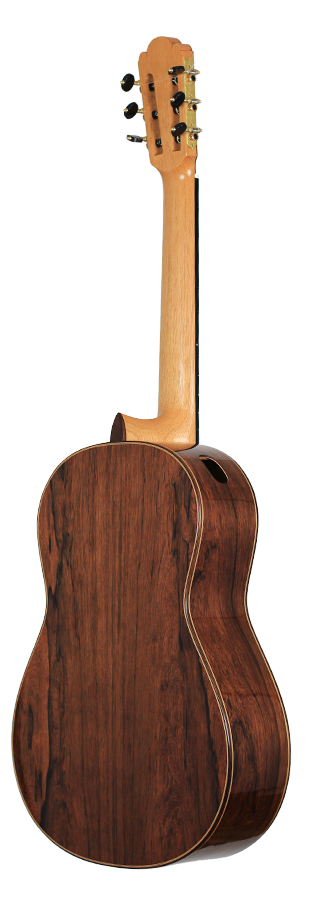 SoldSoldLuthier: Keijo Korelin
 -
Luthier: Keijo Korelin


Frequently Asked Questions About Classical Guitars
How do I choose the right classical guitar for my level?
Choosing the right classical guitar depends on your playing level, musical goals, and budget. Beginners benefit from studio-model guitars from renowned workshops, while advanced players and professionals often choose a handmade master guitar. We are happy to advise you personally and can send detailed sound samples and videos on request.
What is the difference between a master guitar and a studio guitar?
Master guitars are built entirely by hand in the workshop of a single luthier, using only high-quality, well-aged tonewoods. Studio guitars are made in small series, often under the supervision of the master luthier, and offer excellent value for students and ambitious amateur players.
Can I try a classical guitar at home for 14 days?
Yes — every guitar you purchase from us comes with a 14-day home approval period. This complimentary trial applies worldwide to all orders, whether you are in Germany, Europe, the USA, Asia or anywhere else. We ship your instrument fully insured in a high-quality case so you can play it under your own acoustic conditions. If the guitar is not the right one for you, simply send it back and receive a full refund of the purchase price.
Can I try a classical guitar before purchasing?
Absolutely. You are warmly invited to visit our showroom in Karlsruhe, Germany, and test the instruments at your leisure. We are happy to schedule a personal appointment. If a visit is not possible, we send detailed videos and sound samples, and offer extensive consultation by phone or video call.
What payment methods and financing options do you offer?
We accept bank transfer, PayPal, major credit cards, and Klarna. For high-value instruments, we offer individual installment plans on request. Please contact us directly — we will find a suitable solution for every budget.
How do I properly care for my classical guitar?
A classical guitar requires constant humidity between 45 and 55 percent. Store the instrument in its case with a humidifier, avoid direct sunlight and large temperature fluctuations. Change the strings regularly and clean the guitar with a soft microfiber cloth.
You may also be interested Keijo Korelin
Keijo Korelin – Luthier
Keijo Korelin has been building classical guitars full-time since 2006. Over more than 15 years, he has crafted around 120 classical guitars and repaired many high-end instruments.
He is a fourth-generation woodworker – his father was a cabinetmaker, his grandfather operated sawmills, and his great-grandfather built log houses on the Karelian Isthmus. Although he originally considered an academic career in literature, he ultimately chose to study at the Ikaalinen College of Crafts and Design, graduating as an artisan luthier in 2005. He founded his own workshop in early 2006. From the beginning, he knew he wanted to build classical guitars, as he found their tonal palette uniquely compelling.
Throughout his career, he has worked alongside several talented colleagues. His first steps as a luthier were taken under the guidance of master builder Rauno Nieminen. The Liikanen brothers, Kauko and Keijo, taught him the fundamentals of classical guitar making. He performed repair work for Juha Lottonen for several years, while Gernot Wagner introduced him to the craft of building double-top guitars. Gregory Byers further influenced his artistic and technical development.
Through his work, he has met many gifted musicians, with some becoming close friends. He expresses deep gratitude to everyone who has shown interest in his guitars – especially Otto Tolonen and Aleksi Rajala, whose performances have helped spread the reputation of his instruments worldwide.
He lives with his wife Henna, their children Eevert and Verner, and their dogs Kylli and Selma in the small Finnish town of Joroinen. His hobbies include judo and playing the domra and classical guitar. He also spends time caring for their small forest, maintaining their protected 1914 log house, and engaging in volunteer work.