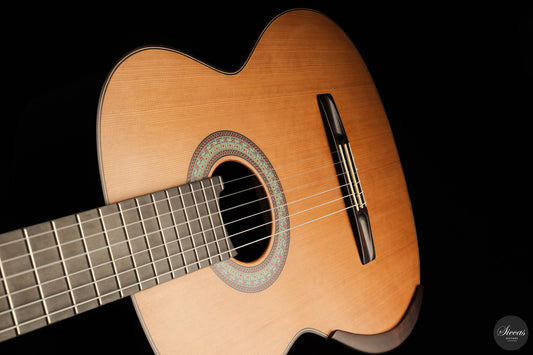
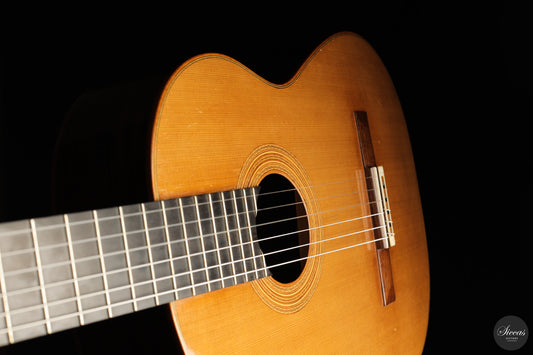
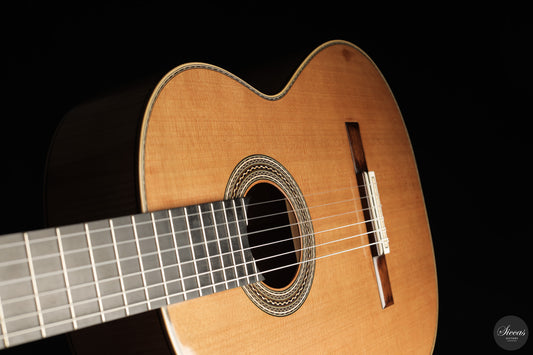
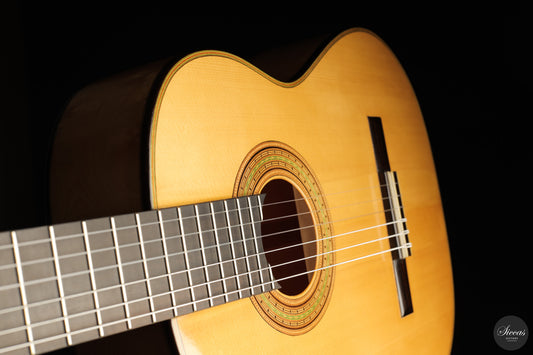
Manuel Ramírez de Galarreta y Planell was born in 1864 in Alhama de Aragón. Although the family usually lived in Madrid, his father's profession required them to reside in Alhama for a period of time. Manuel learned the craft of guitar making from his older brother José Ramírez I. Around 1891, at the age of twenty-seven, he decided to establish himself independently. His original plan was to move to Paris, and when he shared this intention with José, his brother supported him in preparing the project. For unknown reasons, however, Manuel changed his mind and settled instead at 24 Cava Baja Street in Madrid. This decision created tension between the brothers, a situation they were never able to resolve during their lifetimes.
After some time in Calle de la Cava Baja, Manuel moved his workshop first to No. 5 Plaza de Santa Ana and later to No. 10 Calle Arlabán, where he remained permanently. Within a short period, he gained significant prestige not only as a guitar maker but also as a builder of violins and other stringed instruments. He was appointed luthier of the Royal Conservatory of Madrid. He continued the school initiated by his brother, and the makers he trained went on to become some of the finest builders of their time. Among his notable disciples were Santos Hernández, Domingo Esteso and Modesto Borreguero.
Due to the success of the "Guitarra de Tablao" created by his brother José, Manuel continued producing the model, gradually refining it and developing his own plantilla. Over time he achieved a flamenco instrument that remains a reference for this type of guitar, and his students maintained this tradition in their own work.
The Guitar That Changed History
Around 1912, one of the most well-known episodes in the workshop took place. A guitarist with a rather extravagant appearance entered the Arlabán Street workshop wishing to rent a classical guitar. Amused by the request, Manuel agreed out of curiosity and offered him an instrument to try while he continued speaking with José del Hierro, a violin teacher at the Royal Conservatory. Both soon became absorbed by the young guitarist's playing, and the teacher even attempted to convince him to abandon the guitar in favour of the violin, without success. Manuel, who had been following the conversation, decided to give the guitar to the young musician on the condition that he would take it with him around the world, confident that the instrument would flourish in his hands.
That young guitarist was Andrés Segovia. The instrument Manuel gave him that day became the foundation of one of the most celebrated careers in the history of classical guitar. The guitar is now exhibited at the Metropolitan Museum of Art in New York. Alongside Manuel's original label, it still bears the repair label added later by Santos Hernández, one of his most accomplished former pupils.
A School of Luthiers
The true measure of Manuel Ramírez as a luthier is not only found in his own instruments, but in the lineage of makers he trained. His workshop on Calle Arlabán functioned as one of the most important centres of guitar-making knowledge in early twentieth-century Spain. The craftsmen who passed through it carried his methods, his sensibility, and his standards into their own workshops.
Santos Hernández
Santos Hernández worked closely with Manuel Ramírez for many years and is widely regarded as one of the greatest Spanish luthiers of the twentieth century. After Manuel's death in 1916, Hernández continued on his own, building instruments that are today among the most sought-after classical and flamenco guitars in the world. The fact that his repair label appears on the very guitar Segovia received from Manuel speaks to the continuity of that relationship.
Domingo Esteso
Domingo Esteso was another pupil who emerged from the Ramírez workshop to build a distinguished independent career. His flamenco guitars in particular are celebrated for their lightness, responsiveness, and characteristic Castilian sound. Esteso's instruments remain highly valued by players and collectors today, and they carry clear traces of the tradition he absorbed from Manuel Ramírez.
Manuel Ramírez and the Flamenco Tradition
While Manuel Ramírez is often remembered in connection with Segovia and the classical guitar, his contribution to flamenco lutherie is equally significant. Building on the model established by his brother José, Manuel refined the flamenco guitar's construction over years of workshop practice. His plantilla, his choice of materials, and his structural approach produced instruments well suited to the demands of tablao performance — responsive, percussive, and immediate in their sound. The makers he trained, especially Hernández and Esteso, carried this flamenco tradition forward and gave it new life in their own work. If you are interested in exploring instruments in this lineage, you can browse our flamenco guitar collection.
Legacy and Place in Guitar History
Manuel Ramírez died in 1916, leaving behind a workshop legacy that shaped the course of Spanish lutherie for generations. His appointment as luthier to the Royal Conservatory of Madrid reflected the official recognition his craft had earned. His instruments, relatively few of which survive, are treated as historical documents — evidence of a moment when the modern classical guitar was still being defined.
The story of the guitar given to Segovia is sometimes reduced to a romantic anecdote, but it points to something real about Manuel's character as a craftsman: he recognised musical talent and understood that a fine instrument, in the right hands, was more than a commercial transaction. That instinct, together with his commitment to training the next generation of makers, is perhaps his most lasting contribution to the history of classical guitar.
For those interested in the broader family tradition, the José Ramírez collection at Siccas Guitars offers instruments from the dynasty that Manuel's brother founded and that continues to this day. And if you want to understand how the guitars Manuel built compare to modern instruments, our guide to acoustic vs. classical guitar differences provides useful context.
Manuel Ramírez worked for only about twenty-five years as an independent luthier. In that time he built a workshop, trained masters, gave Segovia his first great guitar, and helped establish the sonic and structural ideals of the Spanish classical guitar. Few luthiers have left a mark of comparable depth in so short a career.