
Across the history of music, a small number of artists distinguish themselves through a combination of musical insight, technical consistency, and a personal presence that shapes every interpretation. Ana Vidovic belongs to this group. Her work as a classical guitarist reflects long-term artistic development, grounded in discipline, listening, and a clear understanding of musical structure. Rather than relying on external effect, her performances are defined by focus, balance, and continuity of musical thought.
This concert video, recorded at the Siccas Guitars studio, documents a program that brings together different musical eras and aesthetic languages. The selection of works allows the classical guitar to function as a bridge between baroque form, romantic lyricism, and twentieth-century rhythmic expression.
A Longstanding Musical Relationship with Siccas Guitars
The recording marks Ana Vidovic’s fourth visit to Siccas Guitars. Over the years, these encounters have developed into a sustained artistic relationship. Each session has offered a different perspective on her repertoire, instrument choice, and interpretative priorities, creating a growing body of documented work.
For Siccas Guitars, such collaborations are part of a broader approach to presenting musicians in a concentrated and respectful environment. The focus lies on creating conditions that allow musical substance to unfold without distraction, emphasizing continuity rather than isolated moments.
The Instrument: Jim Redgate Classical Guitar from 2025
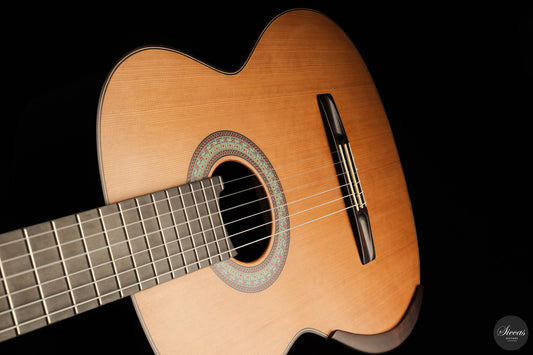
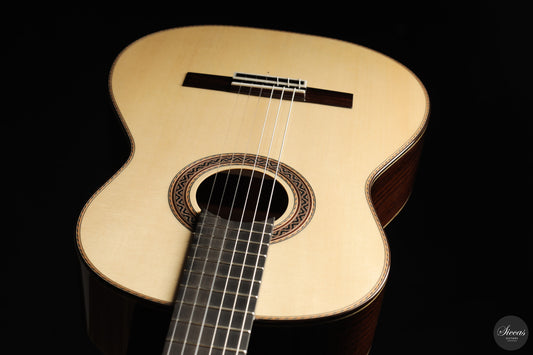
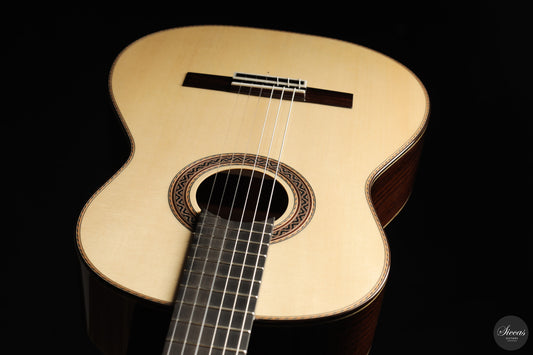
For this concert, Ana Vidovic performs on a classical guitar by Jim Redgate, completed in 2025 and built exclusively for Siccas Guitars. Redgate’s instruments are known for their structural precision, controlled resonance, and reliable response across the fingerboard. His designs reflect a modern approach to guitar making that prioritizes clarity and consistency.
Throughout the program, the guitar supports a wide dynamic range and stable intonation. Subtle variations in touch remain clearly audible, while stronger articulations retain definition without harshness. This balance allows extended musical forms to remain coherent and supports the demands of both polyphonic writing and rhythmic intensity.
The Program as a Coherent Musical Narrative
The program combines works by Johann Sebastian Bach, Astor Piazzolla, and Franz Schubert. Although these composers belong to different historical contexts, their music shares an emphasis on melodic clarity and formal organization. The sequence of pieces creates a continuous narrative rather than a series of stylistic contrasts.
The listener is guided from baroque dance movements through tango-inspired forms and into the world of romantic song, before returning to Bach in a work of large-scale variation. This structure encourages attentive listening and highlights the versatility of the classical guitar.
Johann Sebastian Bach: Flute Partita in A Minor
The concert opens with Bach’s Flute Partita in A Minor, presented in a transcription for classical guitar. The suite consists of four movements: Allemande, Corrente, Sarabande, and Bourrée Anglaise. Each movement is rooted in a specific dance character and relies on rhythmic clarity and proportion.
On the guitar, the Partita requires careful shaping of articulation and phrasing to suggest polyphonic relationships within a predominantly linear texture. Ana Vidovic emphasizes continuity of line and rhythmic stability, allowing the dance origins of the movements to remain present without overt emphasis.
Astor Piazzolla: Nuevo Tango on the Classical Guitar
The central section of the program is devoted to three works by Astor Piazzolla: Verano Porteño, Milonga del Ángel, and La Muerte del Ángel. These compositions belong to Piazzolla’s Nuevo Tango language, in which traditional Argentine tango elements intersect with classical form and rhythmic complexity.
On the classical guitar, these works demand precise rhythmic control, clear articulation, and the ability to shift quickly between contrasting characters. Sharp accents and percussive gestures alternate with sustained lyrical passages. In this performance, the balance between rhythmic tension and melodic continuity remains clearly defined, giving each piece a distinct profile while maintaining cohesion across the set.
Franz Schubert: Ständchen
Ständchen by Franz Schubert appears in a guitar arrangement that preserves the vocal character of the original song. The melody unfolds in a restrained and continuous line, supported by an accompaniment that requires careful balance and tonal control.
In this setting, the guitar functions simultaneously as voice and harmonic foundation. Legato phrasing and controlled dynamics are essential to maintain the intimacy of the music. Within the program, Ständchen provides a moment of lyrical concentration and contrast without disrupting the overall flow.
Johann Sebastian Bach: Chaconne
The concert concludes with Bach’s Chaconne, originally written for solo violin and regarded as one of the most demanding works in the repertoire. When performed on the classical guitar, the Chaconne requires a clear structural overview, endurance, and consistency of tone across an extended sequence of variations.
Ana Vidovic approaches the work with an architectural perspective. Harmonic progression and long-term formal relationships guide the interpretation, allowing the individual variations to form part of a coherent whole rather than isolated events.
The Recording Environment at Siccas Guitars
The concert video was recorded in the Siccas Guitars studio, a space designed to capture the natural sound of classical guitars with precision. The acoustic environment supports transparency, ensuring that articulation, resonance, and dynamic nuance remain clearly audible.
This recording approach avoids excessive post-production and places emphasis on the direct relationship between performer, instrument, and space. It reflects the philosophy of Siccas Guitars, where sound is documented rather than shaped after the fact.
Music, Instrument Making, and Artistic Continuity
This concert video documents the intersection of interpretation, instrument making, and recording practice. It presents Ana Vidovic performing a demanding and stylistically diverse program on a modern classical guitar by Jim Redgate within a focused listening environment.
At the same time, the recording reflects the broader role of Siccas Guitars as a place where musicians, luthiers, and instruments meet over extended periods of collaboration. The result is a detailed musical document that connects historical repertoire, contemporary guitar making, and individual artistic voice.