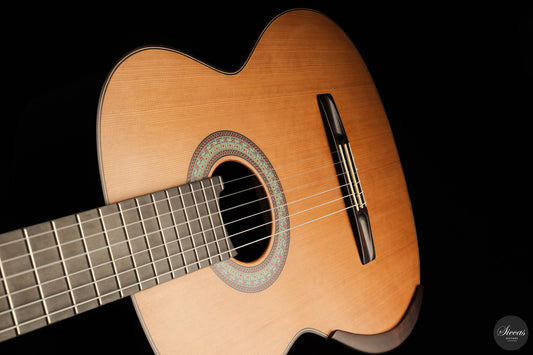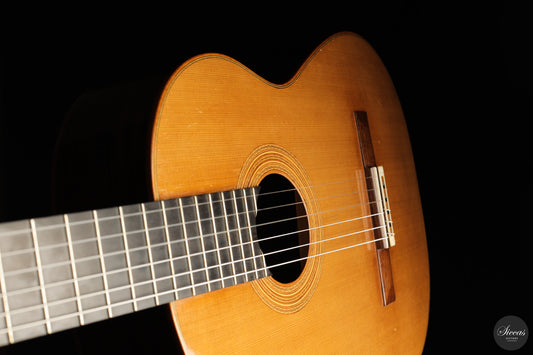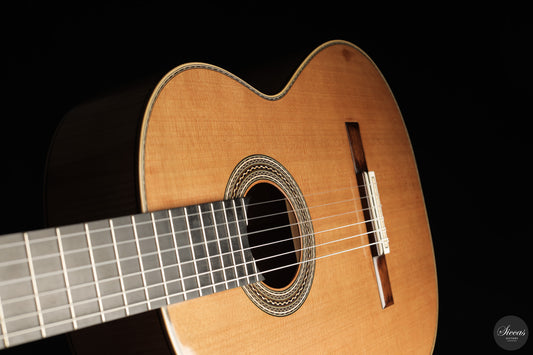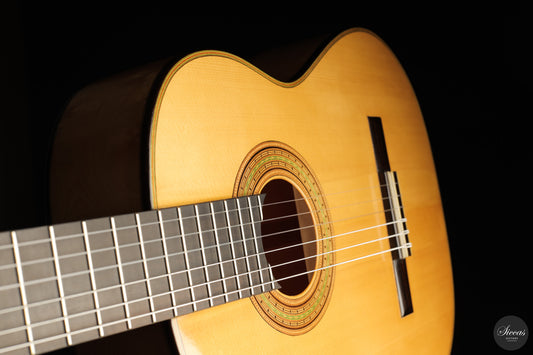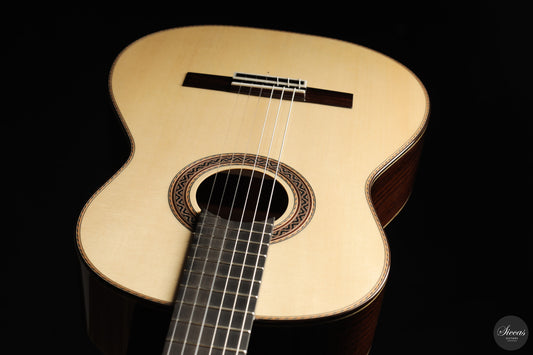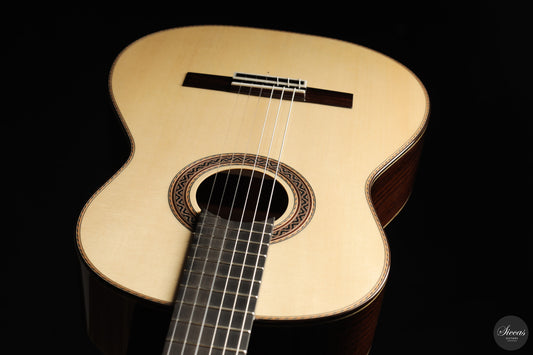

Daniel Friederich is regarded as one of the most influential guitar makers of the twentieth and early twenty-first centuries. His classical and flamenco guitars have had a lasting impact on the sound ideal of modern concert instruments. For many musicians, collectors, and luthiers, his name stands for precision, balance, and an uncompromising attitude toward sound and craftsmanship.
A Personal Perspective on Friederich’s Work
The first encounter with guitars by Daniel Friederich came for Manuel Sicca, co-founder of Siccas Guitars, through his father Mario Sicca, who played numerous instruments by this maker. It became clear early on that Friederich was far more than a traditional luthier. His work combined disciplined craftsmanship, artistic sensitivity, and a distinctly analytical approach to guitar making.
From this perspective, Friederich is understood not only as a craftsman, but as a researcher who regarded each guitar as part of an ongoing process of discovery.
Early Years and Musical Foundation
Daniel Friederich was born in Paris in 1932. His original career began as a classical guitarist. This musical practice formed the foundation for his later understanding of tone, projection, and playability. For health reasons, he had to give up active performance, but turned to guitar making in order to continue pursuing the sound ideals that had occupied him as a player.
In the 1950s, Friederich began building his own instruments, at a time when classical guitar playing was undergoing significant change. Larger concert halls, increasing technical demands, and a growing international audience required instruments with clear projection and reliable tonal control.
Influence of Robert Bouchet
A decisive influence on Friederich’s development was his encounter with Robert Bouchet. Bouchet introduced him to a rigorously structured and acoustically grounded approach to guitar making. The idea of understanding the guitar as a closed, coherent system became central to Friederich’s thinking.
Although this influence remains visible in his work, Friederich quickly developed his own voice. He did not adopt models unchanged, but systematically questioned proportions, material thicknesses, and structural relationships.
The Scientific Approach to Guitar Making
What distinguished Daniel Friederich from many other guitar makers was his consistently methodical approach. He did not work on intuition alone, but combined experience with systematic observation and documentation. Each guitar was measured, described, and analyzed in terms of sound.
Friederich kept detailed workshop journals in which he recorded impressions, measurements, and tonal characteristics. He built his own machines to test wood properties and collaborated with scientific laboratories to better understand acoustic relationships. For him, knowledge meant control, and control meant tonal reliability.
Construction Philosophy and Technical Refinement
The guitars of Daniel Friederich are largely based on traditional fan bracing following Antonio de Torres. Friederich did not fundamentally alter this system, but refined it through precise adjustments. Changes to bracing, soundboard thickness, and body geometry always served a clear goal: bringing balance, projection, and responsiveness into alignment.
His innovation lay in repeatability. By reducing sources of error and carefully controlling parameters, he was able to build instruments that behaved predictably and consistently at a high level.
Material Selection and Craft Execution
Friederich worked with carefully selected tonewoods, most often using red cedar or spruce for soundboards and Indian rosewood for back and sides. Selection was based exclusively on acoustic criteria.
All instruments were finished by hand using traditional French polish shellac. Details such as headstock shape, rosette, and bridge reflect a restrained, functional aesthetic that consistently places sound above decoration.
A Distinct Sound Ideal
The sound of a Daniel Friederich guitar is often described as clear, serious, and precise. Deep basses remain controlled, while trebles are focused and projecting. The midrange is stable and transparent, allowing polyphonic music to speak with particular clarity.
A central characteristic is dynamic balance. The instruments respond reliably at low volume and retain structure under strong attack. This makes them suitable both for large concert halls and for recording situations.
The Collaboration with Roberto Aussel
A special role in Friederich’s work was played by his long-standing collaboration with the guitarist Roberto Aussel. Over a period of nearly forty years, Friederich built a total of seven guitars for him. Each instrument represented a further refinement of the previous one.
Guitar no. 830 is considered the pinnacle of this collaboration. One of Friederich’s final instruments, no. 836, is an almost identical replica of this guitar. Built from red cedar and the finest Indian rosewood, it represents the quintessence of Friederich’s lifetime of research.
About this instrument, Friederich himself wrote: “Classical voice, serious, precise sonority overall, quite clear, but what charm, what class.”
Playability and Universal Adaptability
Friederich’s guitars are known for their ergonomic playability. They adapt to different hands and playing styles and allow for comfortable, relaxed performance. These qualities made his instruments attractive to guitarists across a wide range of musical directions.
Legacy and Significance
Over the course of his life, Daniel Friederich built just over 800 guitars. Each instrument was created with the utmost care and under strict quality standards. Today, his guitars are considered rare collector’s items and reference instruments for modern concert guitar making.
Friederich did not simply build guitars. He shaped voices. Voices that continue to resonate and inspire generations of guitarists and guitar makers. His work unites craftsmanship, scientific curiosity, and musical depth into a legacy of lasting significance.