
What Is a Classical Guitar?
The classical guitar — also known as the concert guitar or Spanish guitar — is one of the most refined and expressive string instruments ever created. With its nylon strings, wide fingerboard, and carefully braced spruce or cedar top, it produces a warm, singing tone that has captivated audiences and players for centuries. Whether you encounter it in a concert hall, a intimate salon, or a guitarist's living room, the classical guitar occupies a unique place among instruments: technically demanding, deeply personal, and capable of extraordinary musical range.
If you have ever wondered what sets the classical guitar apart from the acoustic or steel-string guitars you see in folk, country, or rock music, the answer lies in both its construction and its playing tradition. Understanding those differences is the first step toward appreciating why so many players — beginners and world-class soloists alike — choose the classical guitar as their instrument for life.
Classical Guitar vs. Acoustic Guitar: The Key Differences
The most common source of confusion for newcomers is the distinction between a classical guitar and an acoustic guitar. Both are acoustic instruments that produce sound without amplification, and from a distance they can look similar. But they are fundamentally different tools, built for different sounds and different repertoires.
Strings: Nylon vs. Steel
The single most important difference is the strings. Classical guitars use nylon strings (the three bass strings are wound metal over a nylon or similar core). Acoustic guitars — often called steel-string or Western guitars — use steel strings. This difference shapes everything: the tone, the touch, the build of the instrument, and the technique required to play it.
Nylon strings are softer under the fingers, produce less volume but greater warmth and clarity in the midrange, and respond beautifully to the nuanced right-hand technique classical players develop over years of practice. Steel strings produce a brighter, more cutting tone with greater projection — ideal for strumming chords in a band or accompanying a singer, but not designed for the fingerstyle finesse of classical repertoire.
Body Shape and Construction
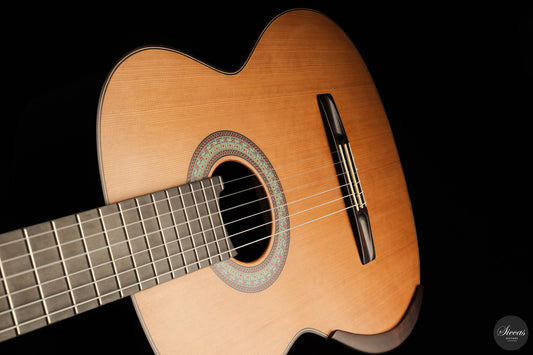
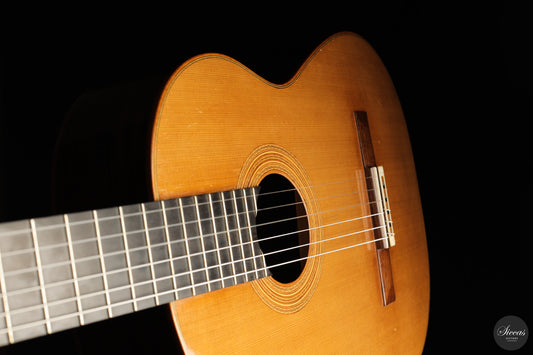
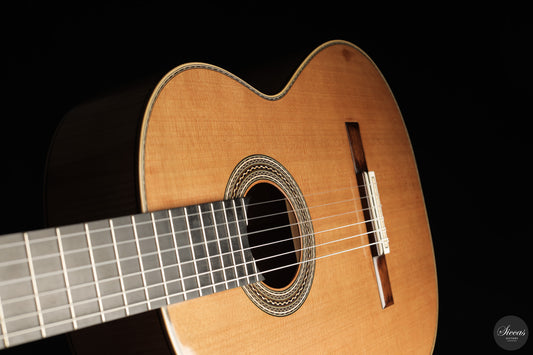
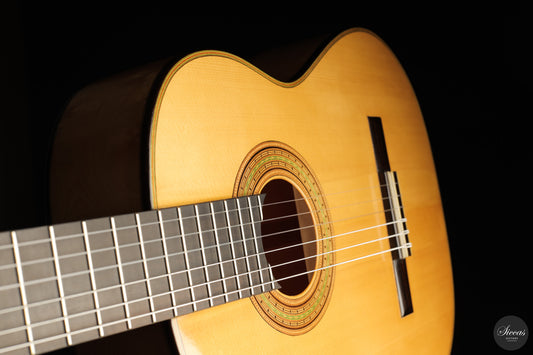
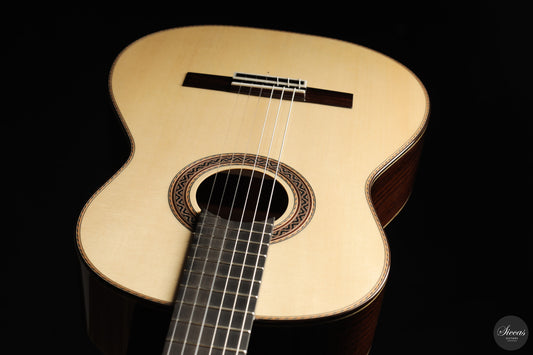
Classical guitars have a slightly smaller, shallower body than most steel-string acoustics. The top (soundboard) is typically made from spruce or cedar — two tonewoods with very different characters. Spruce offers brightness and projection, while cedar provides warmth and immediate response. The back and sides are commonly made from rosewood, cypress, maple, or other tonewoods that contribute to the instrument's overall resonance and color.
The internal bracing of a classical guitar is also distinct. Rather than the X-bracing common in steel-string acoustics, classical guitars use a fan-bracing system — a pattern of thin wooden struts radiating across the underside of the soundboard. This design, refined over generations of luthiers, allows the top to vibrate freely and respond to the gentle attack of fingertips and nails.
Neck Width and Playing Position
The neck of a classical guitar is noticeably wider than that of a steel-string acoustic — typically around 52 mm at the nut compared to 42–44 mm on most acoustic guitars. This extra width gives the left hand room to place fingers precisely on individual strings without accidentally muting adjacent ones, which matters enormously when playing complex counterpoint or multi-voice arrangements.
Classical guitarists also adopt a specific seated playing position: the guitar rests on the left leg (raised with a footstool or guitar support), angled upward, with both arms free to move. This is not mere tradition — it places the instrument in the optimal position for technical precision and physical comfort over long practice sessions.
For a deeper look at how these two instruments compare, see our guide on acoustic vs. classical guitar: key differences and which one is right for you.
The History of the Classical Guitar: From Torres to Today
The classical guitar as we know it today did not spring fully formed from history. It evolved gradually from earlier plucked string instruments — lutes, vihuelas, baroque guitars — through centuries of experimentation by players, composers, and instrument makers across Europe and the Americas.
Antonio de Torres and the Modern Guitar
The pivotal figure in the story of the modern classical guitar is the Spanish luthier Antonio de Torres (1817–1892). Torres transformed what had been a relatively modest parlour instrument into something capable of filling a concert hall. He enlarged the body, refined the top proportions across multiple distinct shapes, and — crucially — introduced the fan-bracing system that remains the foundation of classical guitar construction to this day.
Torres also standardized the scale length at approximately 65 cm, widened the fingerboard to allow greater left-hand freedom, and replaced the traditional wooden friction pegs with geared tuning machines. He kept the soundboard exceptionally thin — around 2.5 mm — trusting the internal bracing to provide structural integrity while maximizing acoustic response. The result was an instrument with greater volume, wider dynamic range, and a singing quality that his contemporaries simply could not match.
Every serious classical guitar made today, whether by a luthier in Andalusia, Japan, Germany, or Canada, descends in direct lineage from Torres' innovations. When you hold a concert guitar, you are holding an instrument whose fundamental architecture was set in the nineteenth century and has never been surpassed.
The Great Luthier Traditions
Following Torres, several luthier dynasties and individual makers developed their own voices within his framework. In Spain, the José Ramírez workshop in Madrid became one of the most influential in the world, producing instruments played by many of the greatest soloists of the twentieth century. In Germany, Hermann Hauser I created guitars that set a new standard for precision and tonal depth — Andrés Segovia famously played a Hauser for decades, calling it among the greatest guitars he had encountered. In France, Daniel Friederich brought a jeweller's precision and an architect's structural thinking to the craft.
Today, the classical guitar world is richer than ever. Luthiers from every continent bring new ideas — alternative bracing patterns, double tops, lattice structures, innovative tonewoods — while remaining in dialogue with the tradition Torres established. If you want to explore the finest instruments available today, our collection of classical guitars is a good place to start.
How a Classical Guitar Sounds — and Why It Sounds That Way
The tone of a classical guitar is difficult to describe in words but instantly recognizable to the ear: warm yet articulate, rich in overtones, capable of whispering and of singing. It is an instrument of contrasts — the same guitar can produce a dry, percussive bass note and a liquid, sustained treble melody within a single phrase.
Several factors shape the sound. The soundboard is the primary radiator of acoustic energy — the strings' vibration is transmitted through the saddle and bridge into the top, which amplifies and colors it. The back and sides reflect and shape that sound before it leaves the instrument through the soundhole. The internal bracing controls how the top flexes and at what frequencies it resonates most strongly.
The player's technique also shapes the sound profoundly. Classical guitarists produce tone with the right-hand fingers (and nails), varying the angle of attack, the point of contact along the string, and the speed and weight of the stroke to produce everything from a bright, nasal timbre (playing close to the bridge, ponticello) to a mellow, flute-like tone (playing over the soundhole or toward the neck, tasto).
The Classical Guitar Repertoire
The classical guitar has one of the most varied and rewarding solo repertoires of any instrument. It spans five centuries and encompasses music written specifically for the guitar alongside countless arrangements of works originally composed for lute, keyboard, orchestra, and voice.
The Cornerstone Works
Certain pieces have become touchstones of the repertoire — works that define what the instrument can do and that every serious student eventually encounters. Recuerdos de la Alhambra by Francisco Tárrega is perhaps the most iconic: a tremolo study of breathtaking beauty that has introduced countless listeners to the instrument. Capricho Árabe, also by Tárrega, showcases the guitar's capacity for color and romantic expression. La Catedral by Agustín Barrios Mangoré is a three-movement work of extraordinary ambition and depth.
The guitar's relationship with the music of J.S. Bach — explored in depth in our article on Bach on classical guitar — has been central to its concert life since Segovia's famous transcriptions brought baroque polyphony to the instrument. Fernando Sor, one of the great composer-performers of the early nineteenth century, left a body of studies and concert works that remain essential; learn more in our piece on Fernando Sor and the classical guitar.
For a curated overview of the repertoire's highlights, see our article on famous classical guitar pieces.
Who Plays the Classical Guitar?
The classical guitar has been shaped by a lineage of extraordinary performers. Andrés Segovia almost single-handedly established the instrument as a serious concert vehicle in the twentieth century, transcribing music from every era and commissioning works from the leading composers of his time. Julian Bream expanded the repertoire further with his insatiable curiosity and unrivalled musicianship. David Russell brought a singing tone and interpretive depth that remains a benchmark for players worldwide. Among the current generation, Ana Vidovic has established herself as one of the most compelling soloists of her era.
Explore the full lineage of great players in our guide to great classical guitarists.
Is the Classical Guitar Right for You?
The classical guitar rewards patience and commitment. It is not the easiest instrument to begin — the wide neck, the technique required for both hands, and the demands of the repertoire all take time to develop. But it is among the most rewarding. Players who commit to it gain access to five centuries of extraordinary music, a technique that translates to virtually any fingerstyle guitar playing, and an instrument that can last a lifetime and improve with age.
If you are wondering how long it takes to reach a satisfying level of playing, our article on how long it takes to learn classical guitar gives an honest, practical answer. And if you are just starting out, our list of easy classical guitar pieces for beginners is a good place to find your first repertoire.
Choosing the right instrument matters enormously. A well-made classical guitar — even a modest student model — will respond better, stay in tune more reliably, and inspire more consistent practice than a poorly constructed one. Our classical guitar collection covers instruments at every level, from carefully selected student guitars to concert instruments by leading contemporary luthiers.
The Classical Guitar Today
Far from being a museum piece, the classical guitar is a living, evolving instrument. Contemporary luthiers continue to push its acoustic possibilities — double-top guitars with their carbon-fibre composite soundboards offer projection and sustain that Torres could not have imagined, while remaining rooted in his structural philosophy. The repertoire expands every year as composers from every tradition find new ways to write for the instrument.
At the same time, the classical guitar's relationship with flamenco — its closest sibling — remains vital and creatively productive. If you are curious about that tradition, our flamenco guitar collection offers a window into a parallel world of equally extraordinary craftsmanship and musicality.
The classical guitar is, in the end, one of those rare instruments that can be everything: a vehicle for intimate self-expression, a serious concert instrument, a gateway into centuries of musical culture, and a daily companion that gives back whatever you put into it. There is a reason players rarely leave it behind.