





Siccas Luthiers - Halo Traditional Cedar


Details
Details
Overview
Overview
Shipping important note
Shipping important note
Important: Additional costs such as import taxes and custom duties may occur when importing goods from the EU into your country.
Delivery times are typically reliable and most instruments arrive within the estimated timeframe.
Should any unexpected delay occur, our team will keep you informed and provide support at every step. For all shipping details and exceptions, please see our Shipping Policy.
Details about GPSR
Details about GPSR


Video overview


More details about the guitar
About the luthier
Siccas Luthiers was founded by brothers Mirco and Manuel Sicca, who have dedicated their lives to the art of classical guitars, inspired by their late father Mario Sicca. Mario excelled not only as a soloist, but also as a respected professor at the Stuttgart Musikhochschule, and as a passionate luthier and collector. His deep love for the instrument continues to guide their vision.
Rooted in the experience behind Siccas Guitars, a reference for hand-made instruments by the world’s finest luthiers past and present, Mirco and Manuel set out to create guitars that reflect the same high standards of sound, aesthetics, and craft. This vision led to the creation of Siccas Luthiers, a project shaped by unique designs developed in-house by a team of experienced luthiers and players.
About the guitar
The Siccas Luthiers Halo Traditional takes the Spanish guitar as its musical and aesthetic foundation without seeking to reproduce a particular historical instrument. Its name reflects the concept: tradition remains at the centre, surrounded by a contemporary approach to detail, refinement, and playing response. The result preserves the open, colourful character associated with traditional Spanish guitars while offering the immediacy and control expected from a contemporary concert instrument.
In this 65 cm version, the cedar soundboard brings a darker, deeper, and more atmospheric character to the Halo. The basses have considerable depth and presence, while the low body resonance around F/F♯ establishes a warm foundation that supports the voice across the registers. Rather than concentrating this resonance only in the lower range, the guitar carries that sense of depth upward, giving the sound a spacious and enveloping quality.
Against this darker foundation, the trebles retain clarity and definition. Notes remain well separated even as the surrounding resonance gives them warmth and colour, allowing the upper register to open without becoming thin or detached from the rest of the instrument. The overall impression is wide and spacious: the sound has room to develop and decay naturally while musical lines remain articulate.
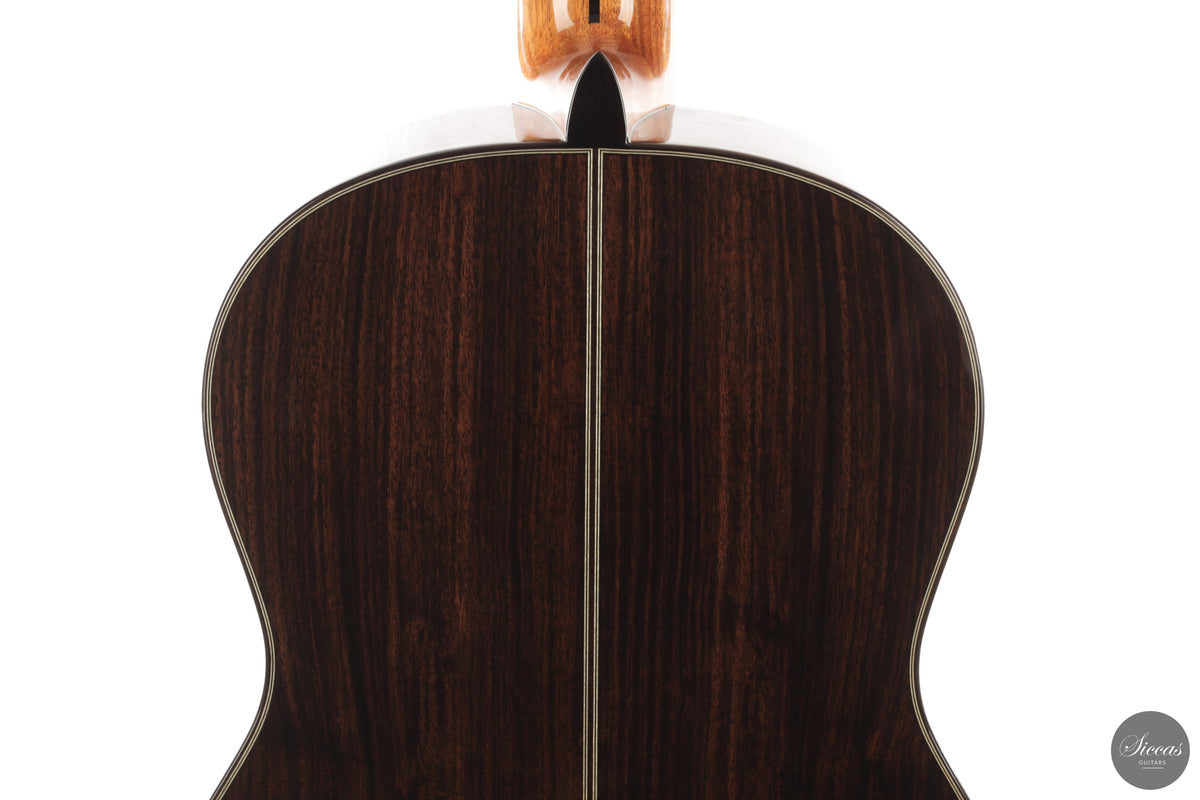
A defining quality of the Halo Cedar is how strongly its own colour participates in the music. Its darker resonance, warm depth, and slightly mysterious character become part of the phrasing itself, giving individual notes and harmonic changes an atmospheric quality without obscuring their shape. Indian rosewood back and sides complement the traditional construction concept, while the full 65 cm scale retains the familiar proportions and feel of a classical concert guitar.
Rather than placing tradition and modernity in opposition, the Halo uses one to frame the other: the character and resonance of the Spanish guitar remain at its core, presented through a responsive contemporary instrument with a distinctly dark and expressive personality. It comes in a hard shell case.
Pre-Order Special Price
This instrument is currently available as part of the Halo Traditional pre-order launch. The special pre-order price is €1,790. After the official launch, the regular price will be €1,990. The reduced price applies only during the pre-sale period. Deliveries will begin in January 2027.
The photos of this guitar are general product images and may differ from the actual instrument. As every guitar is made from natural materials, the grain, colour, and other visual characteristics of the delivered instrument may vary.
Regular care extends the life of the instrument
Even with careful use, a classical guitar may gradually change in appearance or respond to unstable storage conditions. Have a close look at your guitar regularly and be attentif to changes. If your instrument is suffering from its environement, it will let you know.
Protect Your Guitar: Handle with Care
Be mindful when touching your instrument with greasy or unwashed hands: any skin contact is a small attack on the varnish. Of course, a guitar is made to be played, but taking a few precautions helps preserve its beauty: wash your hands before playing, wear long sleeves, and avoid unnecessary direct skin contact with the body of the instrument.
Pro tip: Avoid playing with a button-up shirt, heavy jewelry, or a belt, as these can scratch the guitar. Also, make sure your guitar case is free of any objects that could damage the instrument during storage.
String care
A good habit to adopt is wiping down your strings briefly after each playing session. This small action significantly extends their lifespan and helps maintain a consistent, comfortable feel under your fingers.
Most importantly, clean strings are essential for keeping your instrument in tune. Corrosion, sweat, and dust can affect the uniformity of the strings and interfere with accurate tuning across the entire fingerboard.
Pro tip: If you're having trouble getting your guitar in tune, it might be time to change the strings. A useful test is to compare the pitch of the 12th fret harmonic with the fretted note at the 12th fret; if there's an unusually large gap between them, your strings may have lost their integrity and should be replaced.
Keep Your Shellac Finish Shining!
Got a guitar with a shellac (French polish) finish? Here's a simple trick: Take a clean microfiber cloth and gently breathe on the surface to create a light mist. Then, softly rub to remove fingerprints, sweat, and grease. That’s usually all it takes to keep it looking great, no products needed!
Pro tip: Every few years, treat your guitar to a check-up with a luthier to keep it in top shape.
Storing Your Guitar: Climate Matters
Your guitar can safely stay outside its case, as long as the surrounding environment maintains 42–55% humidity and a temperature between 18–25°C.
Keep in mind that humidity levels can still fluctuate inside the case, especially during seasonal changes.
- Too much humidity may cause overtightened strings and a dull tone.
- Too little humidity can lead to a bulging top, string buzz, or even cracks.
Avoid placing your guitar near radiators, air conditioners, or windows with direct sunlight.
Pro tip: Always close your guitar case while playing. This helps preserve a stable microclimate inside the case, so your instrument is protected the moment you put it back in.