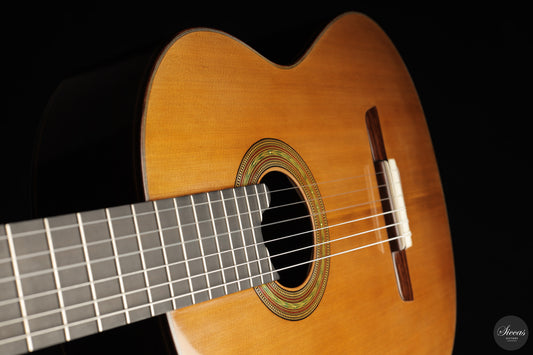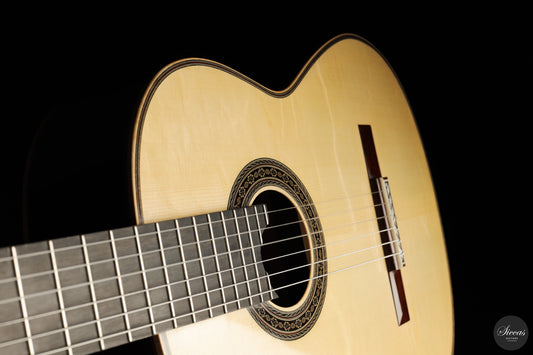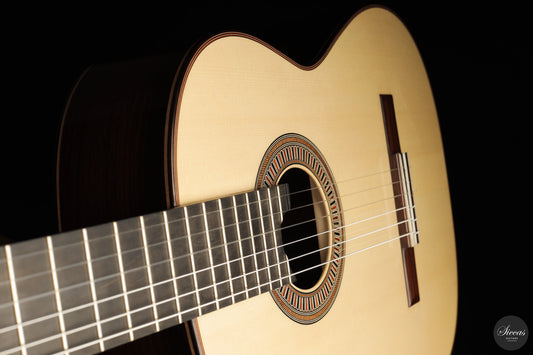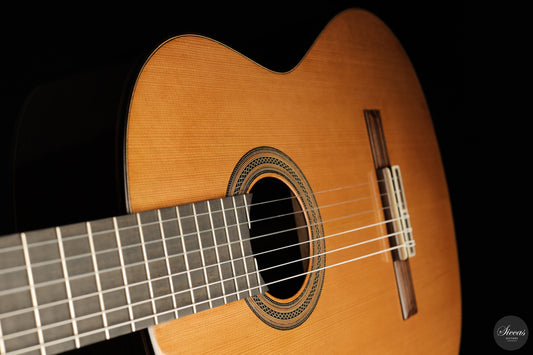

Carlos Juan Busquiel
Carlos Juan Busquiel began playing the guitar at the age of twelve, although his formal musical studies were in violin. His interest in luthiery developed when he built an electric violin for his own use. The instrument was simple, but it opened the door to the world of violin making. His next project was an acoustic violin based on the “Kruse” Stradivari model.
During this period he met master guitar maker Rafael López Porras in Cádiz, who introduced him to the craft of guitar making. Rafael became his first teacher and inspired his passion for building the Spanish guitar. From that moment on, Carlos dedicated himself entirely to guitar construction and continued his training with José Luis Romanillos and Jaume Bosser. The guidance of Romanillos was decisive; it allowed Carlos to deepen his understanding of the concept of the traditional Spanish guitar and its construction principles rooted in the designs of Antonio de Torres. Romanillos later offered further advice when Carlos built a Torres replica.
Influenced by these masters, Carlos Juan Busquiel works in a distinctly traditional style. He primarily builds with spruce tops using traditional fan bracing and relies exclusively on wood as raw material. His aim is to create guitars that are lightweight, comfortable to play, and rich in expressive and musical qualities. When working with cedar tops, he adjusts his approach, creating slightly heavier instruments designed to retain the energy of the string in the soundboard, producing a powerful and responsive tone.
Carlos constructs his guitars in his workshop in Petrer, a town in Alicante on the Spanish east coast. From there, his instruments travel throughout Spain, Europe, Asia, and the Americas.
Performing at Siccas Guitars
Every classical guitarist who performs at Siccas Guitars brings a distinct musical path to the instrument — shaped by years of study, competition experience, and the particular musical tradition they have chosen to inhabit. The classical guitar demands sustained technical commitment and a deep engagement with a repertoire that spans from the Renaissance through to works written for living performers. It is an instrument whose full possibilities only reveal themselves over time.