
Biography
Antonio Marín Montero was born in Granada in 1933. Without a family background in guitar making, he entered the craft through various marquetry workshops and overcame numerous challenges along the way. At a young age, he worked in the workshop of Francisco Moya. In 1957 he joined the workshop of master Pérez, and in 1959, following his father’s advice, he visited Eduardo Ferrer, whose guitar workshop near the Alhambra became decisive for his development.
In 1977 Marín travelled to Paris to meet the luthier Robert Bouchet. From that moment on, he refined and adopted Bouchet’s template with exceptional precision. His pursuit of perfection attracted many aspiring luthiers to his workshop. Among them were his nephew José Marín Plazuelo and José González López, both of whom worked alongside him for more than thirty years.
The reputation of Antonio Marín is international, especially in Europe, the United States and Japan. Many renowned concert artists have performed on his guitars. Although now an elderly gentleman who works increasingly less, his instruments remain highly sought-after. He has never operated with waiting lists, which makes acquiring one of his guitars a matter of patience and dedication.
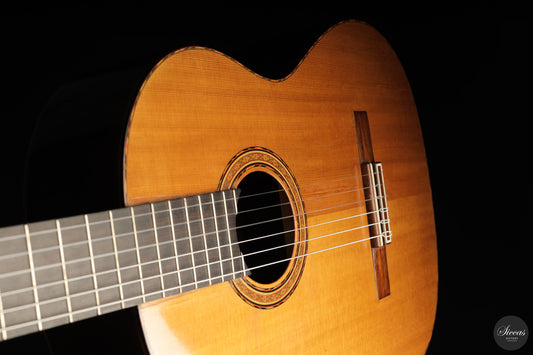
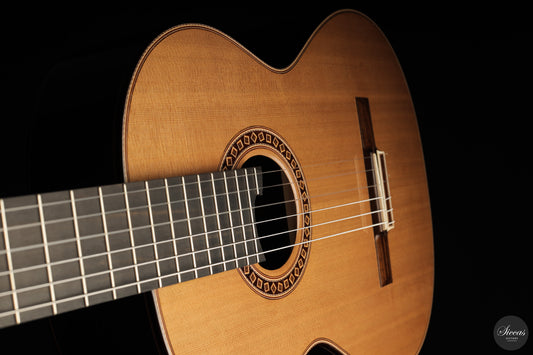
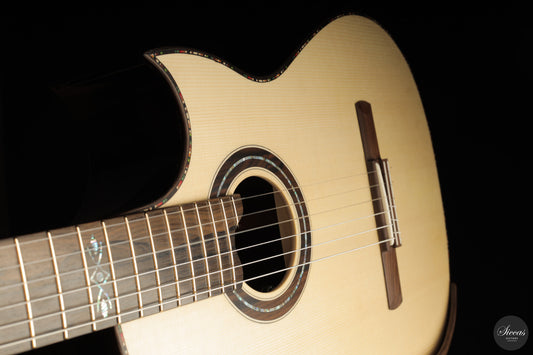
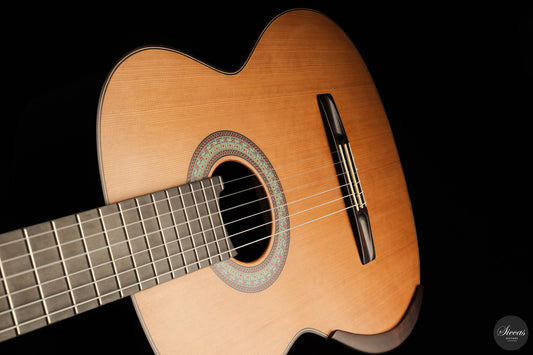
Known primarily for classical guitars, though also respected for his flamenco instruments, Marín’s work is admired for its round, sweet and singing tone, with distinctive trebles, resonant basses and excellent playability. These qualities have made his instruments truly exceptional in the world of contemporary Spanish guitar making.
Granada and the Living Tradition
Antonio Marín Montero was born in 1933 in Granada and began working in a furniture workshop at fourteen before eventually finding his way to Eduardo Ferrer's atelier on the Cuesta de Gomérez — the street leading up to the Alhambra — in 1959. Ferrer's lineage connected directly to Antonio de Torres through Benito Ferrer (1843–1925), placing Marín Montero in an unbroken generational thread from the founding father of modern classical guitar construction.
In 1977 Japanese clients introduced him to French master Robert Bouchet, whose instruments had been played by the Lagoya-Presti duo. Marín Montero spent months in Bouchet's French workshop, co-building three guitars; further collaboration followed in Normandy in 1979. From this emerged the "Bouchet–Marín Montero model," fusing Bouchet's fan-bracing geometry with Granada woodworking traditions. He is widely regarded as the central living figure of the Granada guitar-making school — the city's equivalent of what Cremona represents for the violin. In 2017 the Granada International Guitar Festival named its guitar-making competition after him. His nephew José Marín Plazuelo has shared the workshop since 1979.