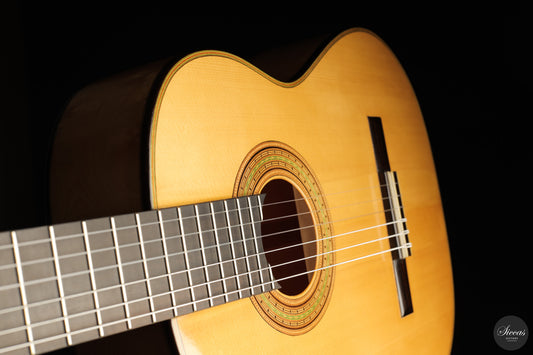
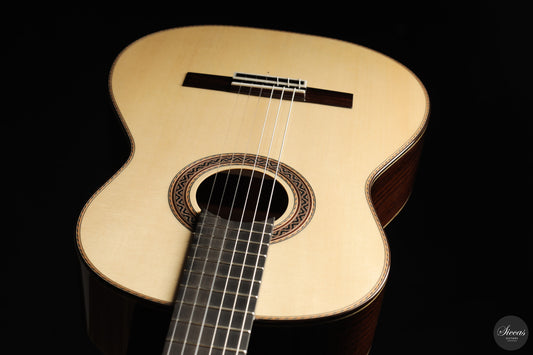
Bernhard Kresse – Luthier & Stauffer Guitar Expert
Bernhard Kresse builds guitars that most contemporary luthiers have never touched. His workshop in Germany produces instruments modeled on early 19th-century designs — Stauffer-style romantic guitars with elevated fingerboards, distinctive scroll headstocks, and ladder-braced spruce tops. These are not replicas made for museum display. Kresse builds them to be played.
Why Historical Instruments?
Kresse came to historical lutherie through research rather than nostalgia. He wanted to understand what classical guitar sounded like before the Torres revolution changed instrument design in the second half of the 19th century. The modern classical guitar — larger body, fan-braced top, extended scale — produces a sound that composers like Giuliani, Sor, and Carulli never heard. Their music was written for something smaller, lighter, and tonally quite different.
That gap between historical repertoire and modern instruments pulled Kresse toward early guitar design. He studied surviving originals in museum collections across Europe, documented their construction details, and began replicating their methods as precisely as available materials allowed. What started as research became a specialty.
The Stauffer design held particular interest. Johann Georg Stauffer worked in Vienna during the early 19th century and produced some of the most sophisticated guitars of the period. His instruments featured a distinctive raised fingerboard — adjustable via a clock-key mechanism — a scroll peghead, and a body shape narrower than modern guitars. Schubert owned a Stauffer. So did several prominent guitarists of the Biedermeier period. The instruments were well-made, musically capable, and representative of an entire tradition that modern lutherie has largely set aside.
For more on the historical context, see our guide on Romantic Guitar – History and Buying Guide → and our dedicated article on Johann Georg Stauffer – The Vienna Maker →.
Construction Methods
Building Stauffer-style instruments requires techniques that fell out of standard lutherie practice over a century ago. Kresse works from historical sources — period illustrations, surviving instruments, workshop inventories — to reconstruct how these guitars were made. Some details are documented clearly. Others require informed interpretation based on tool marks, wood choices, and structural logic.
The ladder bracing is one of the defining features. Modern classical guitars use fan bracing, developed by Torres, which distributes vibration across the lower bout and produces the warm, projecting sound familiar from concert performance. Ladder bracing — horizontal bars across the width of the top — produces a sharper, more transparent tone with a quicker attack. It suits the repertoire from Sor to early Mertz in ways that fan-braced instruments do not.
The elevated fingerboard presents its own construction challenges. On a Stauffer guitar, the neck joins the body at a higher angle, and the fingerboard rises above the plane of the top to meet it. The adjustable mechanism Stauffer himself designed allowed players to fine-tune the action — practical for an era before standardized setup conventions. Kresse replicates this mechanism, which requires precision fitting that takes considerably more time than a conventional neck joint.
Wood selection follows historical patterns where possible. Spruce tops, maple or cherry back and sides, ebony fingerboards — these were the common materials of the period. Kresse sources tonewoods appropriate to the instruments he is making, avoiding the large-scale plantations that supply much of the modern lutherie market and prioritizing naturally dried material.
Scale length on romantic-era guitars typically runs shorter than the 650mm standard on modern classical instruments. Kresse works primarily in the 620–630mm range, which affects string tension and playability. Gut strings — the standard of the period — behave differently from modern nylon, and his instruments are designed around that tension profile, though they can also be strung with modern fluorocarbon strings.
The Challenges of 19th-Century Guitar Building Today
Working in a historical tradition creates practical problems that builders of conventional instruments do not face. Supply chains do not accommodate small workshops producing specialized instruments from period specifications. Kresse sources materials individually rather than through standard lutherie suppliers.
Documentation is another constraint. Surviving Stauffer instruments vary considerably. Some details changed over time; others were never consistent. Kresse has examined instruments in multiple European collections and cross-referenced written sources, but reconstruction always involves judgment. He is not making forgeries and has no interest in producing exact replicas — his instruments are contemporary interpretations of a historical approach, built with the intent that they function as musical instruments rather than artifacts.
The market for these guitars is narrow. Players interested in historical performance practice, scholars, and guitarists curious about the sonic world of early 19th-century repertoire form the primary audience. Kresse's instruments have found homes with professional players in Europe and beyond who perform music of the period on instruments appropriate to it.
There is also the question of repair and maintenance. Romantic-era guitars require different care than modern instruments. The lighter construction — thinner tops, lighter bracing — means they are less tolerant of humidity swings. Kresse advises buyers carefully on storage and provides documentation on his construction choices so that future repair work can be done appropriately.
Interview: Kresse on His Work and Approach
In conversation with Siccas Guitars, Kresse spoke directly about what drives his work and how he approaches the decisions that historical lutherie requires.
On the decision to specialize: he described it as gradual rather than planned. He built conventional classical guitars early in his career, became interested in historical instruments through playing early music repertoire, and found that interest expanding into serious research. At some point the research became the work.
On construction choices: Kresse is clear that his instruments are interpretations, not reconstructions. He works from the best available evidence but does not claim to reproduce exactly what a 19th-century Viennese workshop produced. Materials differ. Tool availability differs. His own experience and judgment shape every instrument. What he aims for is fidelity to the underlying principles — construction logic, tonal goals, playability — rather than surface-level copying.
On the sound: he described the tonal character of his Stauffer-style guitars as more transparent than modern classical instruments, with a clarity in the upper registers and a faster decay that suits ornamental playing styles common in early 19th-century technique. The guitars project differently — not less, but in a way suited to smaller rooms and chamber settings rather than concert halls.
On who plays his instruments: mostly players already embedded in historical performance practice, but also some guitarists who came to them out of curiosity about the repertoire. Several have described recalibrating their technique after extended playing — the lighter action and different tonal response encourage a different approach to the right hand.
Kresse's Instruments at Siccas Guitars
Siccas Guitars has worked with Bernhard Kresse to make his instruments available to players outside Germany. His guitars represent a specific tradition of historical lutherie executed at a high level of craftsmanship. They are appropriate for players interested in period performance, for collectors focused on historical instrument types, and for guitarists who want to understand early 19th-century guitar sound from direct experience.
Each instrument is accompanied by documentation covering materials, construction choices, and care recommendations. Kresse builds in limited quantities, and availability varies.
Browse our full selection of classical guitars → or explore related reading on The History of Classical Guitar and Its Evolution → and Famous Classical Guitar Pieces →.