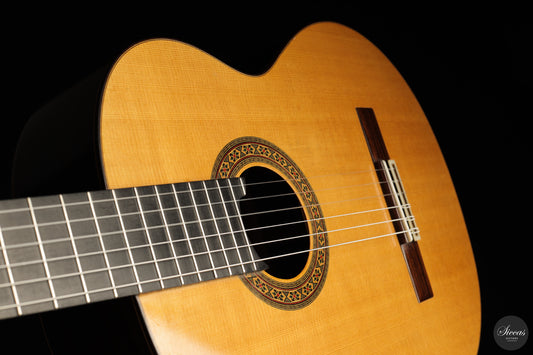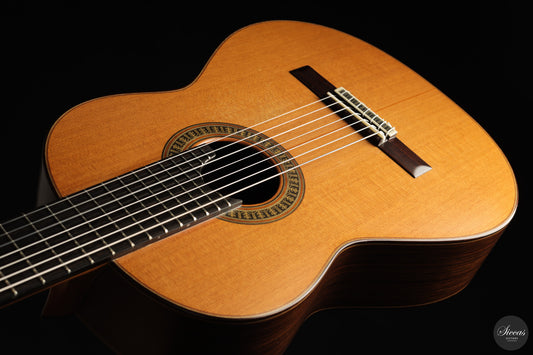

Craftsmanship and Heritage
His professional experience draws on the long-standing tradition of the Carrillo family, whose history dates back to 1744. As the seventh generation of guitar makers, he continues this legacy with exceptional dedication. This heritage played a decisive role in his receiving the Regional Craftsmanship Award in 2009 and the National Award in 2010.
Style and Influences
His approach to guitar making is shaped by several schools, with the Madrid school exerting the strongest influence on the refinement of his craft. This foundation has guided his ongoing development while preserving a distinct artistic identity.
Sound Characteristics and Innovation
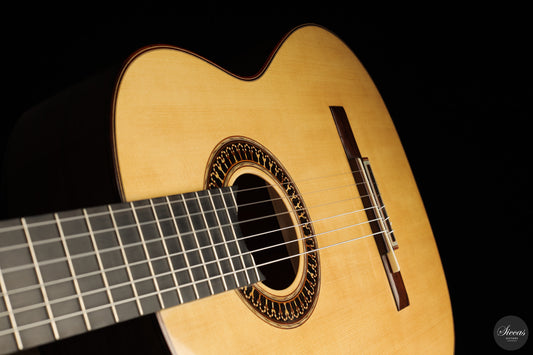
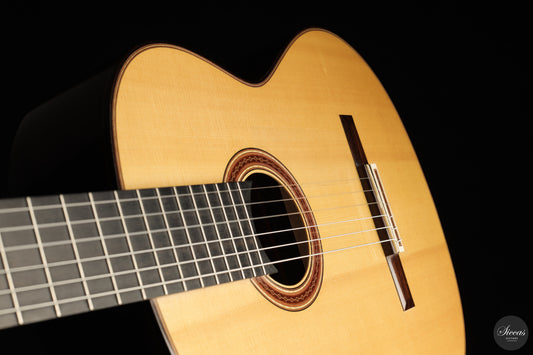
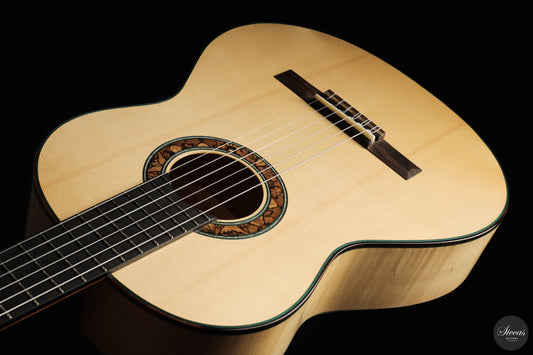
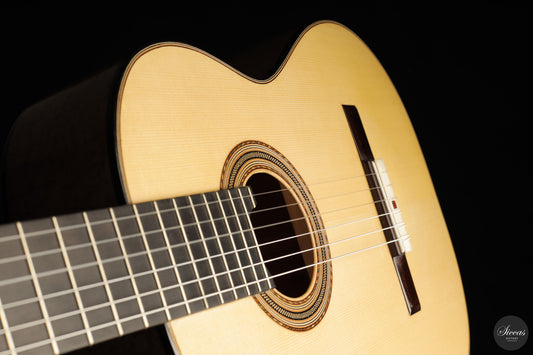
His instruments are known for their characteristic sound, defined by a well-balanced relationship between powerful basses and sweet, singing trebles. Innovation is a continuous element in his work, as he incorporates different construction techniques to meet the specific needs of professional musicians.
His guitars have been chosen by renowned artists such as Paco de Lucía, Tomatito, J. M. Cañizares, El Niño Josele, Rafael Cañizares, Javier Limón, Keith Richards, Josemi Carmona (Ketama), and Duo Montes Kircher.
The Casasimarro Tradition
The guitar-making tradition of Casasimarro, a small town in the province of Cuenca in Castilla-La Mancha, can be traced to Alfonso Ancelmo Alarcón (born 1744), a schoolteacher who learned the craft in Granada and brought it home. The town became known as El pueblo de las guitarras (the town of guitars) by the nineteenth century. The Carrillo family has been part of this tradition since the nineteenth century, with Vicente representing the seventh or eighth generation of makers in a lineage that includes his great-grandfather Blas Carrillo Alarcón (1836–1919), his grandfather Vicente Carrillo López (1881–1962), and his father Vicente Carrillo Cantos (1926–1971). When his father died, his mother Gabriela — who was later officially awarded master craftsman status — kept the workshop open until Vicente was old enough to take over.
Carrillo deepened his training with masters of the Madrid school, including Ángel Benito Aguado and craftsmen from the Ramírez workshop. He prefers the Spanish term guitarrero over "luthier," explaining that when you emerge from a long family tradition, the guitar feels like a living creature rather than a product. His instruments have been played by Paco de Lucía, Tomatito, and Vicente Amigo, among others. In 2010 he received Spain's National Crafts Award.