
Biography
Vladimir Druzhinin was born in 1983 in Novosibirsk, Russia, into a family of scientists. After completing high school with a focus on physics and mathematics, he entered Novosibirsk State University and graduated in 2004 with a bachelor’s degree in physics. He continued his studies in accelerator physics and earned his master’s degree in 2006. From 2000 to 2008 he worked and trained at the Budker Institute of Nuclear Physics.
Alongside his academic studies, he attended the strings department of the Novosibirsk Music College, where he studied double bass from 2004 onward. In 2007 he joined the local philharmonic big band as a bass player. From that moment on, musical activity became his primary focus, and he soon established himself in Novosibirsk’s jazz scene, performing both in the big band and as a session musician.
In 2010 he moved to Moscow, where he met Timofey Tkach and became his apprentice. Under this guidance he transitioned fully into luthiery, which has remained his main occupation.
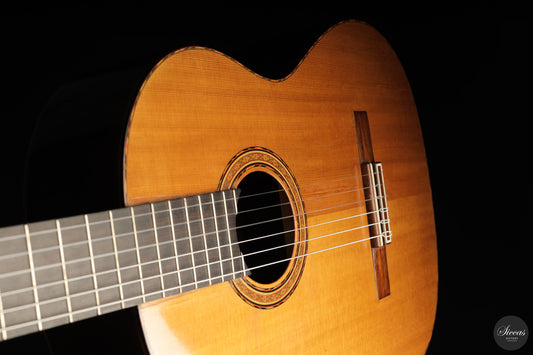
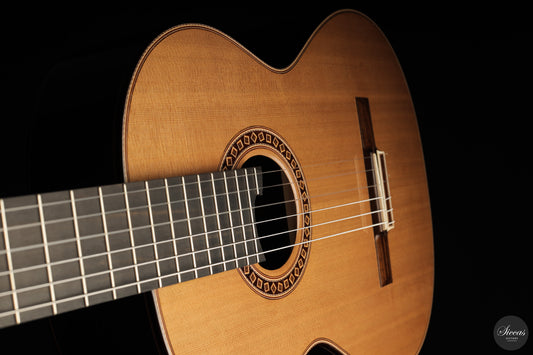
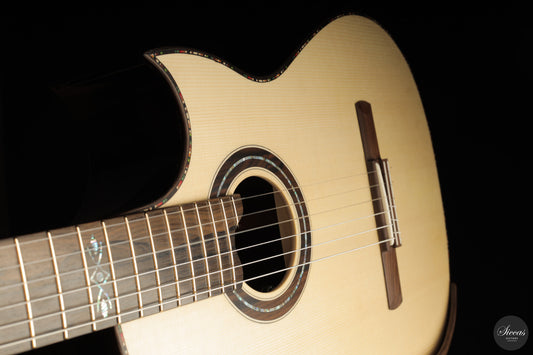
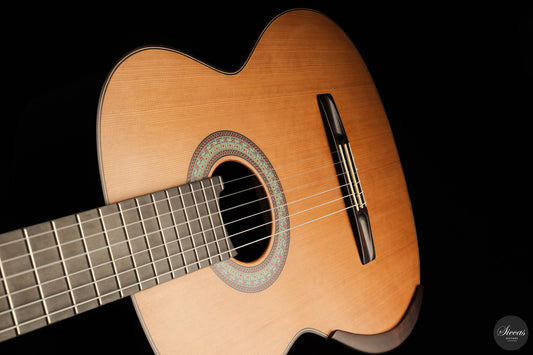
Today he works independently in his own workshop, building various models of classical guitars and lutes, undertaking restoration work, and developing his own acoustic bass design. For him, the creation of acoustic instruments is a precise craft that evolves into an art form, shaped by curiosity and continual discovery.
Philosophy
In his instrument making, Druzhinin follows the principles of the Classical Spanish School. He draws inspiration from figures such as Antonio de Torres Jurado, who defined essential concepts in guitar design during the late nineteenth century. He also recognises the work of Manuel Ramírez, Domingo Esteso, Santos Hernández and Hermann Hauser I, whose contributions shaped the instrument through the early twentieth century. Later makers such as José Ramírez III and Miguel Rodríguez further advanced the evolution of the modern classical guitar.
He views every instrument as a complex acoustic resonator that requires deliberate design and sensitive tuning. His aim is to build professional instruments of the highest class, distinguished by outstanding acoustic qualities. To achieve this, he selects fine materials, carries out precise woodworking and applies a careful step-by-step approach when tuning the soundboard and body.
Great importance is placed on the aesthetics and ergonomics of each guitar, following the classical tradition established by the great Spanish luthiers.
The Craft
Classical guitar construction at concert level demands years of accumulated knowledge: how individual pieces of timber vibrate, how bracing patterns affect tonal balance, how small changes in geometry shift the character of an instrument. A finished concert guitar typically represents several hundred hours of hand work. Every decision — wood selection, arch height, brace dimensions — shapes what a player can do with the finished instrument.