ABBA on Classical Guitar: Money Money Money
ABBA wrote some of the most harmonically rich and emotionally immediate songs of the 1970s — and several of them translate with surprising naturalness to the classical guitar. "Money Money Money" (1976) is perhaps the most dramatic example: its minor-key verses, sweeping modulations, and contrast between dark introspection and bright release map almost directly onto the kinds of musical ideas classical guitarists work with every day.
The Song: A Minor-Key Drama
"Money Money Money" was written by Benny Andersson and Björn Ulvaeus and released in October 1976 on the Arrival album. It reached number one in several European countries and became one of ABBA's most recognisable songs. The song is built around a strong harmonic contrast: the verses move through a brooding A minor, with a piano accompaniment that drives the forward momentum, while the bridge breaks into a major key with the characteristic lift that defines the ABBA sound. The minor-key verses have an intensity and a driving quality that immediately suggests the guitar: the guitar has been a natural instrument for minor-key drama since the Renaissance, and its capacity for sustained minor harmonies with a clear bass line makes it especially well-suited to this kind of material.
The underlying harmonic language — chord progressions rooted in European classical harmony, with clear voice leading, dramatic tension and release, and the kind of careful chord spacing that is associated with trained compositional craft — translates very naturally to the guitar. Andersson and Ulvaeus were trained in European harmony and were deeply influenced by classical and folk music alongside pop, and their chord progressions are typically richer and more carefully voiced than the pop norm. This is what makes their music such fertile territory for classical guitar arrangement.
Why ABBA Works on Classical Guitar
The case for ABBA on classical guitar rests on several musical foundations. First, the harmonic language: ABBA's writing uses suspensions, unexpected modulations, and minor-key drama that feels genuinely at home in a classical context. Second, the melodic quality: their melodies are strong, clear, and memorably shaped — the kind of tunes that work as counterpoint and as accompaniment as well as in their original accompanied form. Third, the polyphonic texture: the classical guitar's capacity for simultaneous melody, inner harmony, and bass lines is precisely what a sophisticated pop song needs when it is stripped of its original orchestration and rendered in a single voice.
The challenge for the classical guitarist arranging ABBA is to find the essential musical content — the melody, the bass movement, the harmonic rhythm — and to present it in a way that preserves what made the original song compelling without merely reproducing it acoustically. The best ABBA guitar arrangements work because they understand this: they are translations of the music into a new language, not transcriptions of a recording. "Money Money Money" works particularly well in this process because its musical content is genuinely strong enough to carry the arrangement without the support of the original production.
Performed at Siccas Guitars
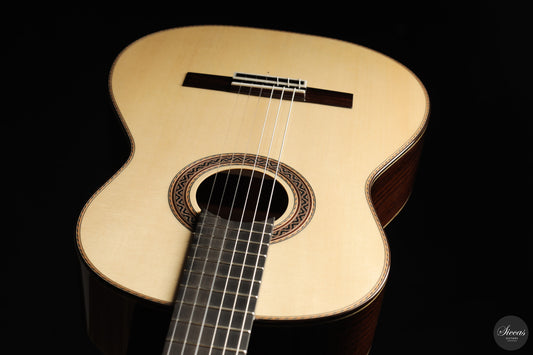
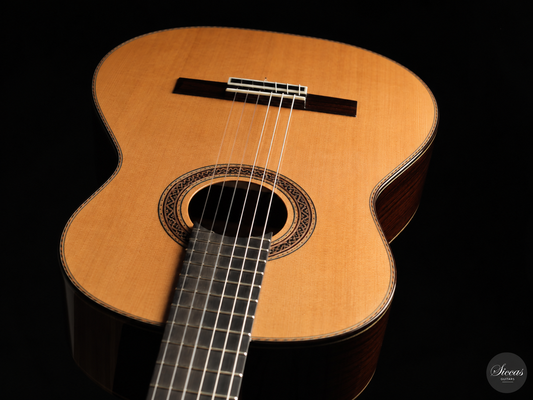
Karlijn Langendijk has performed "Money Money Money" for the Siccas Guitars YouTube channel, playing the arrangement on a Heinzelmann guitar. Langendijk is a Dutch classical guitarist who has built a reputation for bringing popular music — including ABBA and other pop repertoire — to the classical guitar with genuine artistry and technical polish. Her version of "Money Money Money" demonstrates what a well-conceived classical guitar arrangement of ABBA sounds like: the minor-key drama of the original is preserved and, if anything, intensified by the intimacy of the solo guitar; the melody sings above a carefully voiced accompaniment; and the major-key bridge provides the emotional contrast that makes the piece's structure effective.
The video has reached a significant audience on the Siccas platform, which is itself revealing: audiences respond to this music on classical guitar not merely as a novelty but as a genuinely musical experience. The song's quality survives and is in some ways enhanced by the stripping away of its original production, and the classical guitar's voice gives it an intimacy and warmth that the pop recording, for all its technical brilliance, cannot quite match. See more performances in our guide to famous classical guitar pieces.
ABBA and the Classical Tradition
The connection between ABBA and classical music runs deeper than casual listeners might assume. Benny Andersson's musical training was in Swedish folk and popular music, but his harmonic instincts draw on the European classical tradition — on the chord progressions of Romantic harmony, on the voice-leading principles that composers from Bach to Brahms cultivated. Björn Ulvaeus's contributions as lyricist and guitarist were shaped by the folk revival of the 1960s, which itself drew on pre-pop traditions that overlapped with the folk and dance music that classical composers had always quarried for raw material.
The result is music that occupies an unusual position: written for pop production and pop audiences, but built from materials that translate naturally to the classical context. Classical guitarists who arrange ABBA are not imposing an alien framework on the music; they are restoring it to a context that its harmonic language already anticipates. Browse the Siccas Guitars collection or explore our great classical guitarists.
Frequently Asked Questions
Why does ABBA's Money Money Money work on classical guitar?
Its minor-key harmonic language, strong melody, and carefully voiced chord progressions translate naturally to the classical guitar's polyphonic texture. The song's musical content is strong enough to carry a solo guitar arrangement without the support of its original pop production.
Who performed Money Money Money for Siccas Guitars?
Karlijn Langendijk, a Dutch classical guitarist, performed the arrangement on a Heinzelmann guitar for the Siccas Guitars YouTube channel.
Is ABBA's music influenced by classical music?
Yes — Benny Andersson and Björn Ulvaeus's harmonic language draws on European classical harmony, using chord progressions, voice leading, and structural contrasts that are rooted in the same tradition that classical guitarists work in every day.
← All works · Our guitar collection · Great classical guitarists