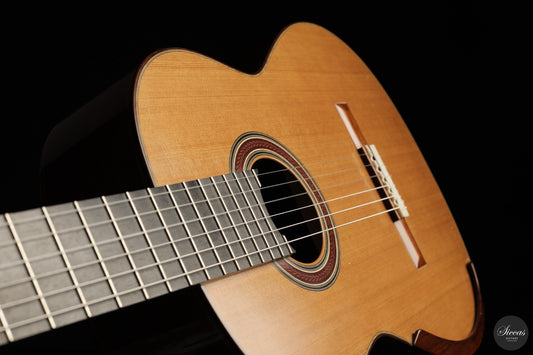
Bella Ciao on Classical Guitar — Tutorial

Bella Ciao on Classical Guitar — Tutorial

Bella Ciao is one of the most instantly recognisable folk melodies in the world — an Italian song of defiance and farewell whose origins reach back to the fields and factories of northern Italy in the late nineteenth century. Brought to a new global audience by the television series La Casa de Papel (Money Heist), it has become one of the most requested guitar pieces for beginners, and for good reason: it is rhythmic, catchy and enormously satisfying to play.

About the song

Bella Ciao began as a folk song — most likely a lament sung by the mondine, the women who worked the flooded rice paddies of the Po Valley, bending in the water from dawn. The phrase "bella ciao" simply means "goodbye, beautiful one" — a farewell addressed to a beloved place or person. In the 1940s, the song was adopted as a marching anthem by the Italian partisans fighting fascism, and it is in that form — defiant, martial, forward-moving — that it became famous worldwide. As a traditional folk song it is in the public domain, free to learn, arrange and perform.

Why it works on guitar

The melody is short, modal and strongly rhythmic — a minor-key march whose repeating structure makes it easy to learn and easy to vary. The guitar can deliver it with real drive: strummed chords push the rhythm, single-note lines carry the melody, and more advanced arrangements add percussive elements that make the piece feel like a one-person band. Its march character means a firm, steady pulse is everything.

How to approach it

Lead with the rhythm. Bella Ciao lives on its forward momentum, so keep a steady, energetic pulse from the first note. Bring the melody out clearly above any accompaniment. As you grow confident, add dynamics — louder on the strong beats, softer on the lighter passages — and use the repetition of the phrase to build intensity.

Difficulty

Beginner to intermediate, depending on arrangement. The basic melody is very approachable for new players; fuller versions with strumming, percussion, and faster passages raise the bar. A satisfying piece that sounds impressive for relatively little effort.

FAQ

Is Bella Ciao hard on guitar?

The basic melody is beginner-friendly. More elaborate arrangements with strumming and percussion reach intermediate level.

Is the music free?

Yes — it is a traditional folk song in the public domain, free to learn and arrange.

Browse our classical guitars · Guitar video reviews

The Library
  • Classical Guitars

    The classical guitar, with its soft nylon strings and characteristic timbre, has become a symbol of chamber music, Spanish tradition, and concert repertoire. Its modern form was shaped by Antonio de Torres in the 19th century, setting the standard for the body, fan bracing, and the 65-centimeter scale length that are still used today. Instruments in this category open up a rich palette from the refined Romantic miniatures of Tárrega to the majestic concertos of Rodrigo. Here you will find guitars that preserve historical continuity and at the same time inspire new interpretations.
    Explore all classical guitars
  • Luthier: Antonio Marin Montero
    Construction Year: 2011
    Construction Type: Traditional
    Top: Spruce
    Back and Sides: Cocobolo
    Soundboard Finish: French polish
    Body Finish: French polish
    Air Body Frequency: G
    Weight (g): 1510
    Tuner: Sloane
    Condition: Excellent
  • Luthier: Jialan Chen
    Construction Year: 2026
    Construction Type: Traditional
    Top: Spruce / Cedar
    Back and Sides: Wenge
    Soundboard Finish: French polish
    Body Finish: French polish
    Air Body Frequency: G / G sharp
    Weight (g): 1595
    Tuner: Alessi
    Condition: New
  • Luthier: Lucio Antonio Carbone
    Construction Year: 2026
    Construction Type: Traditional
    Top: Spruce
    Back and Sides: Indian rosewood
    Soundboard Finish: French polish
    Body Finish: French polish
    Air Body Frequency: F / F sharp
    Weight (g): 1400
    Tuner: Alessi
    Condition: Mint
  • Luthier: Andreas Kirschner
    Construction Year: 2016
    Construction Type: Traditional
    Top: Cedar
    Back and Sides: Indian rosewood
    Soundboard Finish: French polish
    Body Finish: French polish
    Air Body Frequency: F sharp
    Weight (g): 1450
    Tuner: Gotoh
    Condition: Excellent
  • Luthier: Richard Jacob Weissgerber
    Construction Year: 1944
    Construction Type: Traditional
    Top: Spruce
    Back and Sides: Indian rosewood
    Soundboard Finish: French polish
    Body Finish: French polish
    Air Body Frequency: A
    Weight (g): 1185
    Tuner: Landstorfer
    Condition: Very good
  • Luthier: Zbigniew Gnatek
    Construction Year: 2023
    Construction Type: Lattice
    Top: Cedar
    Back and Sides: Madagascar rosewood
    Soundboard Finish: Nitrocellulose
    Body Finish: Polyurethane
    Air Body Frequency: G
    Weight (g): 1760
    Tuner: Pagos
    Condition: Excellent

Discounts and Early Access

Subscribe to our weekkly Siccas Guitars newsletter for immediate access to subscriber-exclusive discounts and early bird specials.