
Prologue
Many myths and stories surround the Madrid guitar maker Santos Hernández. Some portrayed him as silent and secretive, unwilling to reveal details of his work. Family members and close friends, however, described him as friendly and open-minded. Which image is more accurate remains a matter of personal interpretation.
What can be stated with certainty is his significance: in the first half of the 20th century, this guitarrero left exceptionally deep and lasting traces in the history of the Spanish guitar. Increasingly, details suggest that Santos Hernández served as a major guide into modern guitar making for builders across many traditions.
Biographical dates
Born in Madrid in 1873, Santos Hernández began working in the guitarrería of Valentín Viudes at around the age of ten. During that period he first met Antonio Emilio Pascual Viudes y Aznar, with whom he would later work again. Those early years provided substantial experience. It has been reported that he later spent time in workshops such as Rafael Ortega, Saturnino Rojas, and Hijos de González. From 1893 to 1898 he completed military service.
Afterwards, he began working in the workshop of Manuel Ramírez de Galarreta Planells (1864–1916) and by around 1905 became the leading craftsman there. His colleagues included Domingo Esteso, Modesto Borreguero, and A. E. Pascual Viudes. He worked for Manuel Ramírez until his death in 1916, and afterwards for the widow until around 1919, before establishing himself independently.
The earliest guitar associated with Santos as his own is “El Bombón” from 1903, likely built at home at c/Humilladero 10. A guitar created in the Ramírez workshop in 1912 (originally built as an 11-string instrument and later converted to a 6-string guitar) became one of the most famous instruments of the next 25 years. With the “Manuel Ramírez 1912”, Andrés Segovia began his international career.
After 1916, the workshop continued as “Viuda de Manuel Ramírez” with Santos Hernández, Domingo Esteso, and Modesto Borreguero as builders, permitted to stamp their initials (SH, DE, MB) on the label. Santos stopped working for the widow around 1919 and thereafter worked independently. The earliest guitars from the self-established period are dated 1918 and already show the address Aduana 27. A formal permission to establish a guitar shop was granted in 1921. Within the family, however, it was said that Aduana 27 had belonged to him since 1917. In 1932 the street number changed to Aduana 23.
Santos Hernández remained there until his death on March 18, 1943. His widow Matilde Ruiz López (1874–1960) continued the business. In 1945, an exhibition of important Santos guitars took place in Madrid, with performers such as Regino Sainz de la Maza, the sisters España and América Martínez, and Quintín Esquembre playing and lecturing on these instruments.
In 1946, Matilde Ruiz received permission to rename the workshop “Viuda de Santos Hernández”. She employed Marcelo Barbero as a guitar maker and Fernando Solar for violin repairs, since Santos had built violins from time to time. According to later accounts, the Rodríguez family occasionally helped with varnishing. Fernando Solar worked there until 1948; Barbero stayed a bit longer but was already working under his own label in Madrid.
After Matilde Ruiz died in 1960, guitars were built by Francisco Fernández and later by Vicente Checa. Feliciano Bayón de la Morena first handled repairs and then began making guitars under the name “Sobrinos de Santos” in 1963/64. His son Santos Bayón Ruiz started as a guitar maker in 1970 and continued until 2007. The workshop at Aduana 23 then opened only occasionally, with final closure in 2009.
Significant details of Santos Hernández guitars
The headstock silhouette
The evolution of the headstock can be traced through known instruments. “El Bombón” (1903) uses a head design also found on smaller, richly decorated guitars associated with the Manuel Ramírez environment. A 1918 rosewood guitar showing the Aduana label still reflects the classical Ramírez head design. Around 1921/22, several smaller guitars with a 640 mm scale and mother-of-pearl decoration appear with a headstock lacking the small central tip. In 1923, a version with a small notch on each side is documented. By around 1925, the classic Santos headstock emerges and remains the defining form for the rest of his life, though earlier variants continue to appear occasionally.
This development can be understood as a gradual process of abstraction, moving from more carved lines towards a clearer, more block-like silhouette.
At least two instruments show an unusual feature: the tuner openings were cut in the lower area in the style of Antonio de Torres. Santos guitars normally present a more rounded shape there. Both instruments were connected with Regino Sainz de la Maza, and family accounts state that the player insisted on this detail.
The soundhole decoration
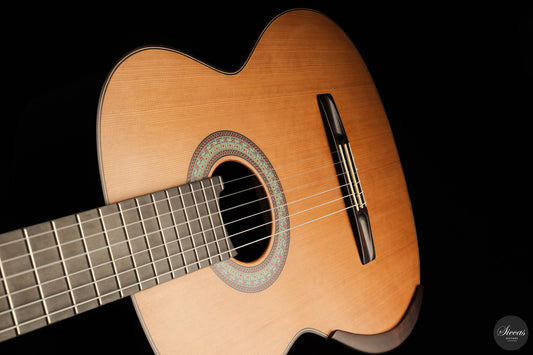
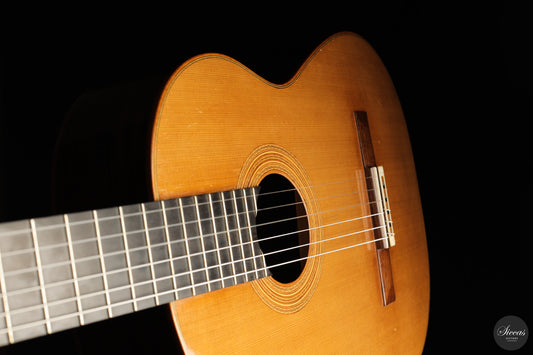
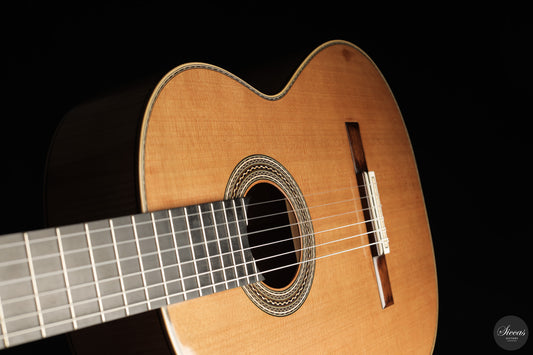
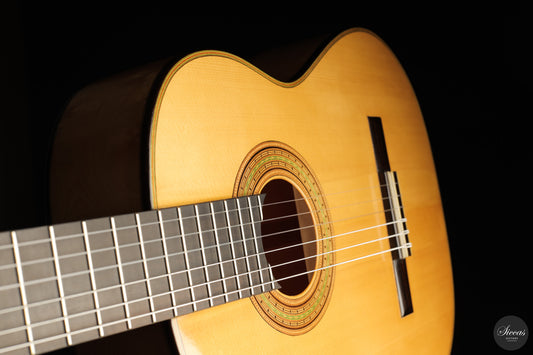
Literature connected to the Rodríguez family reports that Santos gave each guitar a distinctive rosette. The surviving instruments suggest a remarkable variety, from simple coloured rings around small mosaics to refined, filigree inlays, sometimes including mother of pearl. Despite the variety, the decorations are described as carefully balanced rather than excessive, aiming to complete the overall harmony of the instrument.
The bridges
Many Santos guitars show two small bone decorations on the upper and lower parts of the bridge where the strings are tied. A small rectangular bone rim appears from time to time. In some instruments from the 1921/22 period, a rectangular bone piece covers the full tie block and may include inlays of bone or mother of pearl in the wings.
On luxury instruments made from high-grade Brazilian rosewood or strongly figured maple, additional attention was often given to bridge decoration, including small rectangular frames of ivory surrounding mother-of-pearl plates, or layered ivory and mother-of-pearl lines. Family accounts connect such costly decoration with important clients or instruments made for Santos himself.
Extensively decorated guitars around 1921 to 1923
From 1921 to 1923, several smaller, richly decorated instruments survive. Their scale length ranges between 62 and 64 cm, with mother-of-pearl and ivory inlays at the soundhole and bridge wings, and with special labels. One explanation offered is that, when opening his shop in 1921, Santos may have demonstrated a range of models to potential clients, similar to the way Manuel Ramírez used different labels for certain smaller, highly decorated guitars.
Labels and identification
“El Bombón” (1903) is described as carrying a unique label showing only name, city, and year. From 1916 to around 1919, the “Viuda de Manuel Ramírez” label appears with an SH stamp.
In his independent period (1918–1943), Santos is described as using two label types, often referred to as “theatre stage” and “cross”. The first type appears mostly on cypress, mahogany, and Indian rosewood guitars. The “cross” label appears in luxury Brazilian rosewood or maple instruments, often accompanied by elaborate rosettes, rim inlays, and exclusive bridge decoration. These guitars represented the highest standard of his work.
A rosewood guitar from 1918 already shows the “theatre stage” label with Aduana 27 and a headstock linked to the Ramírez tradition. A 1919 flamenco guitar is described as having a special label referencing Plaza de Nicolás Salmerón 8, where the family lived at the time. The smaller luxury instruments from 1921/22 have labels similar to the 1919 flamenco label, but with Aduana 27 printed.
Santos guitars did not carry numbering. Early labels show no handwritten elements beyond the year. Around 1931, his signature appears occasionally, and from about 1935 it appears regularly.
Bracing
Early instruments show influence from Antonio de Torres and later from the Ramírez tradition, followed by increasing experimentation. Surviving guitars show a range of bracing layouts, including different numbers of fan struts, sometimes parallel, and slanted bars. A luxury rosewood guitar from 1921 is described as having a curved back. Some accounts also note unusual assembly sequences, including cases where the top was attached as the final step.
Family explanations emphasise Santos’ careful observation of wood and its drying process. In that view, the material itself influenced the bracing and structural decisions. This aligns with the broader idea that each guitar was treated as its own personality.
The Santos sound
Descriptions of the Santos sound often follow several perspectives, moving from traditional towards modern projection, from intimate warmth towards brilliance, and from small-room use towards large concert halls. Early 20th-century Madrid saw the increasing influence of Torres-inspired designs, while makers such as Vicente Árias were also shaping the scene. Within this environment, Santos pursued progress and refinement throughout his life.
At the same time, guitarists’ demands were changing. In the classical world, figures such as Andrés Segovia and Regino Sainz de la Maza pushed the concert guitar into larger venues. In flamenco, toque gained a stronger role alongside cante and baile, and players developed more virtuosic techniques. Santos is described as meeting these needs by combining a crisp flamenco voice with lyrical qualities, enabling complex passages with strong modulation and tonal colour.
Famous guitars by Santos Hernández
Perhaps the best-known instrument linked to Santos is the “Manuel Ramírez 1912”, built by Santos as an 11-string guitar and later converted to 6-string. Andrés Segovia played it for about 25 years. Santos reportedly requested permission to place his own label inside as the builder, but Segovia refused, allowing only an SH label with a handwritten repair mark.
Segovia received additional Santos guitars from the 1920s onward. One well-preserved 1924 guitar was donated to the Víctor Espinós Music Library in Madrid. Another later instrument was connected, in the narrative, with a break between Segovia and Santos. Santos named this guitar “La Inédita” and kept it for himself; it was sold by the family in 1970.
Regino Sainz de la Maza is presented as a major admirer of Santos guitars. A 1934 instrument named “La Rubia” is associated with the first performance of Joaquín Rodrigo’s “Concierto de Aranjuez” in November 1940 in Barcelona.
Other named instruments mentioned include “La Clavelitos” and “Pepita Jiménez”, with documented movements through musicians and collections. In flamenco history, the guitar “La Leona” is linked to Ramón Montoya and is described as accompanying him until 1946, when it became associated with the de Zayas family collection.
Further examples include players connected to Santos guitars across genres and periods, among them Luise Walker (1910–1998) and Pedro Soler (born 1938). These cases are presented as evidence of the importance of Santos instruments in multiple guitar worlds.
Epilogue
The text concludes with a personal interpretation of what is called “El Espíritu Santos”, listing factors such as his early influences, woodworking talent, sense of aesthetic balance, instinct for discovering sound potential in wood, contact with great players, a persistent desire to progress, and an intense concentration on each instrument he built. The final emphasis remains on a single priority: the sound of music.
Karlstein, 28/02/2022
Siegfried “Hogi” Hogenmüller
Read as PDF with photographs: here