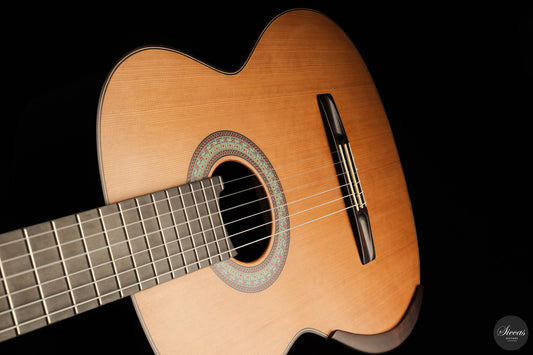
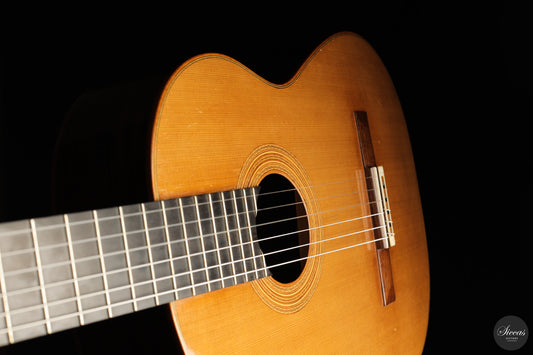
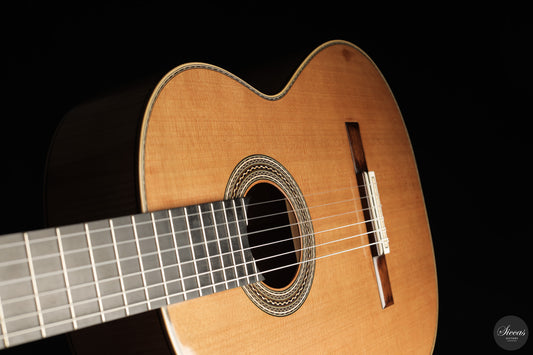
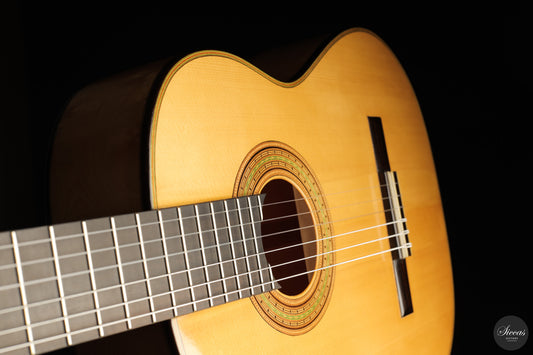
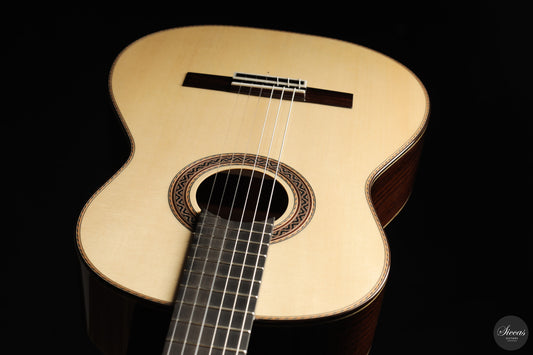
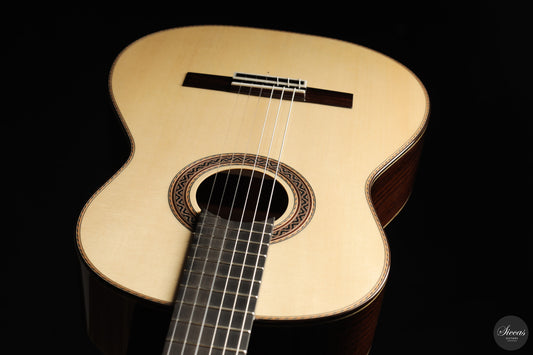
Recently, a guitar bearing this label was offered by the in Lyon, France. The instrument raises several questions, which the following text aims to clarify.
Francisco Simplicio: Master Luthier of Barcelona
Francisco Simplicio (1874–1932) stands among the most significant classical guitar makers of the early twentieth century. Born and based in Barcelona, he trained under Enrique García and later became closely associated with the celebrated guitarist Miguel Llobet, whose exacting standards shaped Simplicio's approach to instrument building. Simplicio developed a highly refined aesthetic sensibility that drew on the Torres tradition while incorporating distinctive decorative and structural elements of his own invention.
His guitars are prized today for their tonal clarity, warm projection, and exceptional craftsmanship. The headstocks, rosettes, and bridges of his instruments are immediately recognizable, combining functional precision with an almost jewel-like attention to ornamental detail. Simplicio worked in Barcelona throughout his career, producing instruments that were sought after by leading performers of his era. He passed away unexpectedly on January 14, 1932, bringing his direct creative output to an abrupt end.
For anyone interested in the broader history of the classical guitar and its great makers, our article on great classical guitarists provides further context on the performers who played these historic instruments.
The Guitar No. 343 of 1931: Establishing Authenticity
First of all, the guitar is unquestionably an original instrument by Francisco Simplicio, built in the final year of his activity as a guitarrero. The decorative elements — including the headstock shape, rosette, and bridge — closely correspond to those of the guitar FS 1931, No. 327, documented by Milanese and Piazza in Francisco Simplicio Luthier (Edizioni Il Dialogo, Milan 2010, page 255). This correspondence confirms that the instrument belongs firmly within Simplicio's late period and is consistent with his known work from 1931.
The construction quality, materials, and execution observed on this instrument are entirely characteristic of Simplicio's workshop at the height of its activity. No significant departures from his established methods have been identified that would cast doubt on its attribution.
The Workshop Succession: Francisco and Miguel Simplicio
Understanding the numbering of this guitar requires a brief account of the workshop's history. Francisco and Miguel Simplicio worked together between 1923 and 1931. As far as current knowledge goes, the last guitar signed and numbered personally by Francisco Simplicio is No. 336 from 1931.
From 1932 onwards, the numbering was continued by his son Miguel Simplicio, reaching No. 342. Since the two craftsmen worked in close collaboration during those final years, it is reasonable to assume that at least six instruments remained in various stages of completion at the time of Francisco's death. Miguel Simplicio therefore continued his father's numbering up to No. 342 of 1932, the last known guitar produced within the workshop.
For instance, No. 338 from 1932, now signed by Miguel Simplicio, is described in Alberto Martínez' publication Classical Guitars in Life Size (Camino Verde, Paris 2018). Guitar No. 342 can also be found in the Milanese and Piazza book on page 258. These documented examples establish a coherent sequence and provide the framework against which the anomalous number 343 must be evaluated.
The Number 343: A Probable Transposition
The designation 343 does not correspond to the year 1931 nor to Francisco Simplicio's autograph in the way that the surrounding numbers do. A plausible explanation could be a transposition of digits. It is possible that Francisco intended to write 334 but inadvertently wrote 343 — a mistake not uncommon in other contexts, and one that would have been easily overlooked in the final months of a busy workshop.
This hypothesis would also explain why, to date, no guitar numbered 334 by Francisco Simplicio has come to light. The absence of No. 334 from the known corpus, combined with the presence of a guitar bearing the transposed number 343, provides circumstantial but coherent support for this interpretation. These remarks should be understood solely as a possible explanation, at least until a guitar numbered 334 is discovered or further documentary evidence emerges.
Historical Significance of Late Simplicio Guitars
Guitars from Simplicio's final years — 1930 and 1931 — represent the fullest expression of his craft. By this point he had refined his voicing techniques, his choice of tonewoods, and his decorative language into a cohesive and immediately recognizable style. Instruments from this period are among the most sought-after by collectors and serious players worldwide.
The survival of a guitar from 1931, whatever its exact number, is a remarkable event. Very few Simplicio instruments from this late phase remain in playable condition, and fewer still come to market with clear provenance. The work of scholars such as Milanese, Piazza, and Martínez has been essential in establishing the documentary record against which individual instruments can be assessed.
If you are interested in exploring historic classical guitars available for purchase, our classical guitars collection includes instruments of exceptional heritage and craftsmanship. Those interested in tonal characteristics can also explore the differences between spruce and cedar tops, a distinction that mattered greatly to early twentieth-century luthiers including Simplicio.
For broader context on the repertoire these instruments were built to serve, our articles on Francisco Tárrega and famous classical guitar pieces trace the musical world in which Simplicio worked.
Karlstein, January 8, 2023
Siegfried "Hogi" Hogenmüller
Read the original article here: View PDF