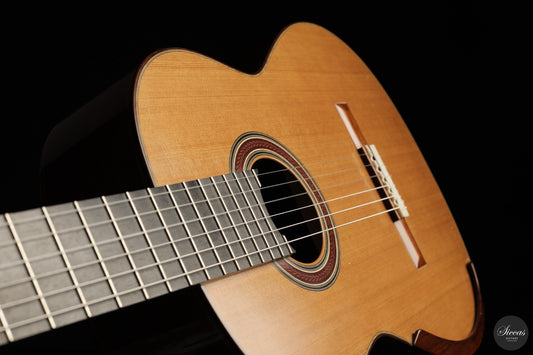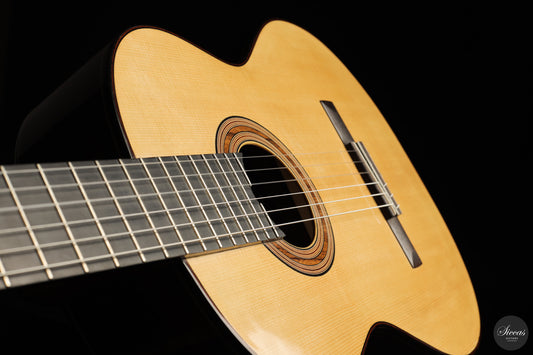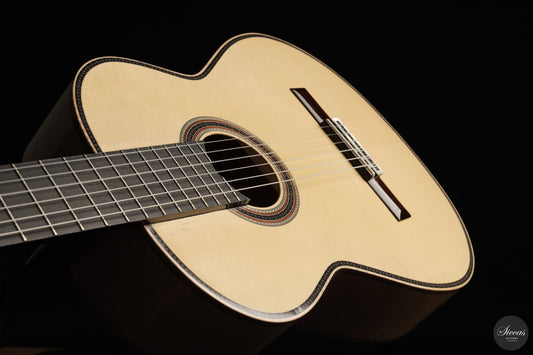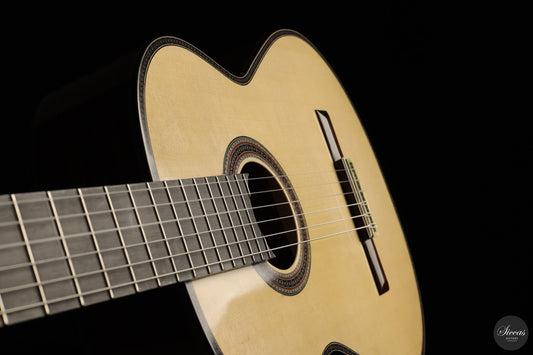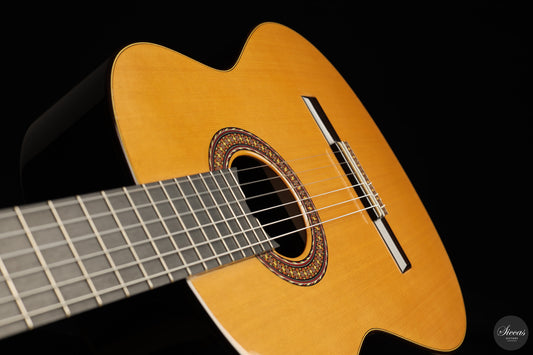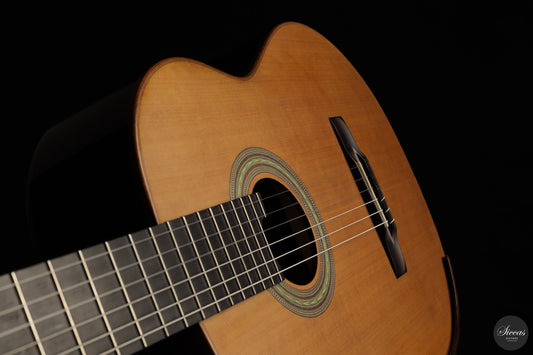

At Siccas Guitars, we take pride in showcasing the finest instruments from across the globe. In our latest video, we conduct an in-depth comparison of some of the best models from leading Australian luthiers, giving classical guitar enthusiasts a detailed insight into the unique features and tonal qualities of these remarkable lattice-braced guitars.
What Is Lattice Bracing?
Lattice bracing is one of the most significant innovations in classical guitar construction of the past century. Rather than the traditional fan-bracing system — which has defined classical guitar making for hundreds of years — the lattice system replaces the wooden fan braces with a grid-like network of thin carbon fibre and balsa wood strips laid across the inside of the soundboard.
The result is a soundboard that is dramatically lighter than a traditionally braced top, yet structurally far more rigid. This combination is the key to the lattice guitar's signature sound: extraordinary projection, fast and direct response, and a clarity of tone that carries even in large concert halls without amplification. For players who perform on stage or in ensembles, this acoustic power is not a luxury — it is a necessity.
The engineering logic is straightforward: a lighter, stiffer plate vibrates more freely and efficiently. Less energy is lost in the wood itself, which means more energy is transferred into the air as sound. The player experiences this as a guitar that responds instantly to the slightest touch, with a dynamic range that rewards nuance and rewards power equally.
Greg Smallman and the Australian Tradition
The lattice-braced classical guitar as we know it today is largely the invention of Greg Smallman, an Australian luthier who developed the technique over decades of research and experimentation. His work transformed the possibilities of the classical guitar and attracted the attention of some of the world's greatest performers.
Smallman's approach was not simply to replace fan braces with a grid — it was a complete rethinking of how the soundboard functions as a whole. His lattice construction uses carbon fibre in combination with balsa wood to create a structure that is both light and remarkably stiff. The result is an instrument with a voice that is immediately recognisable: powerful, clear, and with a sustain that seems to defy the acoustic laws governing conventional instruments.
The influence of Smallman's work spread through Australian lutherie, and today Australia is home to a remarkable concentration of world-class guitar makers who have taken the lattice concept and developed it in their own directions. Names such as Jim Redgate, Stephen Connor, and Philip Woodfield are known to professional players and serious collectors worldwide.
Australian Luthiers Featured in Our Comparison
In the video above, we feature guitars from Greg Smallman, Jim Redgate, and Zbigniew Gnatek. Each of these makers brings their own philosophy and refinements to the lattice-braced concept, and hearing them side by side reveals just how much variation is possible within a shared structural framework.
What unites the instruments is the core character of the lattice design: immediacy of response, volume that fills a room, and a tonal transparency that reveals every detail of the player's technique. What distinguishes them from each other is the individual voice that each luthier coaxes from their choice of tonewoods, their specific lattice geometry, and the countless small decisions that define a master craftsman's work.
Sound Comparison: Clarity, Projection, and Resonance
In the video, we play a variety of pieces that allow each guitar to speak on its own terms. Listening carefully, you can hear the subtle but real differences in clarity, projection, resonance, and overall tonal character between the models. For anyone considering a serious investment in a high-end classical guitar, this kind of side-by-side comparison is invaluable.
Some of the key differences highlighted include:
- Tonal Brightness: Certain models lean toward a brighter, more treble-focused sound, making them ideal for intricate fingerpicking and melodic lines that need to cut through clearly.
- Bass Depth: Others provide a deeper, richer bass response, giving the guitar a full-bodied quality that works beautifully for solo repertoire where harmonic colour is paramount.
- Dynamic Range: The dynamic range and responsiveness of each guitar are put to the test, showing how they handle both soft, delicate passages and powerful, full-bodied playing.
This is precisely the kind of tonal spectrum that makes the lattice braced classical guitar so compelling for professional musicians. The instruments do not simply play loudly — they play expressively across a wide dynamic range, responding to the player's intentions with a directness that traditionally braced guitars can rarely match.
Why Choose a Lattice-Braced Guitar?
For professional guitarists or dedicated students, the decision to invest in a lattice-braced instrument is often driven by a specific need: more projection in performance settings, faster response for technically demanding repertoire, or simply a tonal character that suits a particular musical sensibility.
The lattice guitar excels in live performance contexts. Its projection cuts through ambient noise and fills larger spaces without strain. The sustain and tonal balance offer a playing experience that is fundamentally different from a fan-braced instrument — not better or worse in absolute terms, but distinctly suited to players who want maximum acoustic efficiency and expressive range.
If you are exploring the broader world of classical guitar construction, you may also find our guide to spruce vs cedar tonewoods useful — tonewood choice interacts closely with bracing style to shape the final voice of an instrument. For a broader introduction to the classical guitar repertoire these instruments are built to serve, our article on famous classical guitar pieces is a good starting point.
Players at the beginning of their journey may also want to understand the key differences between acoustic and classical guitars before committing to a particular instrument type. And if you are ready to explore our full range, browse the classical guitars collection at Siccas Guitars.
Why Siccas Guitars?
At Siccas Guitars, we specialise in offering the finest classical and flamenco guitars from master luthiers around the world. Our carefully curated selection ensures that players of all levels can find an instrument that meets their artistic and technical needs. Every guitar in our inventory is personally evaluated, and we work directly with makers to bring you instruments that represent the current state of the art in classical guitar building.
Whether you are looking for your first serious instrument or adding a concert-level guitar to an existing collection, our team is here to help you find the right fit. Explore our collection of classical guitars and double-top guitars — a related family of high-performance instruments — and discover what the finest contemporary luthiery has to offer.