
Leo Brouwer: Maestro of Modern Classical Guitar
Leo Brouwer is one of the most consequential figures in twentieth- and twenty-first-century classical guitar. Born on 1 March 1939 in Havana, Cuba, he is a guitarist, composer, conductor, and teacher whose output has fundamentally reshaped the repertoire of the instrument. Over a career spanning more than six decades, Brouwer has moved from the folk-influenced simplicity of his early pieces through radical avant-garde experimentation and on to a richly expressive neo-romanticism — always keeping the guitar at the centre of his artistic world. His works appear on concert programmes and conservatoire syllabi across the globe, and virtually every serious classical guitarist today has encountered his music.
Understanding Brouwer means understanding both Cuba and the international new-music scene of the post-war era. He grew up in a musical family — his great-uncle was the celebrated Cuban guitarist and composer Isaac Nicola — and began playing guitar as a child. By his late teens he was already composing, and in the early 1960s he travelled to New York to study at the Juilliard School, where he absorbed the serial and avant-garde techniques then transforming Western art music. That education, layered on top of deep roots in Cuban rhythm and son tradition, produced a voice unlike any other in guitar music.
Early Life and Musical Formation
Havana in the 1940s and 1950s was a city alive with music — Afro-Cuban son, bolero, jazz drifting in from the north, and a conservatoire culture shaped by European classicism. Brouwer grew up absorbing all of it. His great-uncle Isaac Nicola had studied with Emilio Pujol (a direct pupil of Francisco Tárrega) and brought a rigorous Spanish-classical tradition to Cuban guitar pedagogy. Under Nicola's guidance, Brouwer received a thorough technical and musical foundation before leaving the island to broaden his horizons.
At the Juilliard School in New York he encountered the twelve-tone and post-serial worlds of composers such as Stefan Wolpe and Vincent Persichetti. He also absorbed the ideas circulating in the European avant-garde — Ligeti, Xenakis, Henze — and returned to Cuba equipped with a new compositional language. This period of study was not a break from his Cuban identity but rather a catalyst: the dissonances, extended techniques, and structural freedom of the avant-garde became tools for expressing something deeply personal and culturally specific.
If you are curious about how the classical guitar's own history created the conditions for composers like Brouwer to emerge, the history of classical guitar and its evolution provides essential context.
Three Periods: A Compositional Arc
Musicologists and Brouwer himself have described his output in three broad phases. While any such framework risks oversimplification, it is genuinely useful for navigating a catalogue that runs to well over a hundred works.
Period One — Simple Music (late 1950s–mid-1960s)
The first period is characterised by a deceptive simplicity. Pieces such as the Danza Característica (1957) and Ecos de un Día Lejano wear their Cuban heritage openly, using syncopated rhythms, modal inflections, and transparent textures. They are accessible without being superficial. The Estudios Sencillos — the Simple Etudes — belong substantially to this phase, though Brouwer added to the set over subsequent decades. These short studies are today among the most widely taught pieces in classical guitar, offering students a path from intermediate technique into genuinely contemporary musical language. If you are looking for entry points into the repertoire, the easiest classical guitar pieces for beginners article discusses how these études fit alongside other beginner-friendly works.
Period Two — Avant-Garde (late 1960s–early 1980s)
By the late 1960s Brouwer was pushing hard against the boundaries of what the guitar could do. Works from this period — La Espiral Eterna (1971), Canticum (1968), Parabola (1973) — employ graphic notation, microtones, controlled noise, and open-form structures. La Espiral Eterna in particular has become a landmark of the avant-garde guitar literature: its title describes the piece's formal logic, a continuously ascending and transforming line that seems to coil around itself, demanding extreme technical precision and interpretative imagination from the performer. These works placed Brouwer squarely among the international avant-garde, and they attracted the attention of leading guitarists including Julian Bream and John Williams, who championed them in concert and on record. Julian Bream was especially important in bringing Brouwer's avant-garde works to international audiences.
Period Three — Neo-Romanticism (mid-1980s–present)
Around the mid-1980s Brouwer underwent what he called a personal and aesthetic "conversion." Without abandoning the harmonic sophistication he had accumulated, he turned back towards melody, lyricism, and traditional forms — filtered through everything he had learned. The guitar concertos of this period — particularly the Concierto de Lieja (1980) and the later Concierto Elegiaco (1985–86) — show this neo-romantic voice fully formed: expansive, emotionally direct, technically formidable. The El Decamerón Negro (1981), a triptych of tone poems evoking African mythology, is perhaps the single most performed work from this phase and has become a staple of the international recital circuit.
Key Works in Detail
Estudios Sencillos (Simple Etudes)
Originally conceived in the early 1960s and expanded over subsequent decades to a set of twenty, the Estudios Sencillos occupy a unique position: they are simultaneously pedagogical tools and serious concert pieces. Each study isolates a specific technical challenge — arpeggios, slurs, rasgueado-derived patterns, thumb independence — while presenting it within a musical argument that stands on its own. Guitarists such as David Russell and Ana Vidovic have performed selections from the set on major stages. David Russell has long championed Brouwer's music, and the études feature in his teaching and recording work.
Danza Característica
Written in 1957, this short dance was one of Brouwer's first published pieces. Its infectious rhythmic energy, rooted in Cuban son clave, made it an immediate favourite. It remains one of the most programmed Latin American guitar pieces of the twentieth century and a useful demonstration of how Brouwer, even at eighteen, could write music that was both technically idiomatic and harmonically fresh.
La Espiral Eterna
Composed in 1971, La Espiral Eterna represents the apex of Brouwer's avant-garde period. The piece demands that the guitarist produce sounds across the entire range of the instrument's expressive possibilities — from delicate sul ponticello harmonics to percussive slaps on the soundboard. Its structure is open: the score includes proportional notation and optional repetition, meaning no two performances are identical. It is a physically demanding and mentally taxing work that rewards players willing to commit to its world entirely.
El Decamerón Negro
Inspired by the anthropologist Leo Frobenius's 1910 collection of African oral narratives, this three-movement work from 1981 — La Huida de los Amantes por el Valle de los Ecos, El Arpa del Guerrero, La Ballada de la Doncella Enamorada — is a masterpiece of programmatic guitar writing. Each movement conjures a specific atmosphere: the frantic flight of lovers, the warrior's harp, the maiden's song. Brouwer's neo-romantic voice is here at its most vivid. The piece can be heard in the video below.
Brouwer as Conductor and Cultural Figure
Composition and performance represent only part of Brouwer's contribution. From the 1970s onwards he built a parallel career as a conductor, leading orchestras in Cuba and internationally. He served as chief conductor of the Orquesta Nacional de Cuba and later of the Orquesta Sinfónica de Córdoba in Spain. His conducting work extended the reach of Cuban and Latin American music into the orchestral mainstream, and his programming consistently championed contemporary music alongside the standard repertoire.
Brouwer has also been a pivotal figure in Cuban cultural life more broadly. He was deeply involved in the Cuban film industry from the 1960s onwards, composing scores for dozens of Cuban and Latin American films. This work gave him a fluency in dramatic and narrative composition that informed even his purely instrumental writing. He held senior positions in ICAIC (Instituto Cubano del Arte e Industria Cinematográficos), the state film institute, and used that platform to support younger Cuban composers and musicians.
Influence on the Guitar Repertoire
Brouwer's influence on the classical guitar extends far beyond his own compositions. As a teacher and advocate he has encouraged countless younger composers — many without a personal connection to the guitar — to write for the instrument, arguing that the guitar's unique timbral and textural possibilities make it a vehicle for the most advanced contemporary musical ideas. His collaboration with guitarists including John Williams, Julian Bream, and later Sharon Isbin and David Russell helped establish a model of composer-performer partnership that has shaped how new guitar music is commissioned and disseminated.
His positioning of the guitar within the Latin American cultural tradition has also been significant. By insisting on the legitimacy of Afro-Cuban and wider Afro-Latin influences alongside European modernism, he helped dismantle the assumption — never entirely absent from the guitar world — that the instrument's highest expression was necessarily European. Brouwer's guitar is a world instrument, drawing on the full breadth of the cultures that have shaped it. This connects him to the broader tradition of great classical guitar pieces that span continents and centuries.
Comparisons with other great composer-guitarists are inevitable. Like Agustín Barrios before him, Brouwer fused non-European musical traditions with classical forms to produce something genuinely new. Like Heitor Villa-Lobos, he worked within a national tradition while addressing universal musical concerns. And like Francisco Tárrega in the nineteenth century, he redefined the expressive possibilities of the instrument for his era.
Leo Brouwer in Performance
Brouwer was an accomplished concert guitarist in his own right, and recordings of him playing his own and others' music circulated widely in the 1960s and 1970s. A hand injury eventually curtailed his performing career, but those recordings preserve a playing style that was clean, rhythmically precise, and undemonstrative — entirely in service of the music. His interpretations of his own early pieces in particular have a natural authority that no later recording can quite replicate.
Today his music is performed by virtually every major classical guitarist. The video below features a performance of one of his works, giving a direct sense of why Brouwer's writing remains so compelling in the concert hall.
Choosing a Guitar for Brouwer's Music
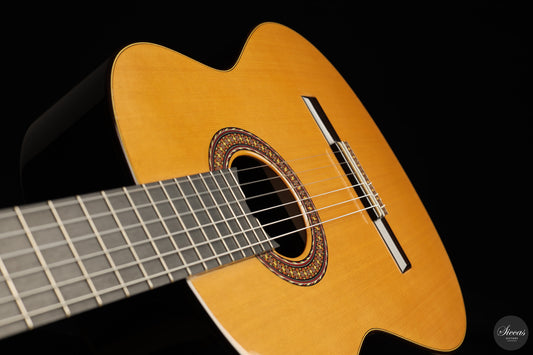
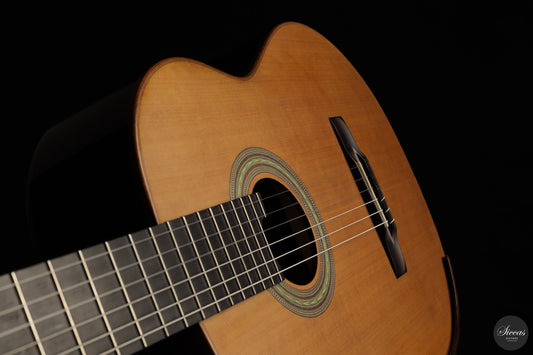
Brouwer's music makes significant demands on both player and instrument. The avant-garde works require a guitar with a wide dynamic range and strong projection across all registers — extended techniques such as behind-the-nut tremolos and sul ponticello passages reveal the character of the top wood immediately. For these works, a spruce-topped instrument often provides the clarity and attack that the music demands; you can compare tonal characters in the spruce vs cedar tone comparison. The neo-romantic concertos and the Decamerón Negro reward a guitar with warmth and singing sustain as well as power. Exploring the full range of classical guitars at Siccas Guitars will help you find an instrument equal to Brouwer's demands.
Conclusion
Leo Brouwer stands as one of the defining musical personalities of our time. His willingness to follow his artistic convictions through multiple stylistic transformations — from simple elegance to searing modernism to expressive neo-romanticism — gives his catalogue a breadth that few composers for any instrument can match. For the classical guitar, he has been simultaneously a challenger and a benefactor: he pushed the instrument into new sonic territories while also providing teachers and students with some of the most musically intelligent and technically rewarding repertoire in existence. Whether you are encountering the Estudios Sencillos for the first time or preparing a performance of La Espiral Eterna, Brouwer's music repays every hour of engagement.