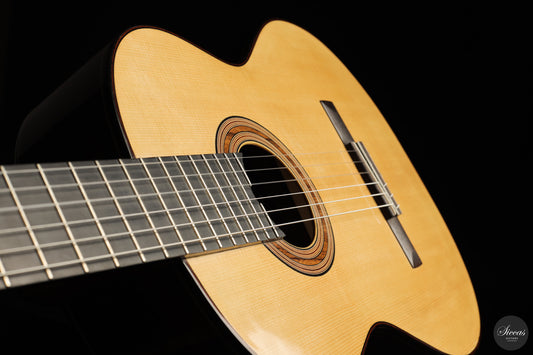
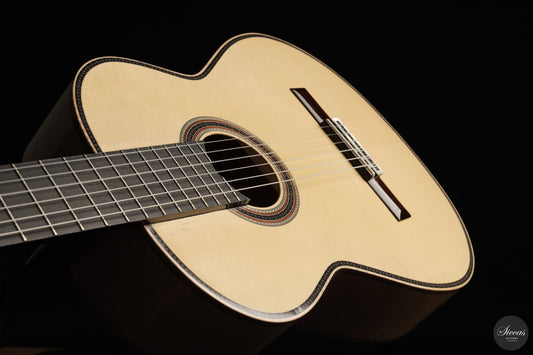
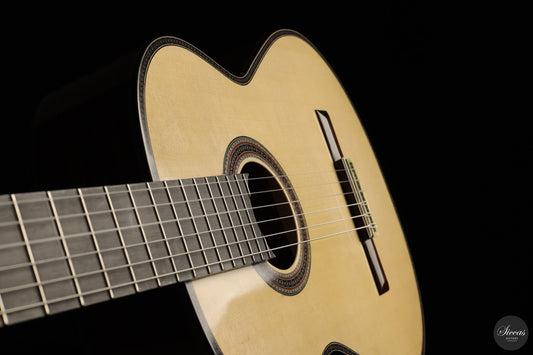
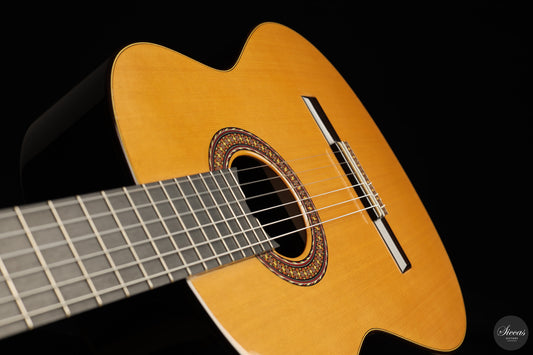
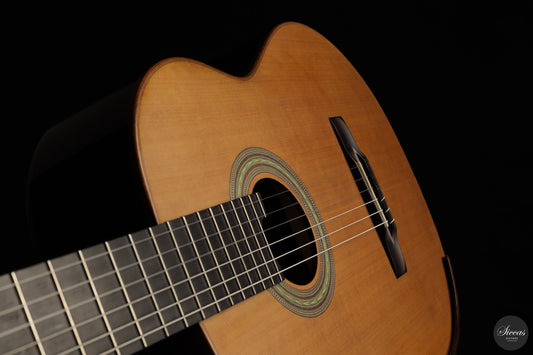
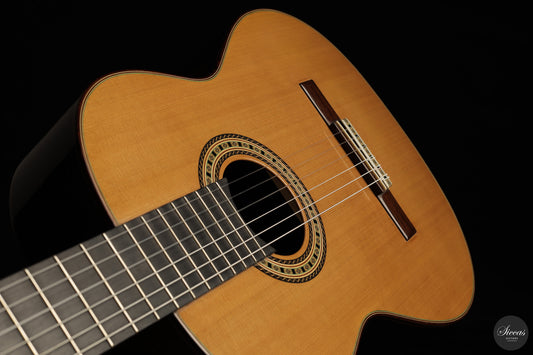
Paco Santiago Marín — Granada Tradition, Concert Power
The Granada school of guitar making is one of the most celebrated lutherie traditions in the world, and Paco Santiago Marín stands among its most respected contemporary voices. Born in Granada in 1946, he has spent more than half a century building concert instruments prized by leading soloists for their power, balance, and tonal depth. His guitars are not just part of the Granada tradition — they are a living expression of it.
Roots in Granada
Santiago Marín grew up surrounded by the craft. His father was a cabinet maker, and from an early age he worked with fine wood and learned to respect its qualities. By the age of twelve he was already at the workbench. The decisive step came in 1963, when he joined the workshop of his uncle, the great Granada luthier Antonio Marín Montero. He spent nearly a decade there — absorbing not just techniques but the underlying philosophy of what a concert guitar must do, how it must balance, how it must project. In 1973, equipped with that foundation, he opened his own workshop in Granada.
The Granada tradition in guitar making traces its lineage to Antonio de Torres (1817–1892), the 19th-century master whose fan-braced construction and instrument geometry defined the modern classical guitar. Every luthier in the Granada school works in conversation with that inheritance — not copying it blindly, but understanding it deeply enough to develop it further.
The Granada Sound
For Santiago Marín, the foundation of the Granada school is Torres's work, but he has never stopped investigating and refining how that ideal is realised in each new instrument. His guitars are admired for strong projection, even balance across the registers, and rich tonal colour — the qualities a concert guitarist needs to fill a large hall with musical argument rather than mere loudness.
The balance between trebles and basses is a particular concern: a guitar that sings in the upper register but loses its grounding in the bass, or vice versa, is usable but not great. Santiago Marín's instruments are consistently cited by players for the equality of their voice across all six strings and all positions on the neck.
Instruments Available at Siccas Guitars
Siccas Guitars offers instruments by Paco Santiago Marín from its collection of concert-quality classical guitars. Both classical and flamenco models have been part of the range, reflecting the maker's command of both main traditions of the Spanish guitar. Each instrument is individually inspected and set up before reaching the player.
For a player looking for a guitar rooted in the Granada tradition — the same tradition that produced instruments for some of the 20th century's finest soloists — Santiago Marín's work represents a direct and living connection to that lineage.
Classical and Flamenco Models
Santiago Marín builds both classical concert guitars and flamenco instruments. While the two share construction principles, they differ in important ways: flamenco guitars are traditionally built with slightly lower action, lighter construction, and different woods (cypress for back and sides being the most common choice) to produce the bright, percussive response and rapid decay the flamenco style demands. Classical guitars built in the Granada tradition emphasise sustain, warmth, and a fuller tonal spectrum.
The ability to build convincingly in both traditions is a mark of a maker who truly understands the Spanish guitar in all its dimensions. Santiago Marín's flamenco instruments are used by working flamenco players; his classical guitars are used on international concert stages.
The Spanish Lutherie Tradition
The story of Spanish lutherie is inseparable from the story of the classical guitar itself. The instrument as we know it — six strings in standard tuning, the distinctive body shape, the fan bracing inside the top — was largely the creation of Spanish makers in the 19th century, with Torres at the centre. The workshops of Granada, Almería, Sevilla, and Madrid continued and expanded this tradition through the 20th century.
What distinguishes the Granada school specifically is its emphasis on handcraft, on the ear as the final arbiter of quality, and on a direct workshop-to-workshop transmission of knowledge. Santiago Marín learned from Antonio Marín Montero; Antonio Marín Montero learned from his own teachers; the chain of knowledge goes back through the Granada workshops to Torres and beyond. This living tradition is not a museum piece — it produces working concert instruments used today on stages around the world.
Other great luthiers in this tradition include José Romanillos (whose work bridged the Spanish and English lutherie worlds), Robert Bouchet (the French maker who combined the Torres inheritance with his own engineering insight), and the great Granada masters of Santiago Marín's own generation.
Choosing a Guitar by Paco Santiago Marín
For a player considering a Santiago Marín guitar, the key qualities to listen for are projection and balance. Play across all six strings, in all positions, at various dynamic levels. The Granada sound at its best is not aggressive or brittle — it is full and clear, with a warmth that comes from the wood and the maker's voicing rather than from mere loudness. The guitar should feel as though it wants to sing; the player's job is simply to give it direction.
Both spruce-topped and cedar-topped models appear in Santiago Marín's output. Spruce tends toward a brighter, more projecting sound that opens up over time; cedar gives a warmer, rounder tone from the first note. Neither is superior — they suit different players, different repertoires, and different environments.
FAQ
Who is Paco Santiago Marín?
A Spanish luthier born in Granada in 1946, one of the most respected makers of the Granada school of classical guitar making. He studied with his uncle, the great luthier Antonio Marín Montero, and has built concert instruments for over fifty years.
What kind of guitars does he build?
Both classical concert guitars and flamenco instruments, all built within the Granada tradition of Spanish lutherie. His instruments are available through Siccas Guitars.
What is the Granada school of lutherie?
A tradition of guitar making centred in Granada, Spain, tracing its lineage to Antonio de Torres and passing workshop knowledge from generation to generation. It emphasises handcraft, tonal balance, and projection suited to concert performance.
Are his guitars suitable for concert performance?
Yes. His instruments have been chosen by professional soloists and are built to the standard required for classical concert playing in large halls.
Famous classical guitar pieces → · Browse our classical guitars · Great classical guitarists