
A Guitar Exhibition at the Heart of Rome
Denis Pécaut arrived at the Roma Expo Guitars 2026 expecting a trade show. What he found was something closer to a pilgrimage site. The event took place in the immediate vicinity of the Trevi Fountain — one of Rome's most visited landmarks — and the setting was not incidental. Organizers chose the location deliberately: the beauty of the city was meant to mirror the beauty of the instruments on display. For a luthier of Pécaut's experience, it worked.
Roma Expo Guitars has established itself over the past decade as the premier showcase for Italian lutherie. The 2026 edition drew makers from across the peninsula — from the workshops of Rome and Florence, from the hills of Cremona, and from luthiers working in smaller towns whose names are not yet widely known but whose instruments deserve attention. Pécaut walked every table.
Denis Pécaut: A Luthier Among Luthiers
Denis Pécaut is a French guitar maker with decades of experience building concert instruments for professional players. He is not a journalist or a trade visitor. When he attends an exhibition like Roma Expo Guitars, he brings with him a working luthier's eye: he looks at joinery, at finish quality, at wood selection, at the geometry of necks and bridges. He plays the instruments. He asks questions about materials and methods. His report from the 2026 event is therefore not a press release — it is a professional assessment from inside the craft.
Pécaut has written about the experience of moving from table to table and encountering, repeatedly, a quality of work that impressed him. Italian lutherie has a reputation for visual elegance, and that reputation held at the 2026 expo. But what struck Pécaut most was the breadth of approaches on display: makers using traditional Spanish-derived fan bracing alongside builders experimenting with lattice and double-top constructions; luthiers finishing in French polish next to those using contemporary thin varnishes. The Italian scene in 2026, as Pécaut saw it, is not a monoculture.
Highlights from the Exhibition Floor
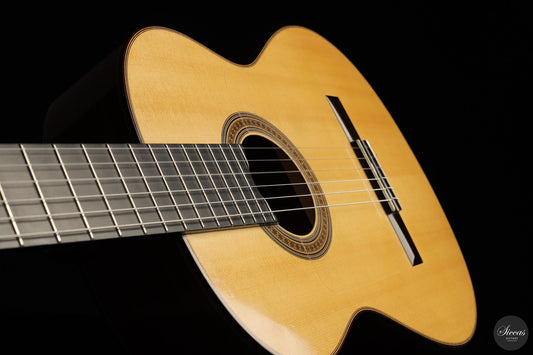
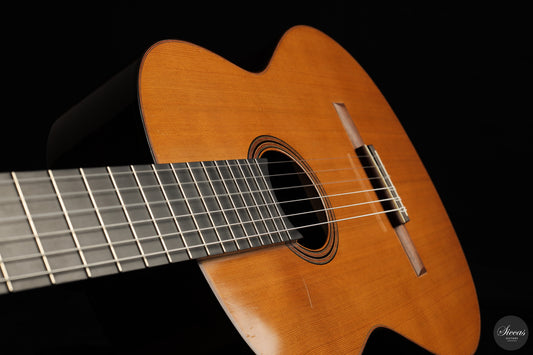
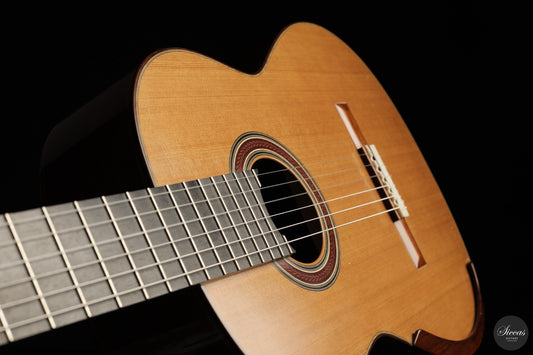
Among the instruments Pécaut singled out for particular attention were several that combined exceptional tonal wood selection with finishing work of the highest standard. He noted one cedar-topped instrument whose soundboard graduation was, in his words, "as even as anything I have seen at a European show in the past five years." The maker — a relatively young Roman luthier — had been building for only eight years, which made the quality of the work more striking.
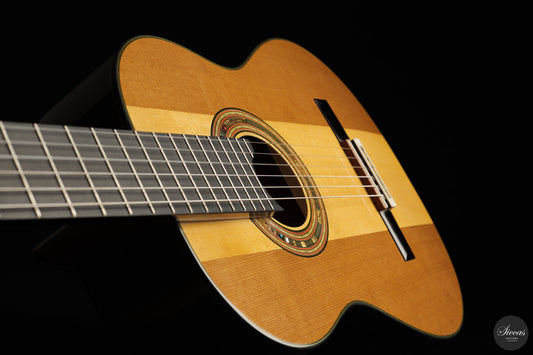
Pécaut also spent considerable time with a builder working in the tradition of the Torres-derived seven-fan construction, using aged European spruce sourced from a supplier in the Austrian Tyrol. The instrument's projection in the exhibition hall was remarkable given its modest visual presentation. No inlay beyond a simple mosaic rosette, no elaborate binding. The maker's investment had clearly gone into the acoustics.
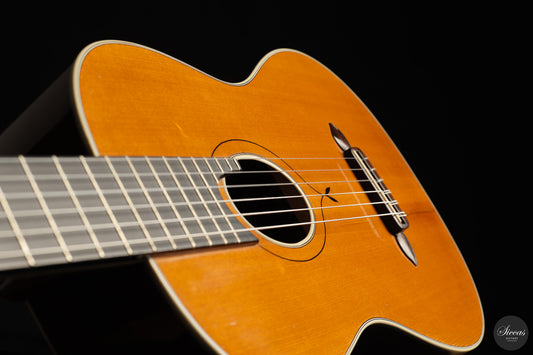
A third highlight was a double-top guitar using a Nomex honeycomb core, built by a maker from the Naples area. Pécaut was initially skeptical — he builds in more traditional modes himself — but acknowledged that the instrument's dynamic range surprised him. He noted that the maker had resolved one of the persistent criticisms of double-top construction: the tendency toward a compressed, less responsive attack in the upper register. This guitar did not have that problem.
Italian Lutherie: Tradition and Innovation
One of the consistent threads in Pécaut's account is the relationship between tradition and experiment in Italian lutherie. Italy does not have a single dominant guitar-making school in the way that Spain does — there is no Italian equivalent of the Andalusian tradition that runs from Torres through Fleta to contemporary Córdoba workshops. Italian makers have drawn from multiple sources: Spanish construction principles, German structural ideas, and increasingly from the Australian lattice school.
This eclecticism, Pécaut suggests, is a strength. Makers who are not bound to a single model feel freer to experiment. At Roma Expo Guitars 2026, that freedom produced instruments that were individually distinctive in ways that a more standardized scene might not allow. The risk, Pécaut acknowledges, is inconsistency — but at this event, the inconsistency ran in the direction of pleasant surprise rather than disappointment.
He was particularly struck by the quality of the wood selection across the event as a whole. European tonewoods — spruce from the Alps and Apennines, maple from northern Italy — appeared frequently alongside the standard imported stocks. Several makers were working with Italian walnut for backs and sides, a choice Pécaut found acoustically interesting and visually compelling.
The Setting: Rome as Context
Pécaut's account returns more than once to the physical experience of the event: the streets around the Trevi Fountain, the sound of the city filtering into the exhibition space, the fact that visitors arrived having already walked through one of the world's great accumulations of craft and art. He suggests, carefully, that context affects perception — that hearing a guitar played in a Roman setting may dispose a listener to find it more beautiful than the same instrument heard in a trade hall in a northern European city.
He is not uncritical. He notes that the event's logistics — the density of the space, the ambient noise, the difficulty of playing instruments properly in a crowded room — made careful acoustic evaluation harder than it would be in a dedicated listening environment. Several instruments he would have liked to assess more thoroughly were inaccessible for extended play due to the volume of visitors. This is a logistical limitation of any popular guitar expo, and Roma Expo Guitars 2026 was clearly popular.
What the Event Reveals About the State of Italian Guitar Making
Pécaut's conclusion is measured and worth quoting in full spirit: Italian lutherie in 2026 is producing concert-quality instruments at a rate that commands international attention. The makers present at Roma Expo Guitars were not apprentices or hobbyists — they were professionals whose instruments would sit comfortably alongside the work of any European tradition. Several were already known to international dealers; others were building their reputations for the first time.
For players looking for a European concert guitar who have not previously explored the Italian scene, the 2026 event, as documented by Pécaut, makes a compelling case for looking south of the Alps. The combination of craft tradition, material intelligence, and the distinctive Italian capacity for visual refinement is producing instruments that deserve a wider audience.
Pécaut ends his account at the Trevi Fountain itself, watching tourists throw coins. He resists the obvious metaphor but lets it stand in the background. Something about making a wish at a fountain, about the belief that beauty has consequences. A handmade guitar, he implies, is also a kind of wish — the maker's wish that the instrument will find a player equal to what it can do.
About Denis Pécaut
Denis Pécaut is a French luthier specializing in concert classical guitars. He has exhibited at major European guitar shows and has built instruments for professional players in France, Spain, and Germany. His writing on lutherie and guitar culture appears regularly in the specialist press. Siccas Guitars is grateful to him for sharing his observations from Roma Expo Guitars 2026.
Full event overview by Siccas Guitars: Roma Expo Guitars 2026 – Full Event Report →