


Brian Itzkin
-

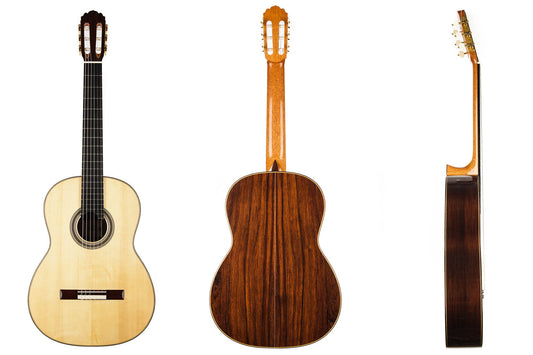 SoldSoldLuthier: Brian Itzkin
 -
Luthier: Brian Itzkin
-
Luthier: Brian Itzkin



Frequently Asked Questions About Classical Guitars
How do I choose the right classical guitar for my level?
Choosing the right classical guitar depends on your playing level, musical goals, and budget. Beginners benefit from studio-model guitars from renowned workshops, while advanced players and professionals often choose a handmade master guitar. We are happy to advise you personally and can send detailed sound samples and videos on request.
What is the difference between a master guitar and a studio guitar?
Master guitars are built entirely by hand in the workshop of a single luthier, using only high-quality, well-aged tonewoods. Studio guitars are made in small series, often under the supervision of the master luthier, and offer excellent value for students and ambitious amateur players.
Can I try a classical guitar at home for 14 days?
Yes — every guitar you purchase from us comes with a 14-day home approval period. This complimentary trial applies worldwide to all orders, whether you are in Germany, Europe, the USA, Asia or anywhere else. We ship your instrument fully insured in a high-quality case so you can play it under your own acoustic conditions. If the guitar is not the right one for you, simply send it back and receive a full refund of the purchase price.
Can I try a classical guitar before purchasing?
Absolutely. You are warmly invited to visit our showroom in Karlsruhe, Germany, and test the instruments at your leisure. We are happy to schedule a personal appointment. If a visit is not possible, we send detailed videos and sound samples, and offer extensive consultation by phone or video call.
What payment methods and financing options do you offer?
We accept bank transfer, PayPal, major credit cards, and Klarna. For high-value instruments, we offer individual installment plans on request. Please contact us directly — we will find a suitable solution for every budget.
How do I properly care for my classical guitar?
A classical guitar requires constant humidity between 45 and 55 percent. Store the instrument in its case with a humidifier, avoid direct sunlight and large temperature fluctuations. Change the strings regularly and clean the guitar with a soft microfiber cloth.
You may also be interested Brian Itzkin
Brian Itzkin – Luthier
Brian Itzkin, the founder of Itzkin Guitars, began his journey into luthiery as a teenager in Long Island, New York. Starting guitar lessons at eight and inspired by his father’s woodshop, he built his first acoustic guitar from a C.F. Martin & Co. kit at the age of 13. “It was acceptable,” he recalls, “but I just kept building and improving.”
A year later, he began corresponding with the renowned Northern California luthier Ervin Somogyi. After two years in college studying English, Brian moved to Granada, Spain, to apprentice with Stephen Hill. This formative experience deepened his passion for classical guitars and Spanish craftsmanship.
Returning to New York, Brian started his own small guitar business while bartending to support himself. Eventually, he decided to leave everything behind and return to Spain. He arrived just before Spain’s nationwide Covid lockdown on March 2, 2020, and stayed until September. “During that time, I built several guitars—one of which I sold through Siccas Guitars in Germany,” he explains. “That experience gave me credibility, led to multiple orders, and since then I’ve been building full-time.”
At just 26 years old, Brian Itzkin is already recognized as a rising talent in modern luthiery. His work is influenced by Antonio de Torres and Vicente Arias, combining 19th-century aesthetics with a modern tonal palette. “I want my guitars to feel cohesive,” he says. “Every element should complement the whole—and they should sound as beautiful as they look.”
Though rooted in traditional Spanish construction, Brian also embraces innovation. He is currently developing a double-top model using Italian Alpine spruce and aerospace-grade composite honeycomb. He is also deeply committed to using ethically sourced and recycled woods—often repurposed from furniture—out of environmental awareness and a desire for accessibility. “I don’t want to be part of the darker side of the timber trade,” he explains. “Sustainable alternatives also tend to be more affordable, which help