


Flamenco
-
Antonio Marin Montero - 2012 No. 690
Price: 6.990 €Unit price per Tax free (0% US)Luthier: Antonio Marin MonteroConstruction Type: FlamencoConstruction Type: Traditional -
Vicente Carrillo - 2025 Flamenca Blanca
Price: 4.999,16 €Unit price per Tax free (0% US)SoldLuthier: Vicente CarrilloConstruction Type: FlamencoConstruction Type: LatticeConstruction Type: Traditional -
Luthier: Santos HernandezConstruction Type: Flamenco
-
Armin Hanika - Flamenco ZF
Sale price 3.696,64 € Price:Unit price per Tax free (0% US)4.201,68 €Save: 505,04 €Manufacturer: Armin HanikaConstruction Type: Flamenco -
Jose Ramirez III - 1959 Flamenca - Augustine Collection
Price: 10.990 €Unit price per Tax free (0% US)Luthier: Jose Ramirez IIIConstruction Type: FlamencoConstruction Type: Traditional -
Gerundino Fernandez Hijo - 2021 Flamenca Blanca 66 cm
Price: 4.990 €Unit price per Tax free (0% US)Construction Type: FlamencoConstruction Type: Traditional -
Armin Hanika - Flamenco KF
Sale price 1.252,10 € Price:Unit price per Tax free (0% US)1.579,83 €Save: 327,73 €Manufacturer: Armin HanikaConstruction Type: FlamencoConstruction Type: Traditional -
Marcelo Barbero - 1955 Flamenca
Price on requestLuthier: Marcelo BarberoLuthier: Rare GuitarsConstruction Type: FlamencoConstruction Type: Traditional








Frequently Asked Questions About Classical Guitars
How do I choose the right classical guitar for my level?
Choosing the right classical guitar depends on your playing level, musical goals, and budget. Beginners benefit from studio-model guitars from renowned workshops, while advanced players and professionals often choose a handmade master guitar. We are happy to advise you personally and can send detailed sound samples and videos on request.
What is the difference between a master guitar and a studio guitar?
Master guitars are built entirely by hand in the workshop of a single luthier, using only high-quality, well-aged tonewoods. Studio guitars are made in small series, often under the supervision of the master luthier, and offer excellent value for students and ambitious amateur players.
Can I try a classical guitar at home for 14 days?
Yes — every guitar you purchase from us comes with a 14-day home approval period. This complimentary trial applies worldwide to all orders, whether you are in Germany, Europe, the USA, Asia or anywhere else. We ship your instrument fully insured in a high-quality case so you can play it under your own acoustic conditions. If the guitar is not the right one for you, simply send it back and receive a full refund of the purchase price.
Can I try a classical guitar before purchasing?
Absolutely. You are warmly invited to visit our showroom in Karlsruhe, Germany, and test the instruments at your leisure. We are happy to schedule a personal appointment. If a visit is not possible, we send detailed videos and sound samples, and offer extensive consultation by phone or video call.
What payment methods and financing options do you offer?
We accept bank transfer, PayPal, major credit cards, and Klarna. For high-value instruments, we offer individual installment plans on request. Please contact us directly — we will find a suitable solution for every budget.
How do I properly care for my classical guitar?
A classical guitar requires constant humidity between 45 and 55 percent. Store the instrument in its case with a humidifier, avoid direct sunlight and large temperature fluctuations. Change the strings regularly and clean the guitar with a soft microfiber cloth.
You may also be interested Flamenco
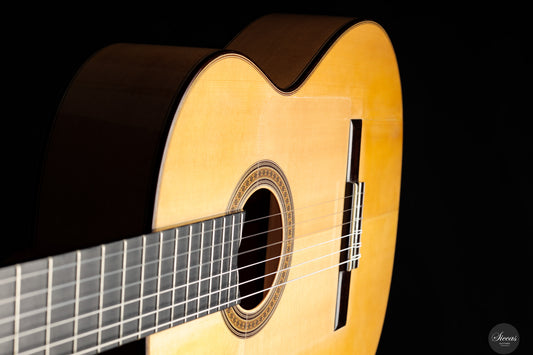
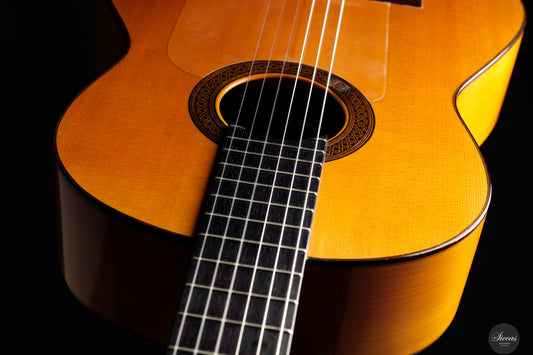
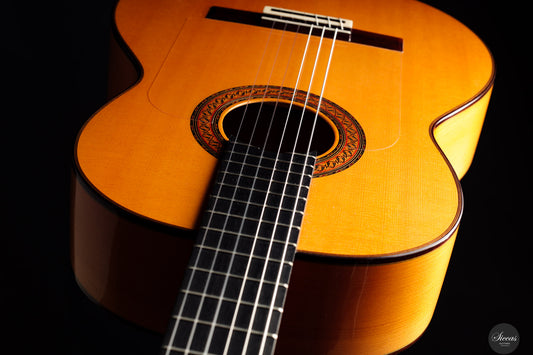
A flamenco guitar is a nylon-string guitar built for the fast, percussive, rhythmically driving music of Andalusia. It shares the shape of a classical guitar but is lighter, with a lower string action and a brighter, drier, more immediate voice. This collection brings together flamenco guitars from renowned makers — both traditional blanca and negra models.
How Flamenco Guitars Differ from Classical Guitars
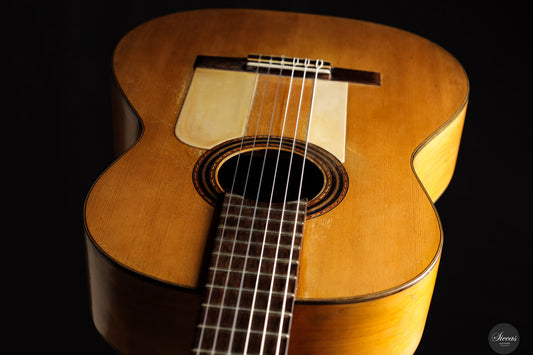
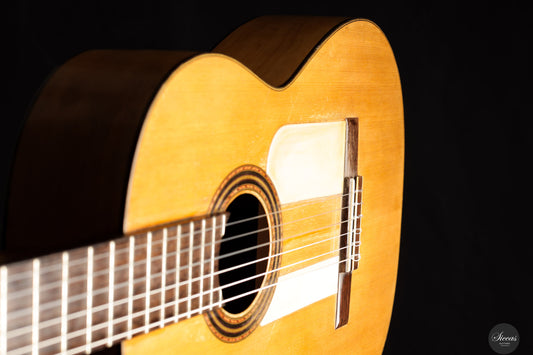
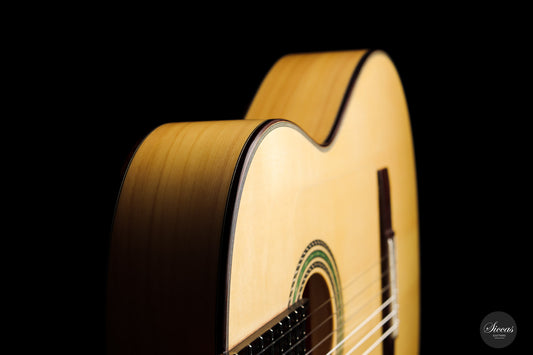
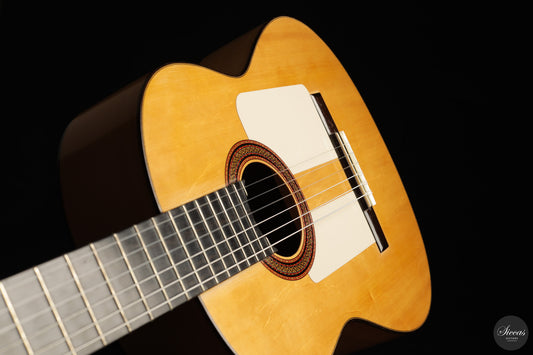
Flamenco guitars have slimmer sides and a lighter build than classical guitars, with a lower, flatter action that makes rapid runs easy and emphasises the music’s percussive character — a light buzz against the frets is part of the sound. The lightweight construction gives a faster, more pronounced attack. Most flamenco guitars carry a golpeador, a clear adhesive tap plate that protects the top from the rhythmic golpe tapping without affecting the tone. Where players once used wooden friction pegs, modern flamenco guitars use standard geared tuners for easier, more precise tuning.
Blanca and Negra: The Woods of Flamenco
Two traditional types define the flamenco sound, distinguished by their back and sides. The flamenca blanca uses cypress for a bright, dry, percussive voice — the classic flamenco sound. The flamenca negra uses rosewood for more volume, sustain, and warmth, moving closer to a classical guitar while keeping flamenco responsiveness. Tops are usually spruce; some modern players choose cedar for added warmth. The demand for more volume — famously driven by Paco de Lucía — reshaped flamenco building, and makers such as Conde Hermanos (whose guitars Paco de Lucía played) became legendary.
Flamenco Playing Technique
Flamenco technique differs sharply from classical playing. Players — called tocaores, their playing toque — strike close to the bridge for a rawer, brighter tone, and favour apoyando (rest stroke, the finger landing on the next string) over tirando for percussive power. Core techniques include rasgueado (rapid strumming with the backs of the fingers), golpe (taps on the golpeador), picado (fast single-note runs), and tremolo. The guitar is often rested on the upper (crossed) leg with the neck almost horizontal, a posture that eases these techniques — though some players use the classical position.
A cejilla (capo) is typical, raising the pitch to suit a singer while keeping familiar chord shapes — ideal for improvised accompaniment. Flamenco often uses open chords with free fingers for melodic additions, blends modal and tonal harmony, and is traditionally passed on by ear rather than notation.
Find Your Flamenco Guitar at Siccas Guitars
Whether you want the crisp snap of a blanca or the fuller voice of a negra, every flamenco guitar here is hand-selected for tone, playability, and craftsmanship — we focus on sound and workmanship, not just names, and set up each instrument in our workshop. Explore the collection, compare it with our classical guitars, and reach out for personal advice — with a 14-day home trial, worldwide.