









Daniele Chiesa - 2025 Doubletop XXX Anniversary
Daniele Chiesa - 2025 Doubletop XXX Anniversary


Details
Details
Overview
Overview
Shipping important note
Shipping important note
Important: Additional costs such as import taxes and custom duties may occur when importing goods from the EU into your country.
Delivery times are typically reliable and most instruments arrive within the estimated timeframe.
Should any unexpected delay occur, our team will keep you informed and provide support at every step. For all shipping details and exceptions, please see our Shipping Policy.
Details about GPSR
Details about GPSR


Video overview


More details about the guitar
About the luthier
Daniele Chiesa was born in Bergamo in 1973 and first approached music as a guitarist, studying both classical and jazz from an early age. In 1994 he moved to Cremona to study musicology, immersing himself in a city whose history is inseparable from the highest traditions of Italian string instrument making. It was there, through the unexpected loss of his own guitar, that he turned toward lutherie. What began as an attempt to replace a stolen instrument became the starting point of a professional path that led him to graduate in 1998 from the violin making school in Cremona as a Maestro Liutaio.
His training continued through a sequence of formative workshop experiences that broadened both his technical knowledge and his understanding of different guitar making traditions. In California he worked with Kenny Hill, gaining direct experience of the traditional Spanish guitar, and later spent a year in the workshop of Tom Ribbecke in the San Francisco Bay Area, where he encountered a distinctly different approach through the making of archtop instruments. Further work with tonewood preparation and grading, including Brazilian rosewood, deepened his material knowledge.
A decisive step followed in Córdoba, where contact with Paco Santiago Marín led Chiesa to settle in Granada and place himself within the living centre of Spanish guitar making. There, working alongside makers such as Antonio Marín Montero, José Plazuelo, and Rolf Eichinger, he refined the methods that would shape his own instruments. Since the early 2000s he has continued to build in Andalucía, developing a personal voice grounded in the Granada tradition while remaining open to careful structural evolution based on long term workshop experience.
About the guitar
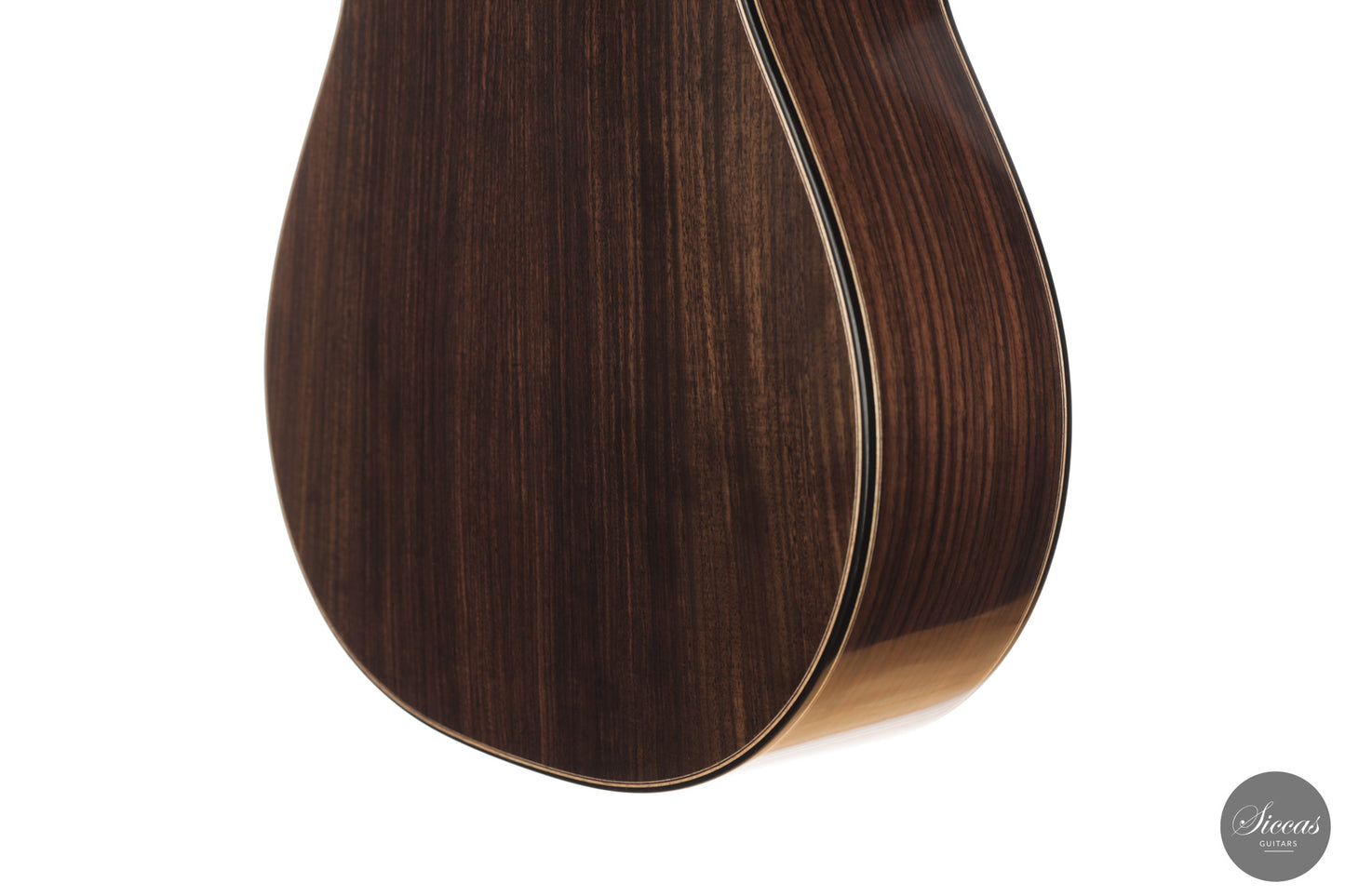
This 2025 anniversary model by Daniele Chiesa is a cedar double top built with Nomex and Indian rosewood, conceived as an advanced extension of his long established work rather than a departure from it. In Chiesa’s own account, this model has occupied much of his recent development, with each new instrument serving as a further refinement of structure, balance, and response. The present guitar reflects that ongoing process through a series of deliberate choices, including laminated sides, an asymmetrical six fan bracing pattern, and a reworked fingerboard structure that allows more exact preparation before final assembly.
What stands out musically is the combination of speed and order. The guitar is highly responsive, with an immediate, fast developing attack, yet the sound remains notably clean. That balance is central to the conception of the model. Chiesa speaks explicitly about the risks that cedar and double top construction can present when left unchecked, especially a tendency toward excessive darkness or an undefined blending of tones. Here those problems are clearly held in control. The voice is focused, even across the fingerboard, and capable of great activity without losing definition. Chords do not collapse into a single mass, and the sound keeps its shape even under a very lively response.
The tonal impression is that of a double top that preserves a strong connection to the traditional guitar. There is colour, detail, and balance in the sound, but also a roundedness and ease of response that belong to the reduced mass and efficiency of this construction. Rather than pushing toward an exaggerated modern effect, Chiesa seems to aim for a more natural integration of double top advantages into a musically familiar language. The result is a voice that feels elegant, precise, and structurally coherent, with a broad dynamic capacity and a particularly even behaviour from one register to another.
Part of that control comes from the underlying construction logic. Chiesa closes this model from the top, a method he values especially in double tops because it reduces the accumulation of edge tension and helps the soundboard remain more relaxed throughout its surface. He also uses interior finishing on the back and sides as a balancing tool, introducing a little more brilliance where cedar and double top construction might otherwise become too dark. These decisions are not presented as theory alone, but as the outcome of long empirical comparison between closely matched instruments. That attitude is characteristic of Chiesa’s work. The guitar is not designed around novelty for its own sake, but around carefully tested adjustments that shape response, clarity, and resilience in a controlled way.
As a result, this anniversary model offers a persuasive synthesis of refinement and power. It reacts quickly, remains composed, and speaks with a clean, elegant tone that avoids both heaviness and excess. For players seeking the immediacy and dynamic ease of a double top without giving up tonal discipline and a strong sense of traditional orientation, this guitar represents a mature and highly resolved interpretation.
Regular care extends the life of the instrument
Even with careful use, a classical guitar may gradually change in appearance or respond to unstable storage conditions. Have a close look at your guitar regularly and be attentif to changes. If your instrument is suffering from its environement, it will let you know.
Protect Your Guitar: Handle with Care
Be mindful when touching your instrument with greasy or unwashed hands: any skin contact is a small attack on the varnish. Of course, a guitar is made to be played, but taking a few precautions helps preserve its beauty: wash your hands before playing, wear long sleeves, and avoid unnecessary direct skin contact with the body of the instrument.
Pro tip: Avoid playing with a button-up shirt, heavy jewelry, or a belt, as these can scratch the guitar. Also, make sure your guitar case is free of any objects that could damage the instrument during storage.
String care
A good habit to adopt is wiping down your strings briefly after each playing session. This small action significantly extends their lifespan and helps maintain a consistent, comfortable feel under your fingers.
Most importantly, clean strings are essential for keeping your instrument in tune. Corrosion, sweat, and dust can affect the uniformity of the strings and interfere with accurate tuning across the entire fingerboard.
Pro tip: If you're having trouble getting your guitar in tune, it might be time to change the strings. A useful test is to compare the pitch of the 12th fret harmonic with the fretted note at the 12th fret; if there's an unusually large gap between them, your strings may have lost their integrity and should be replaced.
Keep Your Shellac Finish Shining!
Got a guitar with a shellac (French polish) finish? Here's a simple trick: Take a clean microfiber cloth and gently breathe on the surface to create a light mist. Then, softly rub to remove fingerprints, sweat, and grease. That’s usually all it takes to keep it looking great, no products needed!
Pro tip: Every few years, treat your guitar to a check-up with a luthier to keep it in top shape.
Storing Your Guitar: Climate Matters
Your guitar can safely stay outside its case, as long as the surrounding environment maintains 42–55% humidity and a temperature between 18–25°C.
Keep in mind that humidity levels can still fluctuate inside the case, especially during seasonal changes.
- Too much humidity may cause overtightened strings and a dull tone.
- Too little humidity can lead to a bulging top, string buzz, or even cracks.
Avoid placing your guitar near radiators, air conditioners, or windows with direct sunlight.
Pro tip: Always close your guitar case while playing. This helps preserve a stable microclimate inside the case, so your instrument is protected the moment you put it back in.
Related guitars
Frequently Asked Questions About Classical Guitars
How do I choose the right classical guitar for my level?
Choosing the right classical guitar depends on your playing level, musical goals, and budget. Beginners benefit from studio-model guitars from renowned workshops, while advanced players and professionals often choose a handmade master guitar. We are happy to advise you personally and can send detailed sound samples and videos on request.
What is the difference between a master guitar and a studio guitar?
Master guitars are built entirely by hand in the workshop of a single luthier, using only high-quality, well-aged tonewoods. Studio guitars are made in small series, often under the supervision of the master luthier, and offer excellent value for students and ambitious amateur players.
Can I try a classical guitar at home for 14 days?
Yes — every guitar you purchase from us comes with a 14-day home approval period. This complimentary trial applies worldwide to all orders, whether you are in Germany, Europe, the USA, Asia or anywhere else. We ship your instrument fully insured in a high-quality case so you can play it under your own acoustic conditions. If the guitar is not the right one for you, simply send it back and receive a full refund of the purchase price.
Can I try a classical guitar before purchasing?
Absolutely. You are warmly invited to visit our showroom in Karlsruhe, Germany, and test the instruments at your leisure. We are happy to schedule a personal appointment. If a visit is not possible, we send detailed videos and sound samples, and offer extensive consultation by phone or video call.
What payment methods and financing options do you offer?
We accept bank transfer, PayPal, major credit cards, and Klarna. For high-value instruments, we offer individual installment plans on request. Please contact us directly — we will find a suitable solution for every budget.
How do I properly care for my classical guitar?
A classical guitar requires constant humidity between 45 and 55 percent. Store the instrument in its case with a humidifier, avoid direct sunlight and large temperature fluctuations. Change the strings regularly and clean the guitar with a soft microfiber cloth.