





This guitar is sold – but we may have something similar.
Our experts know every guitar in the house and are happy to advise you personally.
Ask about similar guitarsDennis Tolz - 2015 Doubletop
Details
Details
Overview
Overview


Video overview


More details about the guitar
About the luthier
Dennis Tolz is one of the defining figures in modern German guitar making. Based in Kiel, he has earned international recognition for double-top instruments that unite advanced construction methods with a clear grounding in traditional lutherie. An important influence on his work was Gernot Wagner, from whom Tolz adopted the Nomex double-top concept before developing it further in a distinctly personal acoustic and aesthetic direction.
What distinguishes his guitars is the way they combine the carrying power and clarity of modern concert instruments with the coloristic range and lyrical warmth more often associated with traditional guitars. Tolz achieves this balance through careful material selection, precise resonance work, and disciplined structural refinement. His instruments are played by leading concert artists worldwide and have become highly sought after both for their tonal qualities and for the long waiting time attached to his work.
About the guitar
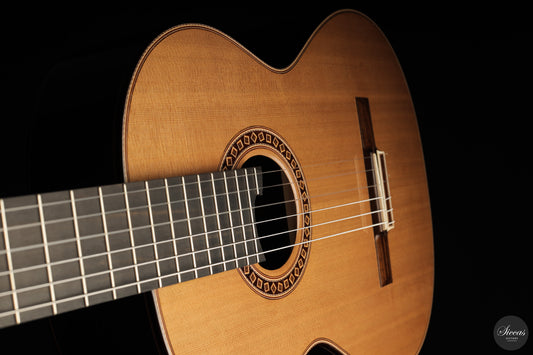
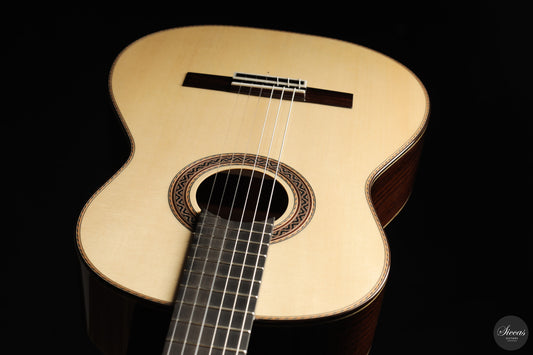
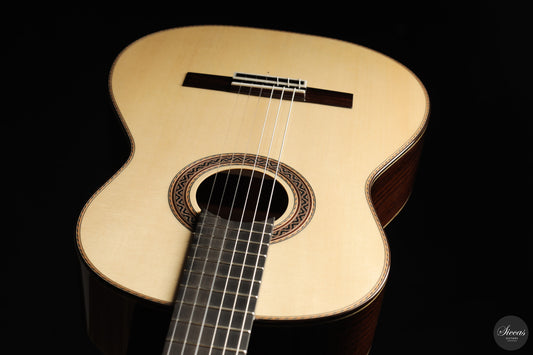
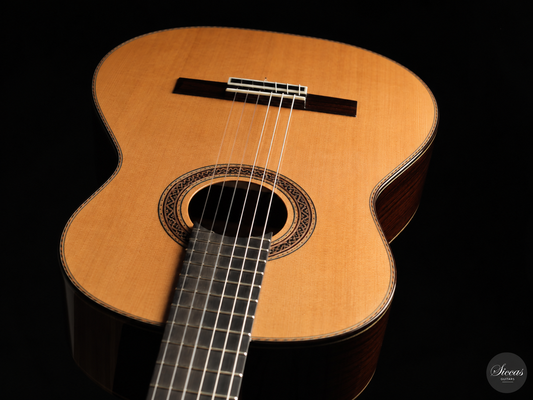
This 2015 Dennis Tolz is a double-top guitar with a cedar top and Indian rosewood back and sides. It does not present itself as a typically modern double-top in the narrow sense. It has the power and speed of response expected from this construction, yet in tonal character it often suggests something closer to a traditional guitar with expanded capability.
Its most notable quality is the balance between projection and color. The guitar responds immediately and produces strong volume, but it does so with nuance and a wide range of tonal shading. Compared to more recent Dennis Tolz guitars, this 2015 instrument has slightly brighter trebles and a somewhat longer sustain. That combination gives the instrument a distinctive voice. Notes carry with ease and remain open and clear without losing their connection to the broader body of sound.
The result is a guitar that brings together the structural advantages of double-top construction with a more traditionally oriented tonal imagination. It feels powerful and highly responsive, yet it does not push that immediacy toward hardness or a merely technical kind of efficiency. Instead, it offers a carrying, colorful, and musically flexible voice that combines strength with refinement.
Condition
The guitar is in very good condition and shows several marks of use consistent with careful but intensive playing. The shellac finish is somewhat worn in places but remains in good overall condition. There are no cracks and no repairs.

While this one is sold, these are ready for you
-
Classical Guitars
The classical guitar, with its soft nylon strings and characteristic timbre, has become a symbol of chamber music, Spanish tradition, and concert repertoire. Its modern form was shaped by Antonio de Torres in the 19th century, setting the standard for the body, fan bracing, and the 65-centimeter scale length that are still used today. Instruments in this category open up a rich palette from the refined Romantic miniatures of Tárrega to the majestic concertos of Rodrigo. Here you will find guitars that preserve historical continuity and at the same time inspire new interpretations.Look all products of the collection -

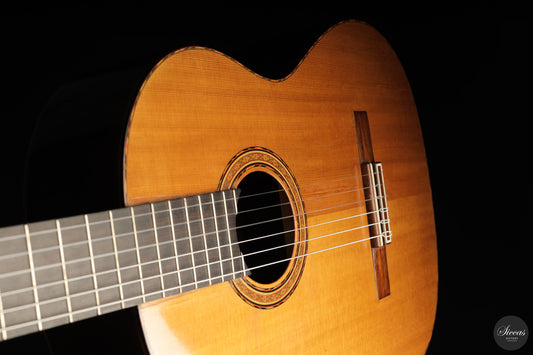 Reserved
César Vera - 1964
Price: 6.990 €Unit price per Tax free (0% DE)ReservedConstruction Type: Traditional -
Friederike Linscheid - 2026 Doubletop
Price on requestReservedLuthier: Friederike LinscheidConstruction Type: Double-Top Guitars -
Martin Bretscher - 2026 Flow-Cut Crossover
Price: 7.490 €Unit price per Tax free (0% DE)ReservedLuthier: Martin Bretscher -

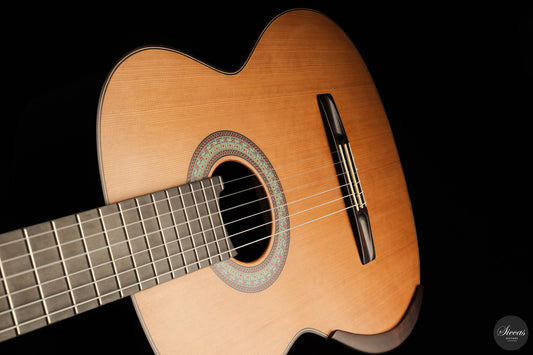 Reserved
Simon Marty - 2026 Classical Guitar
Price on requestReservedLuthier: Simon Marty -

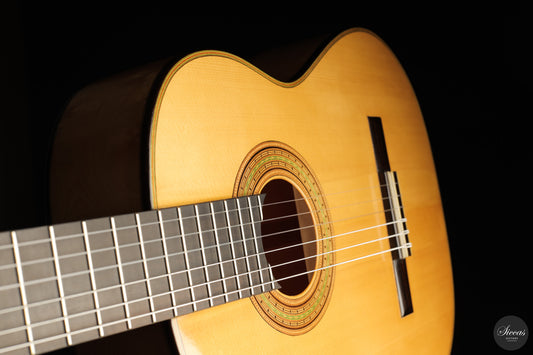 Reserved
Davide Scacchi - 2026
Price: 5.990 €Unit price per Tax free (0% DE)ReservedLuthier: Davide ScacchiConstruction Type: Traditional -
Siccas Luthiers - Halo Traditional Spruce 63 cm
Sale price 1.790 € Price:Unit price per Tax free (0% DE)1.990 €Save: 200 €Pre-OrderManufacturer: Siccas LuthiersManufacturer: Siccas LuthiersConstruction Type: TraditionalConstruction Type: Traditional -
Siccas Luthiers - Halo Traditional Spruce
Sale price 1.790 € Price:Unit price per Tax free (0% DE)1.990 €Save: 200 €Pre-OrderManufacturer: Siccas LuthiersManufacturer: Siccas LuthiersConstruction Type: TraditionalConstruction Type: Traditional -
Siccas Luthiers - Halo Traditional Cedar 63 cm
Sale price 1.790 € Price:Unit price per Tax free (0% DE)1.990 €Save: 200 €Pre-OrderManufacturer: Siccas LuthiersManufacturer: Siccas LuthiersConstruction Type: TraditionalConstruction Type: Traditional -

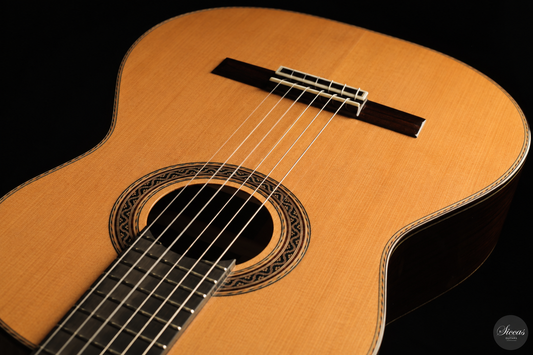 Pre-Order
Siccas Luthiers - Halo Traditional Cedar
Sale price 1.790 € Price:Unit price per Tax free (0% DE)1.990 €Save: 200 €Pre-OrderManufacturer: Siccas LuthiersManufacturer: Siccas LuthiersConstruction Type: TraditionalConstruction Type: Traditional -
Fernando Moreno - 2019 "Rastrojo"
Price: 3.490 €Unit price per Tax free (0% DE)Construction Type: Flamenco











Related guitars
Frequently Asked Questions About Classical Guitars
How do I choose the right classical guitar for my level?
Choosing the right classical guitar depends on your playing level, musical goals, and budget. Beginners benefit from studio-model guitars from renowned workshops, while advanced players and professionals often choose a handmade master guitar. We are happy to advise you personally and can send detailed sound samples and videos on request.
What is the difference between a master guitar and a studio guitar?
Master guitars are built entirely by hand in the workshop of a single luthier, using only high-quality, well-aged tonewoods. Studio guitars are made in small series, often under the supervision of the master luthier, and offer excellent value for students and ambitious amateur players.
Can I try a classical guitar at home for 14 days?
Yes — every guitar you purchase from us comes with a 14-day home approval period. This complimentary trial applies worldwide to all orders, whether you are in Germany, Europe, the USA, Asia or anywhere else. We ship your instrument fully insured in a high-quality case so you can play it under your own acoustic conditions. If the guitar is not the right one for you, simply send it back and receive a full refund of the purchase price.
Can I try a classical guitar before purchasing?
Absolutely. You are warmly invited to visit our showroom in Karlsruhe, Germany, and test the instruments at your leisure. We are happy to schedule a personal appointment. If a visit is not possible, we send detailed videos and sound samples, and offer extensive consultation by phone or video call.
What payment methods and financing options do you offer?
We accept bank transfer, PayPal, major credit cards, and Klarna. For high-value instruments, we offer individual installment plans on request. Please contact us directly — we will find a suitable solution for every budget.
How do I properly care for my classical guitar?
A classical guitar requires constant humidity between 45 and 55 percent. Store the instrument in its case with a humidifier, avoid direct sunlight and large temperature fluctuations. Change the strings regularly and clean the guitar with a soft microfiber cloth.