



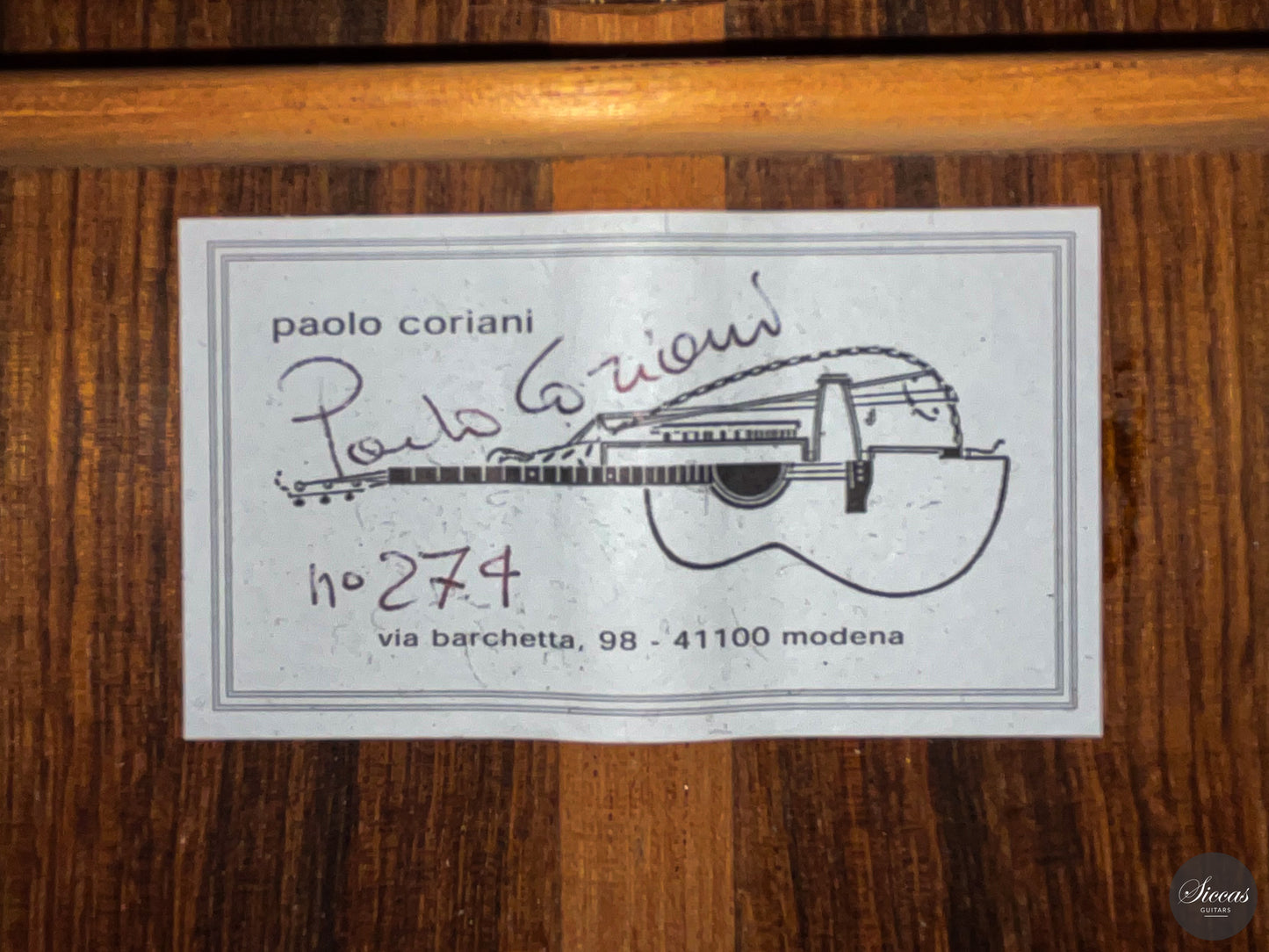
Paolo Coriani - 2025 No. 274


Details
Details
Overview
Overview
Shipping important note
Shipping important note
Important: Additional costs such as import taxes and custom duties may occur when importing goods from the EU into your country.
Delivery times are typically reliable and most instruments arrive within the estimated timeframe.
Should any unexpected delay occur, our team will keep you informed and provide support at every step. For all shipping details and exceptions, please see our Shipping Policy.
Details about GPSR
Details about GPSR
Ask us - right here.
Enrico, our AI team member, replies around the clock.
Instant reply · free · no obligation Rather use WhatsApp


Video overview


More details about the guitar
About the luthier
Paolo Coriani is an Italian master luthier based in Modena, with over four decades of experience in crafting high quality classical guitars. He opened his workshop in 1984 after nine years of apprenticeship at Liuteria Masetti, a family of guitar makers in Modena dating back to 1900. In the early years, he built guitars inspired by the popular models of José Ramírez III and Masaru Kohno. A turning point in his development came with the discovery of the work of Richard Schneider and Michael Kasha, which provided him with his first scientific insights into guitar acoustics and vibrational behaviour.
A major influence on his philosophy was encountering the guitars and writings of Daniel Friederich, who had developed a less empirical construction method by collecting data such as weight and wood flexibility during the building process. Another significant moment was hearing and studying an 1867 Torres guitar once owned by Christian Aubin, an instrument that also inspired Robert Bouchet and Friederich. This contact with historic Spanish instruments deepened Coriani’s appreciation for traditional lutherie.
In the early 1990s, Coriani expanded his acoustic knowledge further through the work of bow maker Giovanni Lucchi and his velocity tester for tonewood selection. In 1993, he participated in a guitar making course in Córdoba led by José Luis Romanillos, centred on Segovia’s 1912 Manuel Ramírez guitar. This experience cemented Coriani’s admiration for Ramírez’s legacy and inspired a long period of research into early twentieth century Spanish guitar makers, including Enrique García, Santos Hernández and Domingo Esteso.
Since then, Coriani has restored numerous historic guitars and studied their vibrational behaviour to inform his own work. Today, his instruments are inspired by the great masters, Ramírez, Torres, Hauser, García and Simplicio, but are not direct copies. Instead, they reflect the character and sound of the originals while being adapted to meet modern performance demands. Rather than simply chasing volume or power, Coriani aims to craft guitars with warm, clear and expressive voices that support the individuality of each player.
His guitars are built in a humidity controlled workshop to ensure long term stability. All woods are naturally seasoned, with soundboards aged for a minimum of 30 years and other components such as ebony, rosewood and mahogany up to 50 or 60 years. Each instrument is finished with coloured shellac using traditional French polishing methods and features individual rosettes, bindings and purflings for a distinctive visual identity.
About the guitar
This Paolo Coriani No. 274 from 2025 is a traditional classical guitar with a spruce top and Indian rosewood back and sides, finished entirely in French polish. Its voice is remarkably balanced, with a brilliant tonal surface shaped by a smooth envelope, allowing brightness to remain present without becoming sharp. The response is immediate and generous, producing satisfying colour with little effort while retaining the capacity to open into a more powerful and resonant voice when pushed.
The low air body frequency of F to F sharp supports a sense of depth and relaxed resonance, giving the guitar a darker foundation beneath its clarity and shine. The Ramírez inspired bracing lends the instrument a familiar Spanish warmth, long sustain and a supple relationship between touch and sound. With a 650 mm scale and a 50.5 mm nut width, the guitar offers traditional proportions, while its low weight contributes to an agile and responsive playing character.
Condition
The guitar is in excellent, almost mint condition. It shows only light wear marks consistent with the most careful use. There is no damage or repair, and the instrument remains in original condition.
Regular care extends the life of the instrument
Even with careful use, a classical guitar may gradually change in appearance or respond to unstable storage conditions. Have a close look at your guitar regularly and be attentif to changes. If your instrument is suffering from its environement, it will let you know.
Protect Your Guitar: Handle with Care
Be mindful when touching your instrument with greasy or unwashed hands: any skin contact is a small attack on the varnish. Of course, a guitar is made to be played, but taking a few precautions helps preserve its beauty: wash your hands before playing, wear long sleeves, and avoid unnecessary direct skin contact with the body of the instrument.
Pro tip: Avoid playing with a button-up shirt, heavy jewelry, or a belt, as these can scratch the guitar. Also, make sure your guitar case is free of any objects that could damage the instrument during storage.
String care
A good habit to adopt is wiping down your strings briefly after each playing session. This small action significantly extends their lifespan and helps maintain a consistent, comfortable feel under your fingers.
Most importantly, clean strings are essential for keeping your instrument in tune. Corrosion, sweat, and dust can affect the uniformity of the strings and interfere with accurate tuning across the entire fingerboard.
Pro tip: If you're having trouble getting your guitar in tune, it might be time to change the strings. A useful test is to compare the pitch of the 12th fret harmonic with the fretted note at the 12th fret; if there's an unusually large gap between them, your strings may have lost their integrity and should be replaced.
Keep Your Shellac Finish Shining!
Got a guitar with a shellac (French polish) finish? Here's a simple trick: Take a clean microfiber cloth and gently breathe on the surface to create a light mist. Then, softly rub to remove fingerprints, sweat, and grease. That’s usually all it takes to keep it looking great, no products needed!
Pro tip: Every few years, treat your guitar to a check-up with a luthier to keep it in top shape.
Storing Your Guitar: Climate Matters
Your guitar can safely stay outside its case, as long as the surrounding environment maintains 42–55% humidity and a temperature between 18–25°C.
Keep in mind that humidity levels can still fluctuate inside the case, especially during seasonal changes.
- Too much humidity may cause overtightened strings and a dull tone.
- Too little humidity can lead to a bulging top, string buzz, or even cracks.
Avoid placing your guitar near radiators, air conditioners, or windows with direct sunlight.
Pro tip: Always close your guitar case while playing. This helps preserve a stable microclimate inside the case, so your instrument is protected the moment you put it back in.
Related guitars
Frequently Asked Questions About Classical Guitars
How do I choose the right classical guitar for my level?
Choosing the right classical guitar depends on your playing level, musical goals, and budget. Beginners benefit from studio-model guitars from renowned workshops, while advanced players and professionals often choose a handmade master guitar. We are happy to advise you personally and can send detailed sound samples and videos on request.
What is the difference between a master guitar and a studio guitar?
Master guitars are built entirely by hand in the workshop of a single luthier, using only high-quality, well-aged tonewoods. Studio guitars are made in small series, often under the supervision of the master luthier, and offer excellent value for students and ambitious amateur players.
Can I try a classical guitar at home for 14 days?
Yes — every guitar you purchase from us comes with a 14-day home approval period. This complimentary trial applies worldwide to all orders, whether you are in Germany, Europe, the USA, Asia or anywhere else. We ship your instrument fully insured in a high-quality case so you can play it under your own acoustic conditions. If the guitar is not the right one for you, simply send it back and receive a full refund of the purchase price.
Can I try a classical guitar before purchasing?
Absolutely. You are warmly invited to visit our showroom in Karlsruhe, Germany, and test the instruments at your leisure. We are happy to schedule a personal appointment. If a visit is not possible, we send detailed videos and sound samples, and offer extensive consultation by phone or video call.
What payment methods and financing options do you offer?
We accept bank transfer, PayPal, major credit cards, and Klarna. For high-value instruments, we offer individual installment plans on request. Please contact us directly — we will find a suitable solution for every budget.
How do I properly care for my classical guitar?
A classical guitar requires constant humidity between 45 and 55 percent. Store the instrument in its case with a humidifier, avoid direct sunlight and large temperature fluctuations. Change the strings regularly and clean the guitar with a soft microfiber cloth.