




This guitar is sold – but we may have something similar.
Our experts know every guitar in the house and are happy to advise you personally.
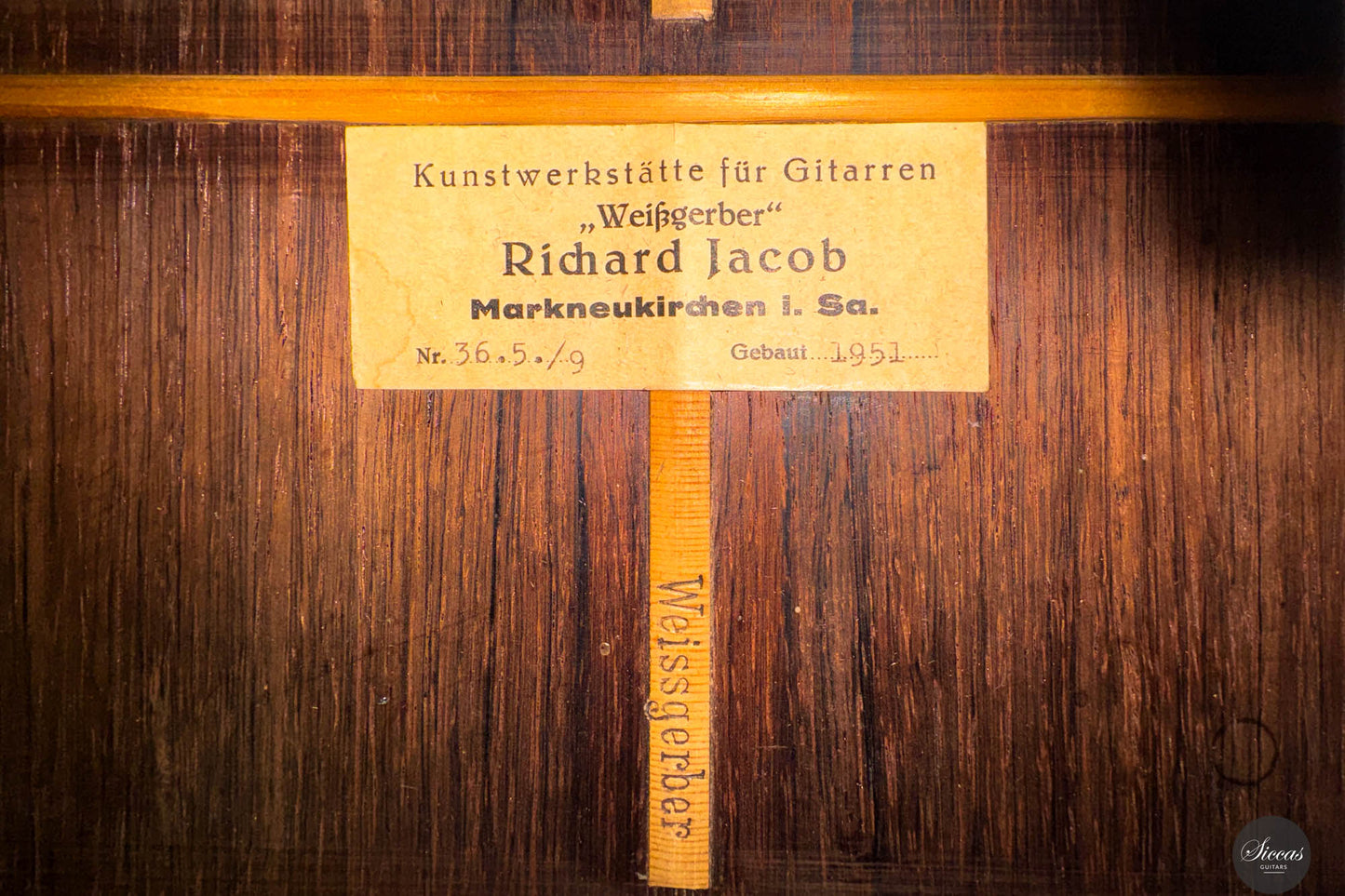
Ask about similar guitarsRichard Jacob Weissgerber - 1951 Torres 36.5./9
Details
Details
Overview
Overview


Video overview


More details about the guitar
About the luthier
Richard Jacob Weissgerber, born in Markneukirchen in 1877 and active until his death in 1960, is widely regarded as one of the most creative, innovative and versatile classical guitar makers of the 20th century. In Germany and beyond, no other master produced a comparable variety of models, forms and designs. His legacy spans an astonishing range of instruments and concepts, marked by exceptional craftsmanship, aesthetic curiosity and acoustic refinement.
Throughout more than five decades of work, Weissgerber explored the Spanish tradition while developing his own voice. His workshop, founded in 1905, became a nexus of experimentation, and many of his guitars are preserved today in European collections. He combined structural daring with expressive purpose — using fluted tops, unusual body shapes and advanced bracing concepts — all aimed at serving the tone, balance and projection demanded by serious players.
About the guitar
This 1951 guitar by Richard Jacob Weissgerber, bearing the registration number 036.5/9 and identified as Model Ideal 54 Solist‑G, represents a rare and expressive example of his late concert instruments. Built in Spanish format with a 650 mm scale and weighing only 1,315 grams, it achieves remarkable lightness and resonance. The back and sides are made of finely figured Brazilian rosewood, paired with a spruce top that features Weissgerber’s distinctive light fluting — a signature detail found only on his special models.
Tonally, the guitar offers a deep, rounded voice with warmth and richness in the basses, and clear, singing trebles that carry easily across a room. The enlarged resonating body and carefully tuned construction allow for both delicacy and presence. The instrument speaks with immediacy and subtlety, responding to the lightest touch while also supporting dynamic phrasing with ease. Its balance, especially across registers, is striking, and the tone remains full and vocal even in pianissimo passages.
The neck is crafted from Sapelli mahogany, fitted with a refined ebony fingerboard and strongly seated frets. The headstock is double veneered and carved on the reverse, reflecting Weissgerber’s sculptural sense of proportion. Elegant French polish enhances the natural depth of the materials. The original Rubner tuners, made in nickel silver with French-style rollers, remain intact and function smoothly.
This guitar also holds historical significance. It is believed to be the first known Weissgerber model with an oval soundhole and is considered a prototype for the later large concert guitars. No other instrument of this exact model is currently known to exist.
Condition
This 1951 Weissgerber guitar is in very good condition for its age showing minimal playing wear. The spruce top shows several professionally repaired cracks: two alongside the fingerboard, each reinforced with cleats; one along the center joint; one beside the bridge, also cleated; and one behind the bridge. All repairs are structurally stable. The finish and setup are well preserved, and the instrument performs with full resonance and clarity.

While this one is sold, these are ready for you
-
Classical Guitars
The classical guitar, with its soft nylon strings and characteristic timbre, has become a symbol of chamber music, Spanish tradition, and concert repertoire. Its modern form was shaped by Antonio de Torres in the 19th century, setting the standard for the body, fan bracing, and the 65-centimeter scale length that are still used today. Instruments in this category open up a rich palette from the refined Romantic miniatures of Tárrega to the majestic concertos of Rodrigo. Here you will find guitars that preserve historical continuity and at the same time inspire new interpretations.Look all products of the collection -
Lorenzo Frignani - 2026 Classical Guitar No. 275
Price: 13.990 €Unit price per Tax free (0% DE)Luthier: Lorenzo Frignani -
Dragan Neshic - 2026 Especial No. 3
Price: 7.490 €Unit price per Tax free (0% DE)Construction Type: Double-Top Guitars -
Oren Myers - 2026 No. 149
Price: 8.990 €Unit price per Tax free (0% DE)Luthier: Oren MyersConstruction Type: Traditional -
Francisco Gil Romero - 2026
Price: 4.990 €Unit price per Tax free (0% DE)Luthier: Francisco Gil RomeroConstruction Type: Traditional -
Hans and Alexander Herb - 2003 Concert
Price: 3.990 €Unit price per Tax free (0% DE)Luthier: Hans-Hermann Herb -
Giorgio Amorella - 2026 "La Gentile"
Price: 4.490 €Unit price per Tax free (0% DE)Construction Type: Traditional -
Kevin Aram - 2026 Torres "Dua"
Price: 8.990 €Unit price per Tax free (0% DE)Luthier: Kevin AramConstruction Type: Traditional -
Vicente Carrillo - 2026 Gabriela II - Spruce 63 cm
Sale price 5.590 € Price:Unit price per Tax free (0% DE)5.890 €Save: 300 €ReservedLuthier: Vicente CarrilloConstruction Type: Double-Top Guitars -
Vicente Carrillo - 2026 Gabriela II - Cedar 64 cm
Sale price 5.590 € Price:Unit price per Tax free (0% DE)5.890 €Save: 300 €ReservedLuthier: Vicente CarrilloConstruction Type: Double-Top Guitars -
Gary Southwell - 2008 A-Series No. 242
Price: 8.490 €Unit price per Tax free (0% DE)Luthier: Gary Southwell




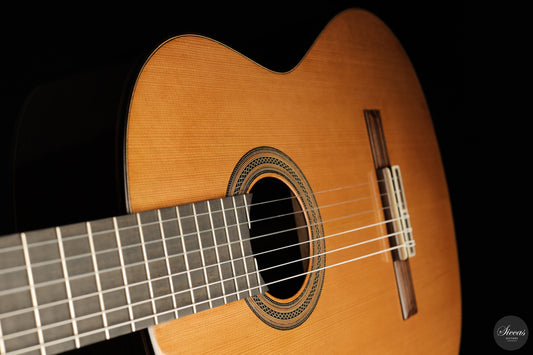


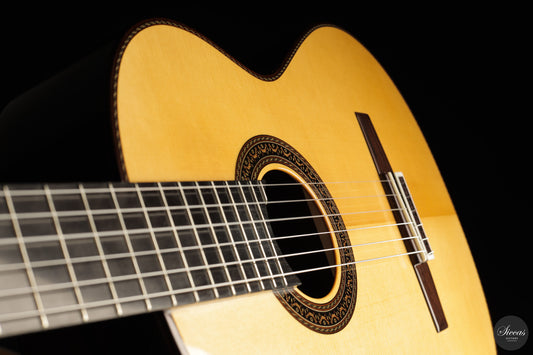

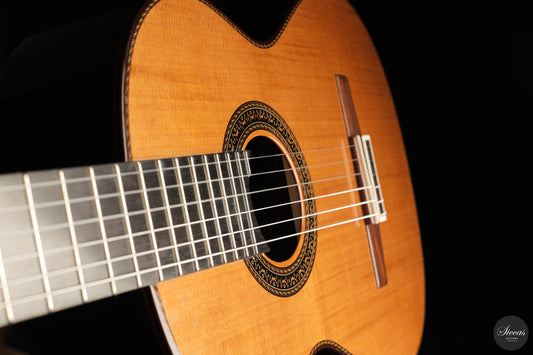

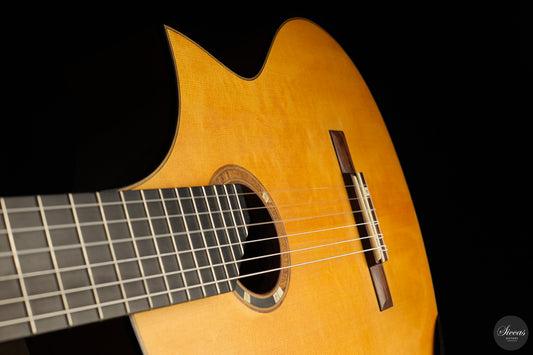


Related guitars
Frequently Asked Questions About Classical Guitars
How do I choose the right classical guitar for my level?
Choosing the right classical guitar depends on your playing level, musical goals, and budget. Beginners benefit from studio-model guitars from renowned workshops, while advanced players and professionals often choose a handmade master guitar. We are happy to advise you personally and can send detailed sound samples and videos on request.
What is the difference between a master guitar and a studio guitar?
Master guitars are built entirely by hand in the workshop of a single luthier, using only high-quality, well-aged tonewoods. Studio guitars are made in small series, often under the supervision of the master luthier, and offer excellent value for students and ambitious amateur players.
Can I try a classical guitar at home for 14 days?
Yes — every guitar you purchase from us comes with a 14-day home approval period. This complimentary trial applies worldwide to all orders, whether you are in Germany, Europe, the USA, Asia or anywhere else. We ship your instrument fully insured in a high-quality case so you can play it under your own acoustic conditions. If the guitar is not the right one for you, simply send it back and receive a full refund of the purchase price.
Can I try a classical guitar before purchasing?
Absolutely. You are warmly invited to visit our showroom in Karlsruhe, Germany, and test the instruments at your leisure. We are happy to schedule a personal appointment. If a visit is not possible, we send detailed videos and sound samples, and offer extensive consultation by phone or video call.
What payment methods and financing options do you offer?
We accept bank transfer, PayPal, major credit cards, and Klarna. For high-value instruments, we offer individual installment plans on request. Please contact us directly — we will find a suitable solution for every budget.
How do I properly care for my classical guitar?
A classical guitar requires constant humidity between 45 and 55 percent. Store the instrument in its case with a humidifier, avoid direct sunlight and large temperature fluctuations. Change the strings regularly and clean the guitar with a soft microfiber cloth.