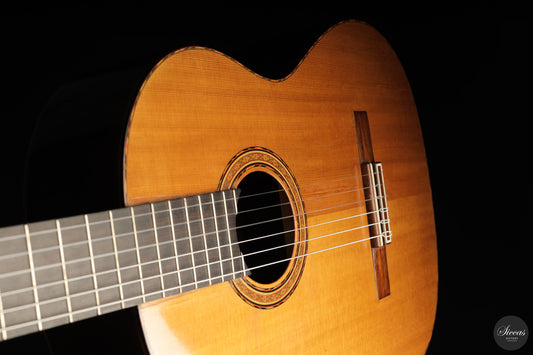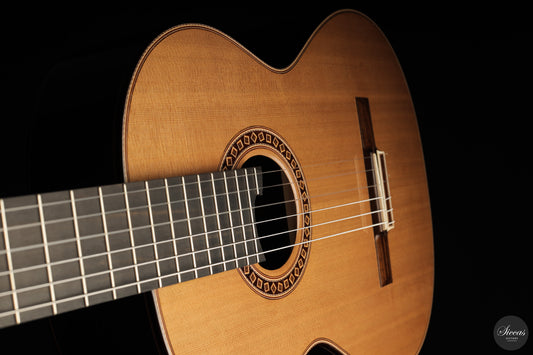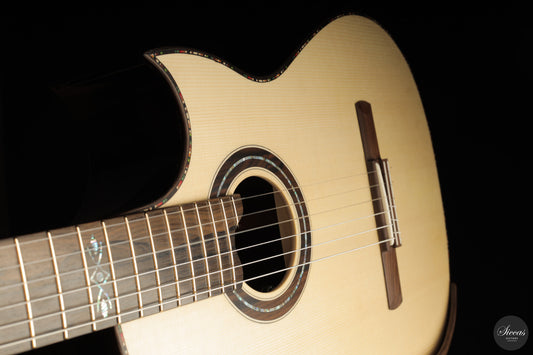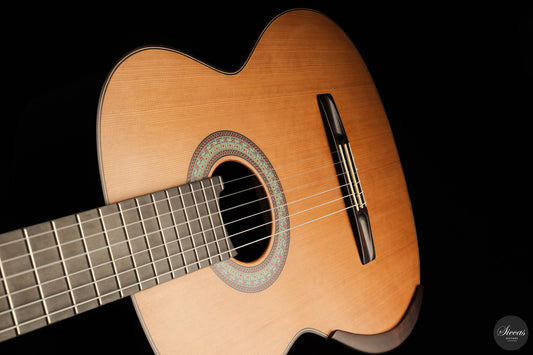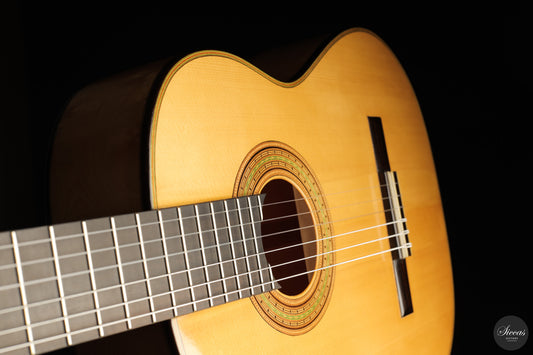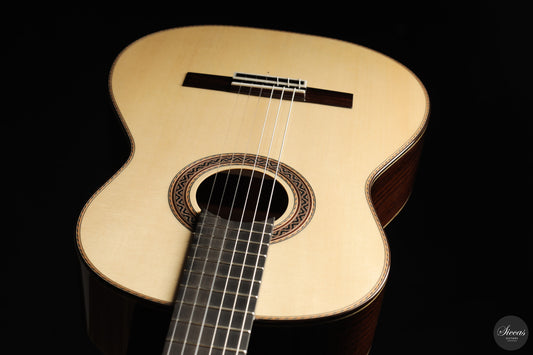

Among the most admired classical guitar makers working in Germany today, Andreas and Solveig Kirschner have built a reputation that extends well beyond their workshop in Niedenstein. Their instruments — particularly their celebrated double-top guitars — are sought after by concert performers worldwide, and the waiting list for a Kirschner guitar is said to stretch to four years or more. What sets this husband-and-wife workshop apart is not simply technical mastery, but a rare unity of purpose: every decision from wood selection to final varnishing is guided by a single, unwavering commitment to the sound of the instrument.
Biography & Training
Andreas Kirschner grew up immersed in the craft traditions of German lutherie and trained in the classical guitar-making tradition before establishing his own workshop. The earliest documented instruments from the Kirschner workshop date to around 2011, though Andreas had been developing his approach for years prior. He is recorded as having worked previously from Landsberg before the workshop eventually settled in Niedenstein, a small town in the Hessian highlands of central Germany. Solveig Kirschner works alongside Andreas as a full partner in the enterprise, and the guitars are consistently attributed to both makers — a reflection of the genuinely collaborative nature of their craft.
The Kirschners situate themselves consciously within the broader European classical guitar tradition. Their work draws on the technical legacy of the great classical guitar makers while embracing the acoustic research and material innovations that have reshaped the instrument over recent decades. This synthesis of heritage and inquiry is central to understanding what makes a Kirschner guitar distinctive.
Construction Philosophy
The defining characteristic of a Kirschner guitar is the double-top soundboard. This construction — pioneered and refined by a generation of experimental European luthiers — uses two ultra-thin layers of tonewood with a Nomex honeycomb core sandwiched between them. The resulting soundboard is lighter than a conventional solid top, yet structurally strong, allowing it to respond to the player's touch with exceptional immediacy and sensitivity. The full development of this approach, and how it compares with other bracing systems, is explored in depth in the guide to fan-braced, double-top, and lattice guitars.
What distinguishes the Kirschners within the double-top tradition is their preferred choice of spruce rather than cedar for the outer layers. Many makers who work with double-top construction favour cedar, which naturally produces a warm, dark resonance. Andreas Kirschner has spoken of spruce as the answer for players who find some double-tops overly dark or lacking in tonal complexity. Spruce brings a brightness and clarity to the sound — a wide range of tone colour and, crucially, a string separation that allows each voice in polyphonic music to speak with its own identity. The result is an instrument that combines the projection and dynamic responsiveness associated with double-top construction with the transparency and articulation more often associated with traditional Spanish guitar-making.
For the back and sides of his instruments, Kirschner has worked with well-matured Indian rosewood, a wood prized for its contribution to tonal warmth, sustain, and focused midrange projection. Necks are typically cedar, fingerboards ebony, and the finish is French-polished shellac — a choice that keeps the wood alive and breathing while giving the instrument an elegance consistent with the finest concert guitars. Seasoning of materials is taken seriously: the spruce used for the soundboard of the documented 2017 model had been seasoned for fifteen or more years before being worked. This patient approach to material preparation is a hallmark of luthiers who build for the long term.
The close relationship between the Kirschners and the professional guitarists who play their instruments is another pillar of their workshop philosophy. Rather than building speculatively, they work in dialogue with performers, refining their instruments in response to the real demands of the concert stage. This ongoing exchange between maker and player — between the workshop and the recital hall — is something the Kirschners consider essential to the evolution of their craft. It places them in a tradition that runs from the great Daniel Friederich in Paris, who famously worked alongside the leading guitarists of his era, to the collaborative ethos found among the best contemporary European makers.
Signature Models
The Kirschner catalogue is built around two principal directions. The first is the double-top concert guitar — their signature instrument, available in standard scale lengths of 63 to 65 cm and built with the spruce/Nomex/spruce soundboard for which they are best known. These instruments are consistently described by those who have played them as offering extraordinary loudness for their weight, combined with a refined, nuanced tone. The second direction is the traditional solid-top guitar, built along more conventional structural lines but reflecting the same philosophy of sound optimisation and material quality. Both models are entirely handcrafted in Niedenstein, produced in small numbers — a deliberate choice that protects the quality of attention each instrument receives.