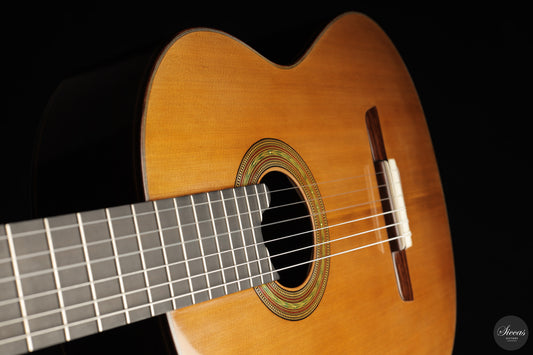
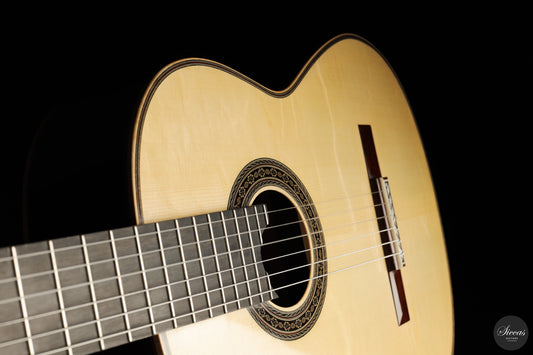
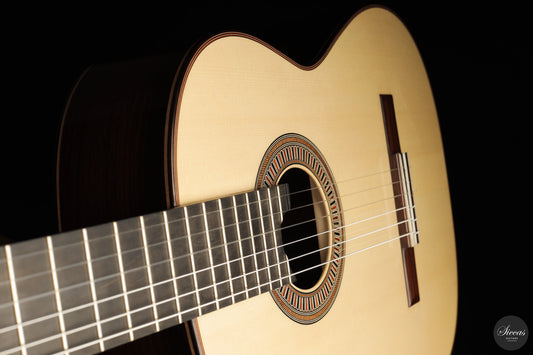
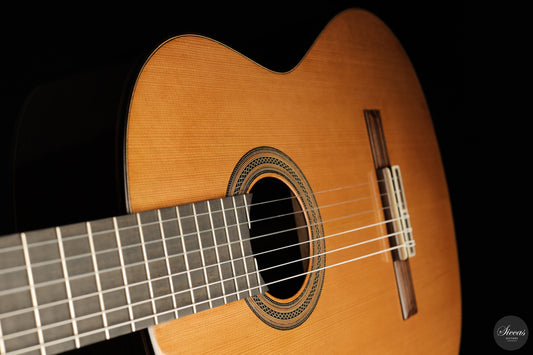
If you've started comparing higher-end classical guitars, you'll keep meeting three terms: fan bracing, double-top and lattice bracing. They describe how the soundboard is built — and that, more than almost anything else, shapes how a guitar sounds and feels. Here's a clear, honest comparison from a dealer who plays and sells all three.
Fan bracing — the traditional standard
Fan bracing is the classic system, refined by Antonio de Torres in the 19th century and still the reference for most Spanish and traditional guitars. Thin wooden struts fan out beneath the lower half of the top.
Its appeal is tonal color and nuance: a warm, complex, vocal sound with enormous range of expression in the right hands. The trade-off is that a traditional top often needs more from the player to project in a large hall — it rewards refined technique rather than handing you volume for free. For many players, that depth and character is exactly the point. Explore our traditional fan-braced guitars.
Lattice bracing — power and projection
Lattice bracing, developed by the Australian luthier Greg Smallman (famously played by John Williams), replaces the fan with a fine criss-cross grid, often reinforced with carbon fibre. This lets the top be thinner and lighter, so it moves more air.
The result is typically more volume, strong projection, long sustain and an even response across the strings — a guitar that fills a hall with less effort. Some players feel the most extreme lattice instruments trade a little of the traditional "color" for that power; many modern players consider it a fair exchange. See our lattice-braced guitars.
Double-top — efficiency and sustain
A double-top (or "sandwich top") is a different idea altogether: two very thin wooden skins bonded around a lightweight honeycomb core (usually Nomex). Pioneered by luthiers such as Matthias Dammann and Gernot Wagner, it makes the top extremely light and responsive.
Double-tops are known for high volume, long sustain and a quick, effortless response — notes bloom with very little input. Like lattice, they project powerfully; the ongoing debate among players is whether the very even, powerful sound has the same character as a great traditional top. The best examples are remarkable instruments. Browse our double-top guitars.
Which one is right for you?
- You value traditional color, nuance and a vocal tone → fan-braced.
- You play larger venues or want maximum volume and projection → lattice or double-top.
- You want power with an effortless, sustaining response → double-top.
There's no objectively "best" construction — only the one that matches your repertoire, your venues and your ear. And builders matter as much as concepts: a great fan-braced guitar can out-project a mediocre lattice, and vice versa. The only real test is to hear them side by side.
Hear the difference
This is where recordings help more than words. Because tonal character is so personal, listening to the same kind of music on each construction — ideally in a consistent setting — tells you more than any description. We document instruments across all three concepts so you can compare with your own ears before you ever pick one up.
Frequently asked questions
Are double-top and lattice guitars louder than traditional ones?
Generally yes — both designs are built for greater volume and projection. Traditional fan-braced guitars are often prized instead for tonal color and nuance.
What is lattice bracing?
A criss-cross grid of struts (often with carbon fibre) under the top, developed by Greg Smallman. It allows a lighter top, giving more volume and sustain.
What is a double-top guitar?
A soundboard made of two thin wooden layers around a light honeycomb core (Nomex), pioneered by Matthias Dammann and others. Very efficient, with strong projection and sustain.
Which is best for a soloist in concert?
Many concert players choose lattice or double-top for projection; others prefer a traditional top for its color. It depends on the hall, the repertoire and personal taste.
New to choosing an instrument? Read our beginner's buyer's guide, or browse all our classical guitars →