
David Rubio – The Englishman Who Transformed Classical Guitar Making
David Rubio (1934–2000) is one of the most remarkable figures in the history of the classical guitar — a self-taught luthier who, through sheer observation, memory, and obsessive craft, built instruments that reached the hands of the world's greatest players within just a few years of picking up his tools. Born David Joseph Spink in London, he adopted the name "Rubio" — a reference to his distinctive red beard — during his years as a flamenco guitarist in Spain, and under that name he became a legend. His guitars, lutes, harpsichords, and, later in life, bowed instruments defined the breadth of a career that spanned four decades and produced over a thousand instruments coveted by performers and collectors alike.
From London to Flamenco: An Unlikely Beginning
Rubio's path to lutherie was anything but conventional. After studying medicine at Trinity College, Dublin, he discovered late in the course that colour-blindness would prevent him from pursuing his intended career in surgery. He turned instead to his other consuming passion: music. Moving to Spain, he scraped a living as a flamenco guitarist, accompanying singers and dancers, and was eventually recruited by a touring flamenco company. That journey brought him, in time, to New York, where he settled for several years and played flamenco in hotels and cafés. It was in those years that the idea of building guitars first took root. As he later put it: "In Spain I had sat shooting the breeze in the back of the guitar-makers' shops, and watching them at work. I have a photographic memory, and I decided one day that I wanted to make guitars." He bought wood and, relying entirely on his visual memory of what he had seen in Spanish workshops, built his first instrument. The result was startling in its quality.
During his time in New York he also studied with luthier Miguel Company, refining the skills he had initially taught himself. His early guitars drew on the traditions he had absorbed in Spain — the warmth, the responsiveness, the tonal colour of the great Iberian makers — but the sound he achieved was distinctly his own: less aggressive than Spanish instruments of the era, yet sweeter and more nuanced than the German school. That particular voice attracted attention almost immediately.
Julian Bream and the English School of Lutherie
When Rubio returned to England in the mid-1960s, his path crossed decisively with that of Julian Bream, the pre-eminent British guitarist and lutenist of his generation. Bream became both a champion and a collaborator, and Rubio initially settled at Bream's country estate in Dorset before establishing his own workshop in Duns Tew, near Oxford. With Bream's encouragement, Rubio deepened his study of historical models, drawing inspiration from Robert Bouchet and from earlier Spanish masters including Santos and Simplicio. Bream played Rubio guitars in concert and on recordings from the mid-1960s onwards. A 1965 Rubio was the instrument on which Bream recorded Benjamin Britten's "Nocturnal" for the landmark album Twentieth Century Guitar — one of the defining recordings in the instrument's history.
The impact of this partnership was far-reaching. Rubio's success in producing world-class concert instruments outside the traditional centres of guitar making — Madrid, Granada, Paris — helped establish what came to be known as the English school of lutherie. He proved that rigorous craft, a deep ear, and imaginative dialogue with historical models could yield instruments fit for the highest international stages, regardless of geography. Among the classical guitar makers of the twentieth century, very few made that leap as swiftly or as convincingly as Rubio did.
Workshop, Materials, and Construction Philosophy
Rubio's construction approach was rooted in a deep respect for acoustic tradition combined with an openness to experimentation. His guitars from the 1960s and 1970s typically featured spruce or cedar soundboards and rosewood or cedar back and sides, crafted with the meticulous attention to graduation and bracing that his years of observing Spanish makers had ingrained in him. He favoured the fan-braced tradition inherited from Torres and his successors, but applied it with the sensitivity of someone who had absorbed the instrument as a player before ever touching a plane or chisel.
As his workshop in Duns Tew grew, Rubio expanded well beyond the guitar. He took in a team of harpsichord makers who had left the workshop of the pioneer maker Goble, and rapidly mastered that craft too. His harpsichords earned considerable acclaim in the early music world. Then, following a move to Cambridge in 1979, he began building baroque and eventually modern setup violins, violas, and cellos — a third domain in which he achieved distinction. In a career of extraordinary range, he produced guitars, lutes, theorbos, vihuelas, citterns, panduras, harpsichords, and bowed instruments: a breadth matched by very few makers in history. Like Ignacio Fleta before him, Rubio brought a multi-instrument perspective to the guitar that informed the depth and resonance of everything he made.
The Brahms Guitar: A Final Innovation
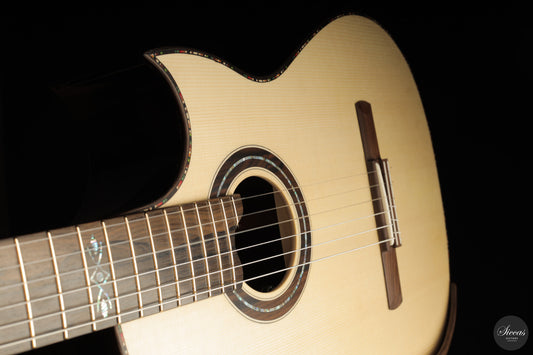
In the final decade of his life, Rubio undertook one of his most audacious projects: the design and construction of the instrument now known as the Brahms guitar. The commission came from Scottish guitarist Paul Galbraith, who sought an instrument with an extended range — two additional strings beyond the standard six, adding a low B a fourth below the standard bass E, and a high A a fourth above the standard treble E. Rubio's solution was characteristically inventive. Drawing on the Renaissance model of the orpharion — a lute-family instrument with a staggered, fan-shaped string arrangement — he created a guitar with a slanting bridge and nut, fanning the frets across the full length of the fingerboard to accommodate the different string lengths. The first Brahms guitar was completed in 1993, and Rubio himself gave it its name after hearing Galbraith play his arrangement of Brahms's Variations, Op. 21a on the new instrument. Galbraith adopted a cello-like playing position, with the guitar held vertically on an endpin, and the instrument — amplified further by an external resonance box — became the vehicle for some of the most distinctive classical guitar recordings of the 1990s. This innovation, conceived in the final years of Rubio's working life, demonstrates the restless, inventive spirit that defined him throughout his career. It also inspired a generation of luthiers who continue to build the design today, among them Rubio's own protégé Martin Woodhouse.
Legacy and Influence
David Rubio died on 21 October 2000 at the age of sixty-five, leaving behind an instrument-making tradition that continued at his Cambridge workshop under his family and associates. His guitars remain among the most sought-after vintage instruments in the classical world, prized for their tonal complexity, their responsiveness under the player's touch, and the craftsmanship that underpins every detail. His legacy is also conceptual: he showed that a luthier shaped by experience rather than formal apprenticeship — one who listened deeply, studied widely, and refused to be confined by a single tradition — could stand alongside the great names of European guitar making. His influence is felt in the work of British makers who followed him, and in the broader recognition that the classical guitar is a living instrument whose makers need not be bound by geography or convention. Alongside figures such as José Luis Romanillos and Daniel Friederich, Rubio belongs to the generation that redefined what was possible for the concert classical guitar in the second half of the twentieth century.
Browse available David Rubio guitars → in the Siccas Guitars collection.