
Dietmar Heubner – Berlin Luthier Bridging Tradition and Modern Sound
Dietmar Heubner is one of Germany's most quietly compelling contemporary luthiers — a craftsman who began his journey with wood long before he ever bent a guitar rib, and who has spent decades refining an instrument-building philosophy that is as thoughtful as it is demanding. Based in Berlin, Heubner builds classical guitars by hand using traditional methods while pursuing a distinctly modern sonic vision: wide dynamic range, exceptional projection, and the tonal richness that lets a serious player develop a sound entirely their own. In an era when many makers reach for technological shortcuts, Heubner's commitment to the hand plane and the scraper blade sets him apart among the classical guitar makers working today.
From Cabinet Maker to Guitar Builder
Heubner's path to the guitar workshop was not a straight one. He came of age as a craftsman in Stuttgart during the 1980s, where he trained as a cabinet maker — a foundation that gave him an intimate, tactile understanding of wood that formal lutherie schools rarely replicate. It was in Stuttgart that he first began constructing classical guitars, and although the pull toward instrument making was clear from the start, his early years in cabinetry proved formative. The discipline of working with raw timber, reading its grain, accounting for movement and resonance — all of this became embedded in his approach to the guitar long before he had a lutherie workshop of his own.
For nearly three decades, Heubner ran his workshop in southern Germany, steadily building a reputation among discerning players who valued instruments with genuine character. Then, in the summer of 2018, he made a decisive move: he relocated his workshop to Berlin, setting up at Hauptstrasse 155 in the Rosenthal district. The move brought him into contact with a small, close-knit group of Berlin-based luthiers who share knowledge, experience, and a collective dedication to the craft. This community — known informally as the Berlin Luthiers — has provided Heubner with an environment of collegial exchange that has sharpened his work still further. The spirit of that collaborative circle recalls the workshop culture that shaped earlier generations of European luthiers, from Robert Bouchet in Paris to the Spanish masters whose influence continues to resonate across the instrument.
Construction Philosophy: The Hand Before the Machine
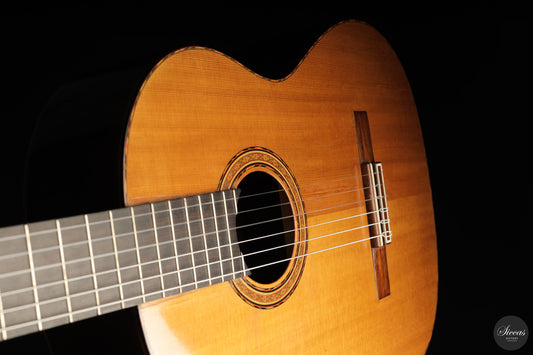
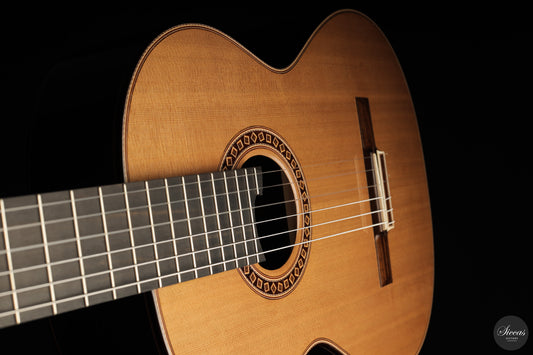
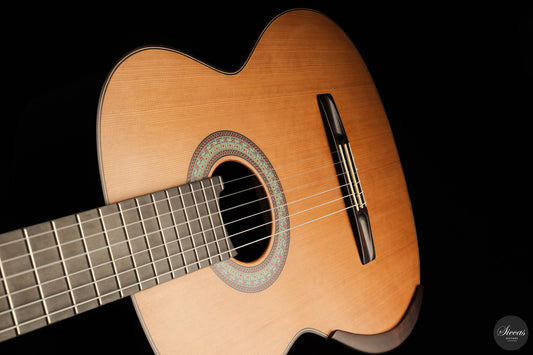
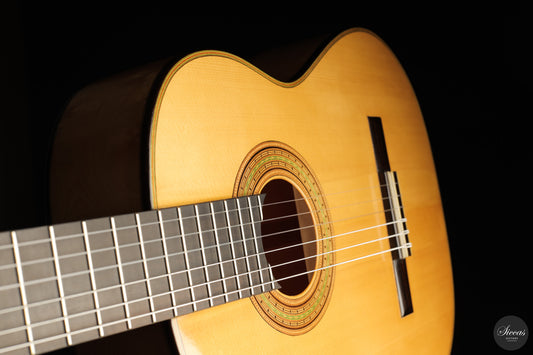
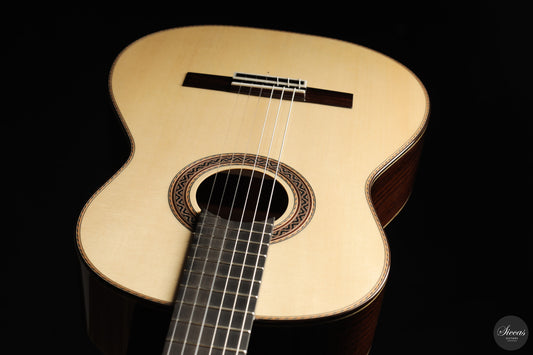
What distinguishes Heubner's instruments above all else is the primacy he gives to direct, physical engagement with the wood. He has made a deliberate choice to work without machines wherever possible, relying instead on hand planes and scraper blades to shape soundboards, backs, and sides. This is not mere aesthetic preference. By working the wood by hand, Heubner is able to respond in real time to its individual characteristics — adjusting thickness across the top with a sensitivity that no automated process can replicate, and coaxing from each piece of timber exactly the acoustic potential it holds.
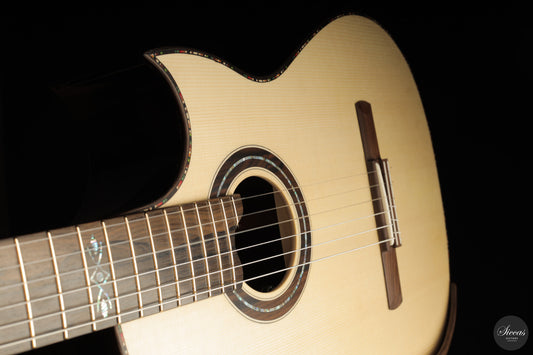
His soundboards are typically built with five fan braces and an additional diagonal bar — a traditional Spanish-influenced layout that he has refined through years of experimentation. The choice of tonewood varies, but Heubner has worked extensively with Austrian Alpine spruce for his tops, prizing its stiffness-to-weight ratio and the clarity it lends to the upper registers. He also builds cedar-top instruments for players who prefer a warmer, more immediately responsive feel. For the back and sides, African rosewood has featured prominently across many of his builds, lending the instruments a broad tonal palette and a richness of sustain that complements his bracing philosophy. The discussion of how bracing choices shape the final voice of the instrument connects naturally to the broader landscape explored in fan-braced, double-top and lattice classical guitars, where construction method and tonal outcome are inseparable.
Heubner's stated goal is to build an instrument that bridges tradition and modernity — one that preserves the tonal qualities associated with the great historical guitars while offering a contemporary sound aesthetic suited to the demands of today's concert stage. His instruments are praised for their sustain, their volume, and above all their range of timbres, which give the player genuine freedom to shape a personal voice rather than being constrained by the guitar's own character.