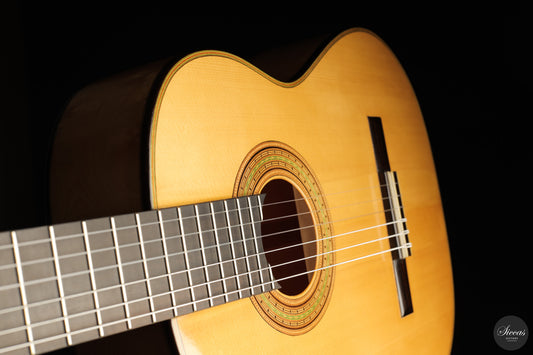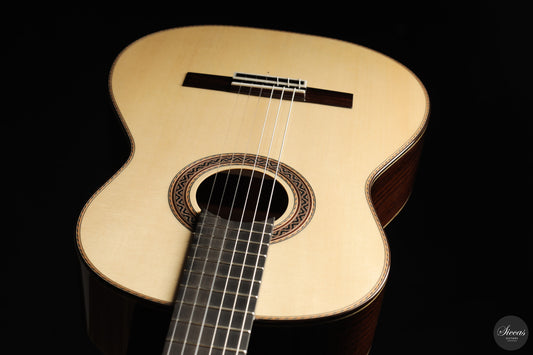

Fritz Ober – A German Master of the Torres-Hauser Tradition
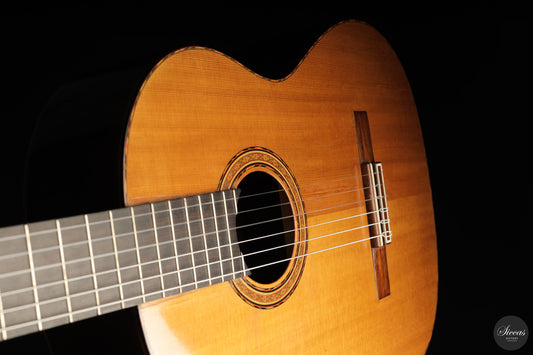
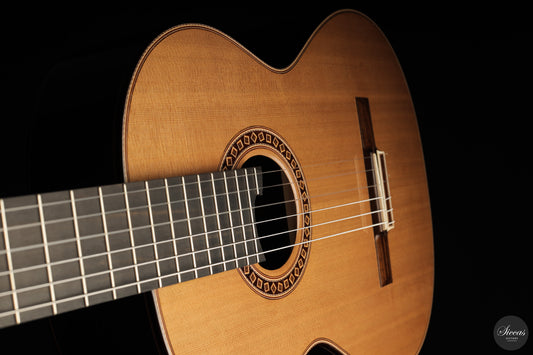
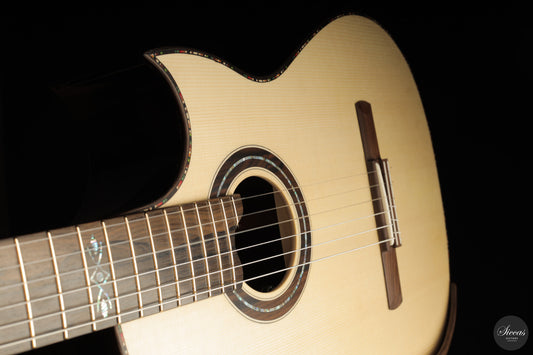
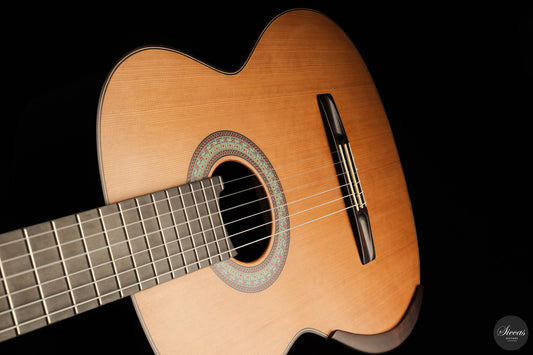
Fritz Ober (1955–2020) stands among the finest classical guitar makers Germany has produced in the modern era. Working from his Munich workshop across more than four decades, he pursued a singular vision: to unite the resonant depth of Antonio de Torres with the harmonic clarity of Hermann Hauser I, creating instruments of exceptional tonal range, responsiveness, and beauty. His passing in September 2020 left a profound loss in the world of classical guitar making, yet his legacy endures in the instruments he left behind and in the work now carried on by his son.
Early Life and Path to Lutherie
Fritz Ober was born in Rosenheim, Bavaria, in 1955 and spent his formative years in the small village of Übersee am Chiemsee. From an early age he was drawn to two things that would define his life: playing the guitar and working with wood. He built his first instruments largely on his own initiative, relying on books to teach himself the craft — a self-directed approach that gave him a thorough grounding in the underlying principles of guitar construction before he ever entered a formal workshop.
As his skills developed and his commitment to lutherie deepened, Ober sought professional training. He completed a two-year apprenticeship under Helmut Buchsteiner, at the time one of the very few trained luthiers in Upper Bavaria. This apprenticeship shaped Ober's rigorous, historically informed approach to the craft, and upon its completion he established his own workshop in Munich. There, he quickly attracted attention for his ability to build pre-Torres instruments — Panormo-style guitars and renaissance lutes — demonstrating a command of historical construction techniques that set him apart from the outset.
Craft, Philosophy, and the Torres-Hauser Vision
Fritz Ober's approach to guitar making was defined by an almost monastic commitment to traditional methods. He worked entirely without machines or sandpaper, relying on hand tools and natural hide glues and resins. He split his own spruce logs by hand — at times sourcing the wood himself from trees in the nearby Alps — a practice that ensures optimal grain alignment and tonal consistency in a way that sawn timber cannot reliably replicate. This level of attention to material selection and preparation was characteristic of the great historical makers whose work he studied and, in some cases, restored.
His restoration work brought him into direct contact with some of the most significant instruments in European collections. He worked on guitars by Ignacio Fleta, Daniel Friederich, Robert Bouchet, Torres, Hauser I, Santos Hernández, Manuel Ramírez, Esteso, and Simplicio, among others. The experience of handling these instruments at the most intimate level — examining their construction from the inside out — profoundly informed his own building philosophy.
In his later career, Ober dedicated himself almost exclusively to guitars built in what he described as the Torres/Hauser I tradition. He articulated his goal with characteristic precision: "What I try to do is create the deep and profound singing qualities of the Spanish tradition (Torres), combined with the harmonic clarity, evenness and transparency of Hauser I. This should produce a guitar capable of powerful projection and quick response as well as light/easy playability." It was not imitation he was after, but synthesis — a voice that drew on the best of both lineages while remaining distinctly his own. For those interested in the broader structural choices that shape how a classical guitar sounds, his work offers a compelling case study alongside the fan-braced, double-top, and lattice approaches practiced by makers of later generations.
Notable Players and International Recognition
Word of Fritz Ober's instruments spread through the highest levels of the classical guitar world. His roster of players included members of the Romero family, Wulfin Lieske, Jürgen Ruck, Earl Klugh, John Ingwerson, Doug Rubio, and Andy Summers. Wulfin Lieske, one of the most respected guitarists in Germany, commissioned Ober to build a copy of the famous "La Leona" — the Torres guitar of singular historical and tonal importance — and performed in concert with the instrument, a mark of extraordinary trust in Ober's fidelity to the original.