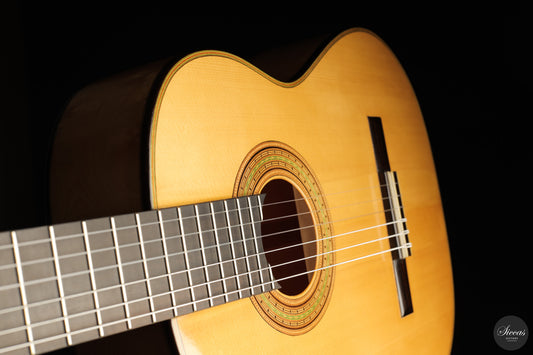
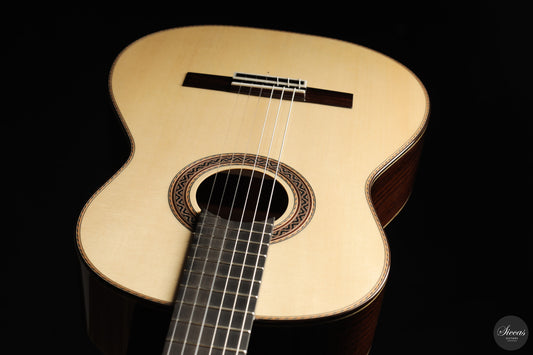
José Marques – A Portuguese Voice in Contemporary Lutherie
Among the most compelling voices in contemporary classical guitar making, José Marques occupies a distinctive position: a Portuguese craftsman whose instruments carry the weight of deep tradition while embracing the most sophisticated acoustic innovations of the modern era. Rooted in Iberian lutherie and refined through years of study abroad, Marques builds concert guitars that demand the attention of serious players seeking power, nuance, and an unmistakable tonal character. His workshop near Lisbon has become a quiet hub of excellence in a lineage that stretches back to the great makers of the nineteenth century.
From Carpenter's Apprentice to Concert Instrument Maker
Marques's path to lutherie began not with the guitar but with wood itself. He started working as a carpenter at the age of fourteen, developing an intuitive understanding of timber — how it moves, responds to humidity, and behaves under tension — long before he ever considered applying that knowledge to musical instruments. This foundational grounding in woodworking would prove decisive, giving his later guitar work a structural solidity that purely music-trained luthiers sometimes lack.
His formal transition into instrument making came through an apprenticeship with master luthier Daniel Luz in the Alentejo region of Portugal. Under Luz, Marques learned to build the Portuguese guitar and the viola campaniça — traditional instruments that carry their own distinct organological demands. These instruments cultivated in him a sensitivity to voice, sustain, and tonal colour that would later inform every classical guitar he built. From these regional roots, Marques turned his full attention to the concert classical guitar, recognising it as a vehicle capable of expressing the full range of his emerging craft.
Seeking to deepen his technique and absorb contemporary approaches to lutherie, Marques spent approximately five years working in the United Kingdom, based in Bury St Edmunds, Suffolk. This period brought him into contact with the broader international community of guitar making and exposed him to the kind of cross-pollination of ideas that distinguishes the very best modern luthiers from regional craftsmen working in isolation. By the time he returned to Portugal and established his workshop in Cortiçois — a small town not far from Lisbon — he carried with him a synthesis of tradition and innovation that would define his mature work.
Construction Philosophy and Signature Models
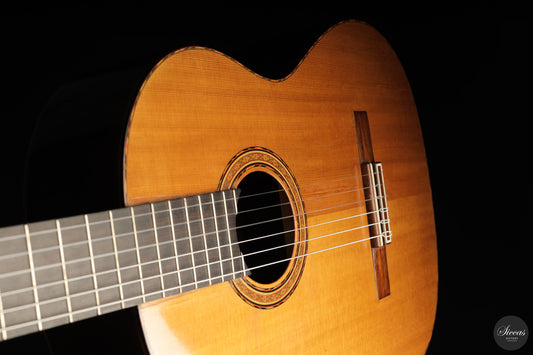
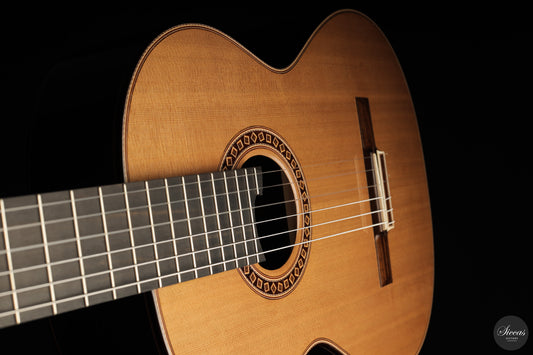
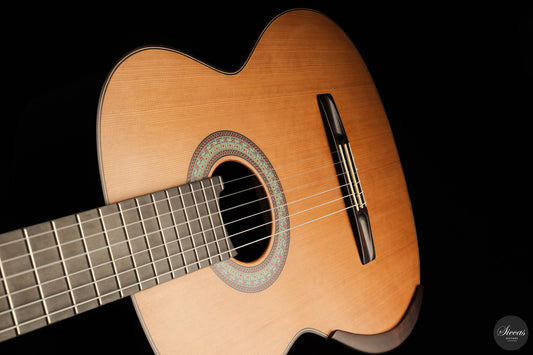
Marques describes his guiding philosophy simply: an instrument should be an extension of the artist — light to the touch but infinite in its possibilities. That principle shapes every decision in his workshop, from wood selection and bracing architecture to the finishing coat applied by hand. He works with tonewoods of the highest grade, including Brazilian rosewood, macassar ebony, and cocobolo for the back and sides, paired with carefully selected cedar or spruce tops. His finishing approach favours hand-polished French varnish, a time-consuming technique that rewards the player with a natural resonance that thicker lacquer finishes can suppress.
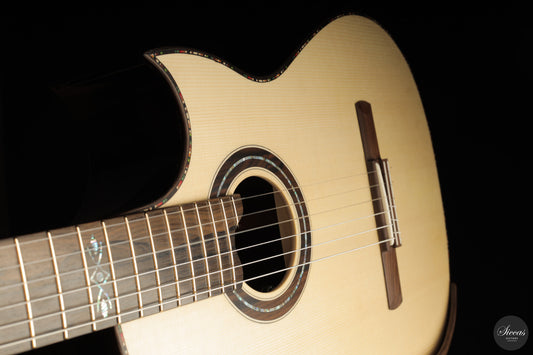
Two construction approaches define Marques's output. His double top guitars use either a Nomex polymer or balsa core sandwiched between two thin layers of cedar or spruce, producing tops of extraordinary stiffness-to-weight ratio. The result is a guitar of remarkable projection and tonal clarity — qualities discussed at length in the broader conversation about fan-braced, double top, and lattice guitars and the acoustic principles underpinning them. His second model, the lattice hybrid, employs an all-wood lattice structure without carbon fibre, seeking to marry the projection advantages of modern bracing with the warmth and complexity of tone that traditional materials provide. The result is an instrument of balanced clarity — firm in the bass, bright and articulate in the treble — without the sometimes clinical quality that full carbon fibre lattices can produce.
Marques also pays close attention to playability and customisation. He fits instruments with reinforced fingerboards and allows players to specify string length, nut width, and tuning machine style, treating each commission as a dialogue between maker and musician. Sound ports are available on request, a detail that speaks to his openness toward contemporary lutherie practice.
Influences and the Tradition He Carries Forward
Marques is candid about his intellectual debts. He cites Daniel Friederich as a formative influence — the French master whose rational, research-driven approach to bracing brought new rigour to concert guitar design in the second half of the twentieth century. Equally present in his thinking are Antonio de Torres, the nineteenth-century Spanish maker whose fan-bracing template remains the structural bedrock of the classical guitar, and José Luis Romanillos, the Spanish-British maker whose deep historical scholarship and tonal refinement brought the Torres tradition into contemporary conversation. Hermann Hauser, Dominique Field, and the double-top pioneers Matthias Dammann and Gernot Wagner round out an intellectual genealogy that spans more than a century of lutherie.
This breadth of influence is not mere name-dropping. It signals the seriousness with which Marques approaches his work. He is part of a generation of makers who have studied the literature, examined historical instruments, and made deliberate choices about which elements of the tradition to carry forward and which to interrogate. In this sense, he belongs among the classical guitar makers who understand that progress and tradition are not opposites but companions.
Workshop and Present-Day Practice
Today, Marques works from his workshop in Cortiçois, Portugal, producing a small number of concert instruments each year. The limited output is a deliberate choice: each guitar receives extended personal attention, and Marques's reputation depends entirely on the consistency of his work rather than on volume. He accepts commissions from professional and advanced amateur players, and his instruments have found their way onto international stages and into the collections of discerning guitarists across Europe and beyond.
His position in Portuguese lutherie is notable precisely because the country is not typically associated with the concert classical guitar in the way that Spain, France, or Germany are. Marques draws on that identity rather than hiding it — the Alentejo apprenticeship, the Portuguese guitar traditions, the return home after years abroad — all of it feeds into an instrument-making practice that is recognisably of its place while aspiring to the highest international standards. He is, in this sense, a genuinely Portuguese contribution to a conversation that has long been dominated by luthiers from other traditions.
Browse available José Marques guitars → in the Siccas Guitars collection.