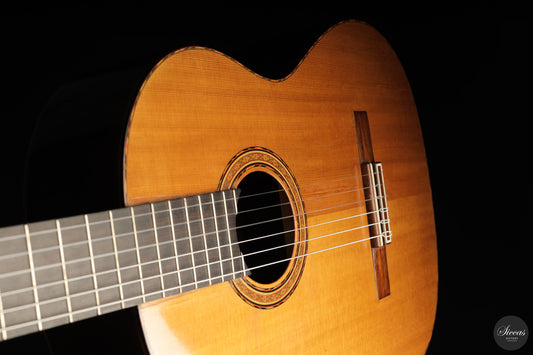
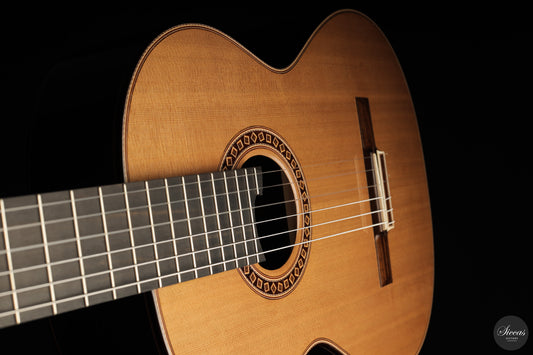
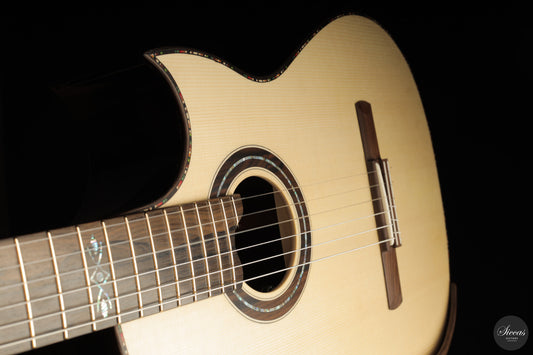
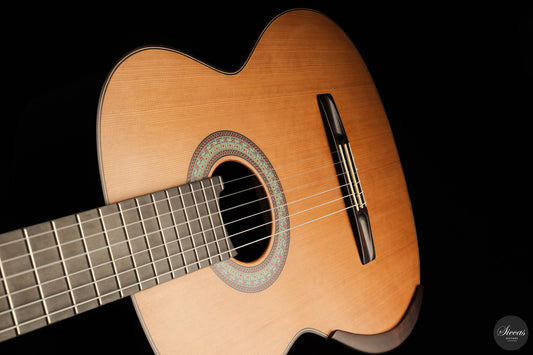
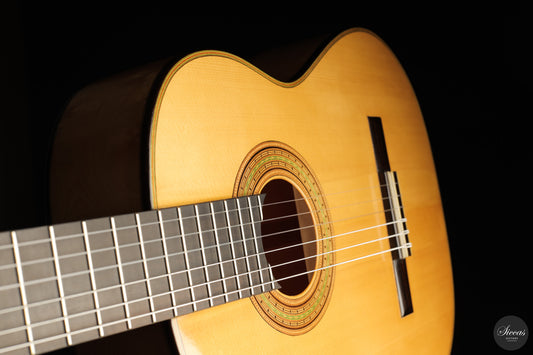
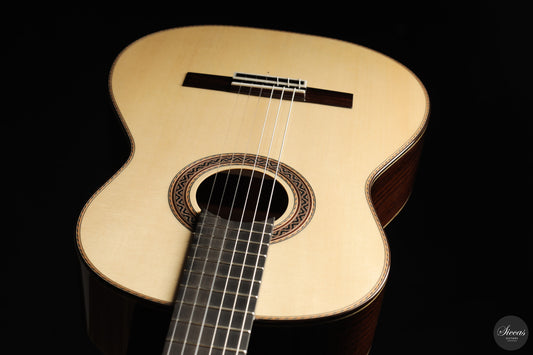
Juan Hernandez stands among the finest classical guitar makers to emerge from the Valencia region of Spain, a luthier whose instruments combine over five decades of accumulated craft knowledge with an unwavering commitment to traditional Spanish construction. Born in 1948 in Turís, a small town in the province of Valencia with deep roots in guitar making, Hernandez has built a workshop whose output is recognized by discerning players and collectors around the world. His guitars are not simply manufactured objects — they are handmade instruments that carry the warmth, precision, and tonal depth that define the very best of the Spanish school.
From Apprentice to Master: Training at the Esteve Workshop
At the age of fifteen, Juan Hernandez entered the Esteve guitar workshop, one of the most respected production ateliers in Valencia's storied guitar-making tradition. This early immersion in professional lutherie proved foundational. Under the discipline of the Esteve environment, he learned not only the manual skills of the trade — shaping tops, bending sides, fitting braces — but also the exacting standards of quality control that separate a truly fine instrument from a merely serviceable one. Over the years, Hernandez rose through the ranks, eventually taking on supervisory responsibility for the workshop's highest-grade models, gaining direct experience with the premium tonewoods and refined construction tolerances that concert-level instruments demand.
This training in a structured, professional workshop sets Hernandez apart from many luthiers who came up through purely solo apprenticeships. Where others learned guitar making in relative isolation, Hernandez absorbed a breadth of technical knowledge by working alongside skilled colleagues across every stage of production. By the time he struck out on his own, he carried with him not only personal mastery but an institutional depth of knowledge that continues to inform every guitar that leaves his bench. The classical guitar making tradition of Valencia has produced generations of superb craftsmen, and Hernandez represents one of its most accomplished modern voices.
The Workshop: A Family Craft in Turís
Today, Juan Hernandez runs his own workshop in Turís together with his son Alberto Hernandez and a small team of skilled artisans. This family dimension is central to the workshop's identity — it is not a factory operation but a closely supervised atelier where every instrument receives personal attention at each stage of construction. The workshop builds both classical and flamenco guitars entirely by hand, selecting tonewoods carefully and working with the unhurried pace that fine lutherie demands.
The construction philosophy at the Hernandez workshop draws on the deepest roots of the Spanish tradition. Instruments are built using the traditional Spanish method, in which the neck is set first and the body constructed around it — a technique that creates a more intimate connection between the neck join and the top, and one that differs fundamentally from the bolt-on or dovetail approaches common in other guitar-making traditions. This method, practiced by the great masters of the past, remains the backbone of Hernandez's approach. For players interested in understanding how bracing systems affect tone and playability, the workshop's range spans fan-braced, double-top and lattice designs, offering distinct tonal characters within a consistently high standard of finish.
Every guitar that leaves the workshop carries a unique serial number and bears the personal signature of Juan Hernandez — a direct guarantee of authenticity and individual craftsmanship. This personal accountability is characteristic of the artisanal tradition in which Hernandez was formed, and it reflects a conviction that the luthier's relationship to each instrument does not end when the finish is applied.
Signature Models: From Concert to Maestro
The Hernandez workshop produces a focused range of models, each designed with a specific player profile and tonal ideal in mind. The Concert model is the foundational instrument of the range — a handbuilt classical guitar aimed at advanced students and professional players who seek the projection and tonal complexity of a Spanish concert instrument without compromise. Built with premium tonewoods including European spruce or Western red cedar tops paired with Indian rosewood or cypress back and sides, the Concert delivers the balanced warmth and clear articulation that Spanish-school playing demands.
At the apex of the range sits the Maestro, Hernandez's flagship concert instrument. The Maestro is built with a wooden lattice bracing system — a construction technique that dramatically increases the top's surface area of vibration while reducing its overall mass, producing an instrument of exceptional volume and tonal brilliance without sacrificing the woody, organic character that distinguishes a Spanish guitar from a purely modern concert machine. Players who have spent time with the Maestro consistently remark on its combination of power and sensitivity: it projects effortlessly in concert settings while remaining responsive to the softest dynamic gradations in intimate performance. The lattice construction approach connects Hernandez to a broader movement in contemporary lutherie, though his interpretation remains firmly rooted in the tonal aesthetic of the Spanish school rather than the more extreme high-tension approaches sometimes associated with lattice instruments.
Beyond these core models, the workshop also builds a Torres model — a tribute instrument inspired by the form and bracing philosophy of Antonio de Torres, widely regarded as the father of the modern classical guitar. Hernandez also constructs a small-bodied Romántica model recalling the proportions of nineteenth-century romantic guitars, as well as extended-range instruments including eight- and ten-string guitars for players working in the broader repertoire of the classical and transcription traditions. This range of historically informed and contemporary models speaks to a workshop that is both rooted in tradition and alive to the diversity of modern classical guitar playing.
Legacy and Place in the Spanish Tradition
Juan Hernandez occupies a distinctive position in the landscape of contemporary Spanish lutherie. He emerged from the same Valencian tradition that produced some of the most respected workshop-trained makers of the twentieth century, yet he has developed a voice that is unmistakably his own. His instruments are prized by professional players and serious amateurs across Europe, the Americas, and Asia, and they appear regularly in the stock of leading specialist dealers worldwide.
The Spanish tradition of lutherie is long and deep. The towering figures of the past — Ignacio Fleta, José Luis Romanillos, and their predecessors — established standards of craft and tonal vision that continue to define what a great Spanish classical guitar can be. Hernandez works in this lineage with full awareness of its demands. Like the French masters of an earlier generation — Robert Bouchet and Daniel Friederich — whose work transformed what was expected of a handmade concert instrument, Hernandez has pursued personal standards of excellence that place craft above commercial convenience.
The workshop's ability to produce instruments across a range of bracing systems and historical references — from Torres-inspired fan-braced designs to contemporary lattice models — reflects a breadth of technical mastery that few makers achieve. At the same time, the family structure of the workshop, with Alberto Hernandez now playing a central role alongside his father, suggests that the tradition being built in Turís has the character of something intended to endure beyond a single generation.
Browse available Juan Hernandez guitars → in the Siccas Guitars collection.