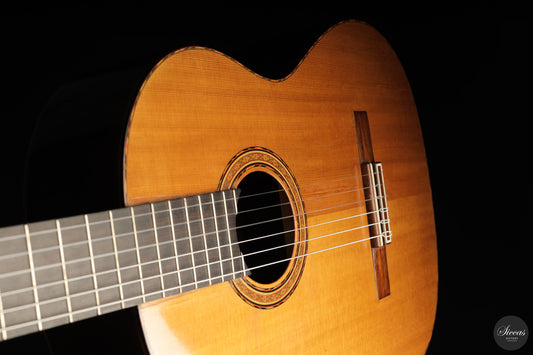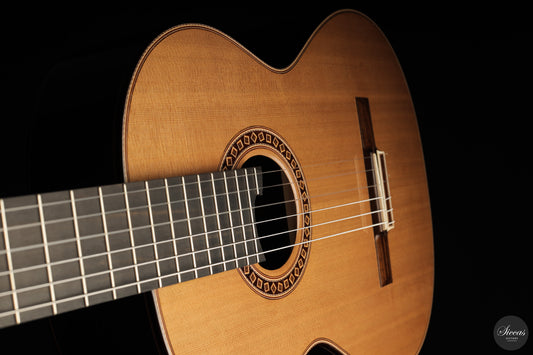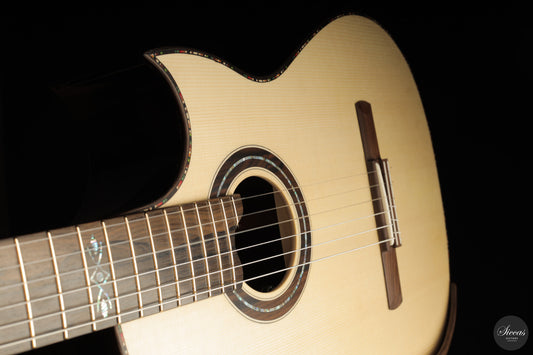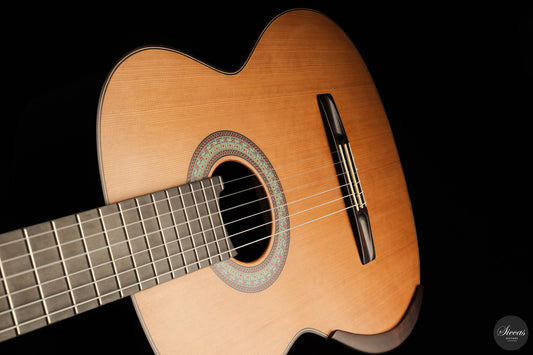

Karel Dedain – Belgian Master Luthier from Ghent
In the landscape of contemporary classical guitar makers, Karel Dedain occupies a distinctive place: a Belgian craftsman rooted in the old Spanish tradition who produces instruments of exceptional refinement, all by hand, all to order, in his workshop in the historic city of Ghent. Born in 1976, Dedain has spent nearly three decades studying, teaching, and refining his craft, and the instruments that leave his workshop reflect both the depth of his historical knowledge and the discipline of a maker who never hurries.
Formation and Training in Puurs
Dedain's path to lutherie began with an unexpected catalyst: a passion for flamenco guitar playing. That passion drew him, in 1998, to the Centre for Musical Instrument Building (CMB) in Puurs, Belgium, one of the few institutions in Europe offering systematic, multi-year training in guitar construction. He remained there as a student until 2005 — seven years of intensive study, primarily under the guidance of Walter Verreydt, a respected figure in European guitar making pedagogy. The CMB curriculum was thorough, but Dedain's own curiosity drove him deeper still: he studied the historical instruments of the great Spanish makers with the attention of a scholar, analyzing the geometry, bracing patterns, and tonal choices that had defined the concert guitar for generations.
By 2006, he had transitioned from student to professional — and, simultaneously, from student to teacher. That same year he joined the CMB faculty, where he has taught classical guitar making ever since. The dual role has served him well: teaching demands a precision of language about construction that forces a craftsman to understand every decision he makes, and Dedain's explanations of his own methods have a clarity that reflects years of helping students grasp the same principles.
Construction Philosophy: Spain Absorbed, Not Imitated
Dedain's guiding conviction is that the old Spanish masters solved most of the essential problems of guitar acoustics long before the modern era, and that the best a contemporary maker can do is understand those solutions deeply rather than replace them with novelty. This places him in a tradition that includes giants like Daniel Friederich and Robert Bouchet, makers who engaged seriously with historical precedent while contributing their own voices.
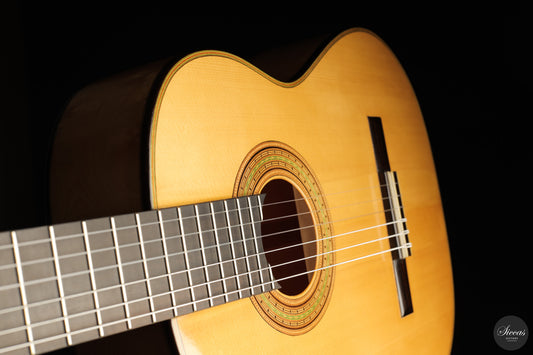
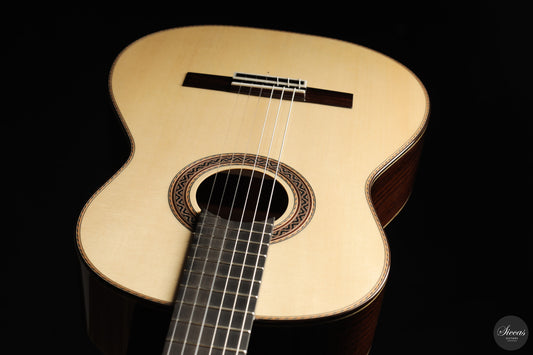
In practice, Dedain's method combines traditional Spanish construction — the solera-based building approach in which the top is worked flat and the sides and back are assembled around it — with selective modern refinements. Every piece of tonewood he uses is hand-selected and dried in his own workshop, a process that can take years but ensures that the timber is fully stable before it ever becomes part of an instrument. All his guitars receive a French polish finish on both the soundboard and the body, a choice that reflects his aesthetic commitments as much as acoustic ones: French polish, applied by hand in many thin coats, remains the most acoustically transparent finish available, and it gives his instruments a visual warmth that modern lacquers cannot easily replicate.
He builds approximately eight guitars per year, all pre-ordered. That figure is not a constraint imposed by the market but a deliberate choice: it allows him to give each instrument the time it deserves, to monitor tonewoods through the seasons, and to maintain the integrity that a higher volume would inevitably compromise. His scales range from the standard 650 mm down to shorter 648 and 640 mm options, and he works with a varied palette of tonewoods — spruce and cedar tops, Madagascar rosewood, satinwood, and flamed maple for backs and sides — selecting combinations according to the tonal profile he and each client are pursuing.
Historical Replicas: Torres, Garcia, Arias, and Esteso
Alongside his original concert instruments, Dedain is known for a dedicated line of historically informed replicas. He builds faithful reproductions of guitars by Antonio de Torres, Manuel Garcia, Manuel Arias, and Domingo Esteso — four figures who, between them, shaped the trajectory of the classical guitar from the mid-nineteenth century through the early twentieth. This is not a sideline for Dedain; it is central to his identity as a maker. Understanding how Torres voiced a top, how Esteso used his bracing pattern, or how Garcia achieved his characteristic balance is, for Dedain, the most direct way to remain in conversation with the tradition he loves. Each replica is built using period-appropriate methods, and the process of building them feeds back into his original work, sharpening his ear and hand alike.
The replica line also serves a distinct clientele: players with a strong interest in historical performance practice, scholars, and collectors who want an instrument that sounds and responds as the originals would have — without the fragility and value concerns that come with owning a nineteenth-century original. To understand the broader context in which these instruments sit, it is worth exploring the history of fan-braced guitar construction, the tradition from which Torres and his successors drew.
Reach and Recognition
Dedain's instruments are played across Europe, the United States, and Asia by both amateur enthusiasts and professional concert guitarists. The fact that his waiting list has remained consistent over many years speaks to the reputation his work has earned — not through competition prizes or institutional celebrity, but through the accumulated testimony of players who have lived with his guitars. The Ghent workshop has become a quiet point of reference in European lutherie: a place where Belgian craft traditions meet the deepest roots of Spanish guitar making.
His relationship with international dealers like Siccas Guitars has brought his work to a wider audience, and instruments from across his career — from early 2013 and 2014 models through to recent builds — appear regularly in the hands of discerning buyers. The consistency across those instruments, separated by a decade or more, is itself a mark of a maker who has found his voice and does not feel the need to chase trends.
A Legacy Being Written
Karel Dedain is still in the middle of his working life, and his legacy remains one in progress. What is already clear is that he belongs to a generation of European luthiers who have taken the responsibility of the Spanish tradition seriously — who have gone back to the source material, studied it without shortcuts, and then built on it with patience and conviction. His dual role as maker and teacher ensures that the knowledge he has accumulated will not remain private: his students at the CMB in Puurs carry it forward, and the instruments he produces carry it into the world's concert halls and practice rooms. For players seeking a handmade concert guitar that is both historically grounded and entirely of the present moment, Dedain's workshop represents one of the more compelling addresses in European lutherie today.
Browse available Karel Dedain guitars → in the Siccas Guitars collection.