
Lisa Weinzierl – A Bavarian Voice in the World of Classical Guitar Making
Lisa Weinzierl is one of the most distinctive voices to emerge from the German guitar-making tradition in recent years. Trained at the legendary instrument-making school in Mittenwald and certified with the coveted German Crafts Master Certificate (Meisterbrief), she has built a reputation for instruments that combine clear aesthetic refinement with deep technical mastery. Her guitars are produced in strictly limited numbers each year, making each one an object of genuine rarity and intention.
From Mittenwald to the World's Finest Workshops
Weinzierl's formation as a maker began in Mittenwald, the small Bavarian town that has shaped instrument builders for centuries. Yet her education extended far beyond any single school or tradition. She undertook intensive studies and long-term apprenticeships with a remarkable range of established luthiers — among them Gernot Wagner, Andreas Kirschner, Gert Esmyol, Peter Ziegler, Christopher Schütz, and Leo Sprenger — accumulating a breadth of practical knowledge that few makers her generation can match. This cross-pollination of influences from across the German-speaking world gave her a fluency with different construction philosophies, allowing her to develop a personal voice rather than simply inheriting a single lineage.
A further chapter of her formation came at the celebrated London workshop of W. E. Hill and Sons, where she worked under the guidance of Stefan-Peter Greiner and Robert Brewer Young — two figures regarded as among the most important maker-restorer voices working today. This international dimension sharpened her understanding of tonal refinement and the relationship between a guitar's construction and its long-term sonic potential. She continues to divide her time between Bavaria and this creative London environment.
Restoration, Study, and the Education of the Eye
One of the most formative chapters of Weinzierl's development was her work as the sole restorer at Siccas Guitars. In this role she had hands-on contact with an extraordinary breadth of the world's finest instruments — guitars by the great twentieth-century masters that most makers only ever encounter in photographs or descriptions. Restoration demands a level of intimacy with an instrument that even careful study cannot replicate: one must understand not only how a guitar was built but why it sounds the way it does, and how its voice has changed over time. For Weinzierl, this access to exceptional historical instruments became a direct source of knowledge, informing her own construction choices at every level — from the graduation of the top to the geometry of the neck joint.
This kind of studied attention to the great tradition is something she shares with makers discussed in our overview of classical guitar makers, where the most important figures have consistently combined direct practical training with a deep literacy in what came before them.
Construction Philosophy and Signature Approach
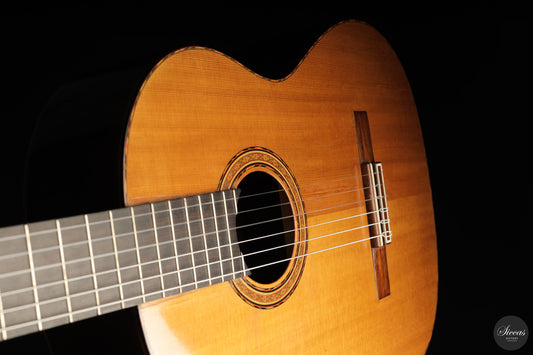
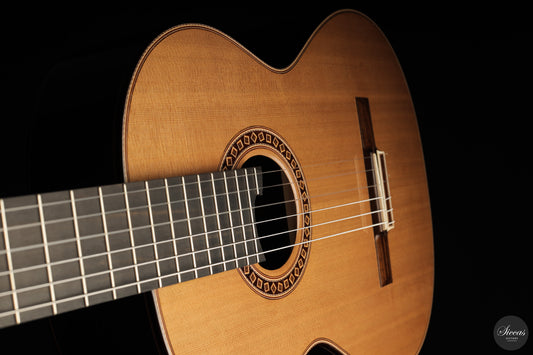
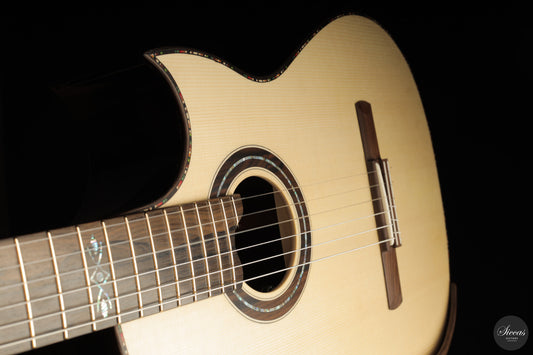
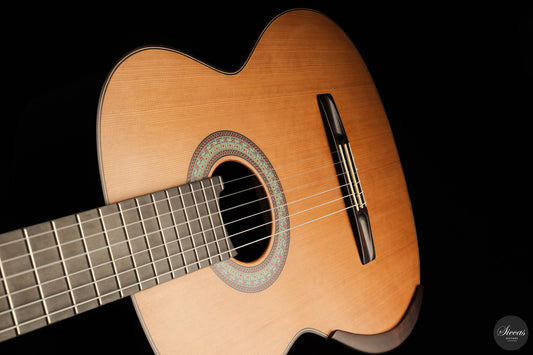
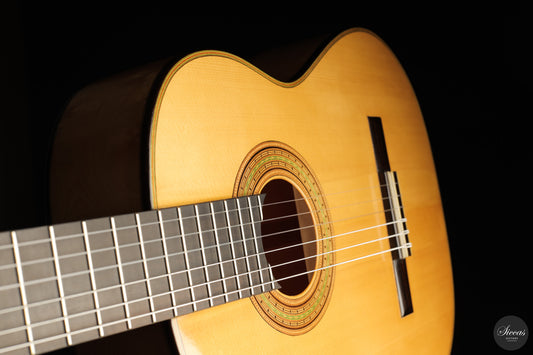
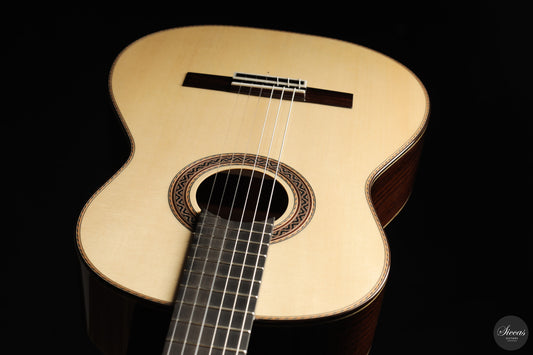
Weinzierl's instruments are immediately recognisable for what one might call a disciplined elegance. She selects her tonewoods with exceptional care, prioritising materials whose acoustic properties have been proven over time rather than novelty for its own sake. Her finishing work — in particular the meticulous application of French polish — reflects a commitment to traditional craft that is increasingly rare in contemporary lutherie. French polish, the shellac-based finish that characterized the great guitars of the nineteenth and early twentieth centuries, requires patience, sensitivity, and an intimate understanding of how the finish interacts with the wood beneath it. Applied with skill, it preserves the acoustic liveliness of the top in a way that synthetic finishes cannot.
Beyond aesthetics, Weinzierl places equal emphasis on what she describes as perfect setup and functionality — the idea that a beautifully voiced guitar must also provide the player with freedom and reliability in performance. This dual commitment to sound and playability reflects a mature understanding of what professional guitarists actually need from an instrument, and it places her work firmly within the tradition of makers who regard the musician's experience as the final measure of quality.
Her approach to construction is rooted in the traditional fan-braced idiom that has defined the Spanish classical guitar — a tradition explored in depth in our guide to fan-braced, double-top and lattice guitars. Within that tradition she brings her own sensibilities to bear: a refined aesthetic language, precise voicing, and the cumulative intelligence of a maker who has studied great instruments from the inside out.
Recognition and Standing
Weinzierl's craftsmanship has been formally recognised by the Bavarian state government, which awarded her both the Gold Medal and the prestigious Master Crafts Award — honours that place her among the most accomplished instrument makers to emerge from the region. These awards are not simply prizes for technical proficiency; they reflect a holistic judgement of a maker's vision, their command of material and process, and their contribution to a living tradition.
Her appearance in the Siccas Guitars catalogue alongside figures who have defined the art of classical guitar making speaks to the regard in which she is held by specialists and players alike. In a field that has been shaped by towering figures — from Daniel Friederich to José Luis Romanillos — Weinzierl represents a younger generation that is absorbing those legacies and beginning to build something genuinely new from them. Her limited annual production ensures that each instrument receives the full measure of her attention, and that the guitars leaving her workshop carry the weight of serious, sustained thought about what a classical guitar can be.
Browse available Lisa Weinzierl guitars → in the Siccas Guitars collection.