Masaki Sakurai – Master Luthier and Guardian of the Kohno Legacy
Masaki Sakurai (1944–2025) stands as one of the most significant classical guitar makers to emerge from Japan, carrying forward a workshop tradition that shaped the global perception of Japanese lutherie across six decades. As the nephew of the legendary Masaru Kohno and eventual president of Kohno Guitar Manufacturing, Sakurai did far more than safeguard an inheritance — he deepened it through rigorous acoustic research, competition-winning design, and an unwavering commitment to the principles of craft his uncle had established. His passing in July 2025, at the age of eighty-one, marked the end of an era and the passing of a genuine master.
From Engineering to Lutherie: Early Training and the Kohno Workshop
Sakurai's path into guitar making was shaped by both family ties and intellectual curiosity. He studied electrical engineering at Sophia University in Tokyo before joining Kohno Guitar Manufacturing in 1967, where he apprenticed directly under Masaru Kohno. That scientific background would prove more than incidental — it would eventually inform the most distinctive contribution of Sakurai's career. The Kohno workshop had already earned international recognition during the 1960s, and Sakurai entered it at a moment of genuine momentum. He absorbed the traditions of the Spanish-influenced construction that Kohno had championed while developing his own understanding of how a guitar's architecture produces — or inhibits — sound. By the time Masaru Kohno passed away in 1998, Sakurai had been an integral part of the workshop for over thirty years and was the natural successor to lead it. The lineage he inherited placed him among the great classical guitar makers of the twentieth century's second half.
The 1988 Paris Competition and a Signature Model
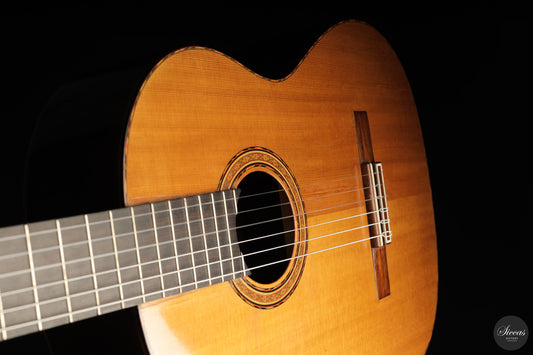
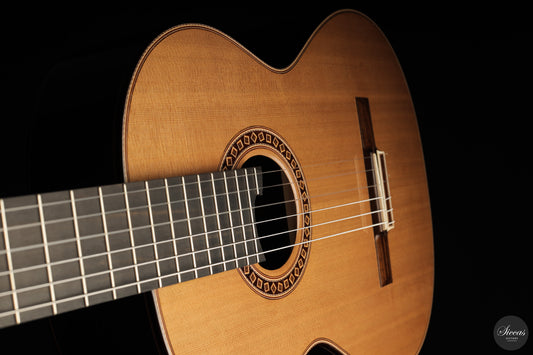
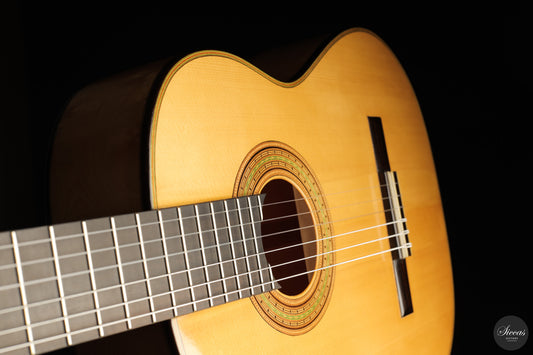
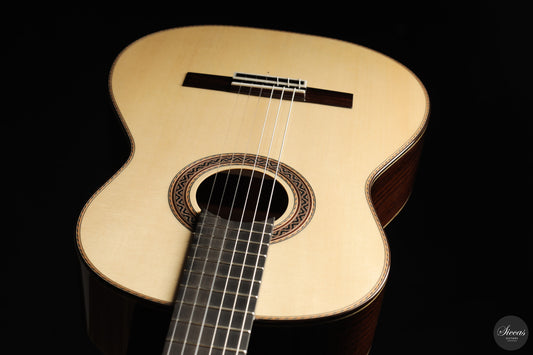
The defining public milestone of Sakurai's career came in 1988, when he was awarded first prize at the Fourth International Guitar Making Competition in Paris — one of the most prestigious events in the luthier world. This recognition confirmed what those within the guitar community already understood: Sakurai had developed a voice of his own, distinct even from the Kohno tradition he had grown up within. The competition-winning guitar gave its name to what became one of his most celebrated production models, the "P.C." (Paris Competition). Built with spruce or cedar soundboards and Madagascar rosewood for the back, sides, and bridge, finished with a cashew varnish and fitted with ebony fretboards, the P.C. model represents decades of refinement from that original design. It remains a direct descendant of the award-winning instrument — not a commemorative piece, but a living continuation of the ideas Sakurai explored in Paris. The French capital has historically been a crucible for lutherie ambition; figures such as Daniel Friederich built careers around Parisian guitar culture, and Sakurai's triumph there placed him in distinguished company.
Acoustic Research and a New Approach to Bracing
What distinguishes Sakurai from many luthiers of comparable stature is the degree to which he subjected the craft to scientific method. Around 2002, he began a collaboration with Professor Hiroshi Okamura, a specialist in vibration engineering at the Shibaura Institute of Technology in Tokyo. Together, they attached sensors to soundboards to study the propagation of sound and analyse vibration mechanisms with a precision that traditional lutherie rarely attempted. The findings led Sakurai to develop a revised bracing system — one that runs across both the upper and lower areas of the soundboard rather than following the conventional reduced bracing pattern on the bass side. The results are audible: his guitars produce a tighter, better-defined bass register, greater evenness of tone across all positions, and a volume that belies the refinement of the playing feel. This research-led approach distinguishes the Kohno-Sakurai tradition from the more intuitive, historically anchored methods pursued by European contemporaries such as Robert Bouchet or Ignacio Fleta — not as a matter of superiority, but of philosophy. Sakurai believed that understanding the physics of wood was inseparable from serving the musician who would eventually play the result.
The workshop's guiding principles — KOKORO (spirit), WAZA (craftsmanship), and HIBIKI (resonance) — reflect this dual commitment to tradition and inquiry. Wood selection is treated with the same care as acoustic design, and every instrument leaves the Tokyo workshop with consistent string action and a playing ease that professional guitarists frequently cite as one of the defining characteristics of a Sakurai guitar.
Guitar Models and the Sakurai-Kohno Line
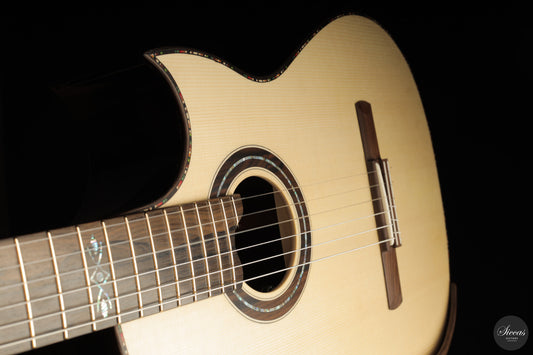
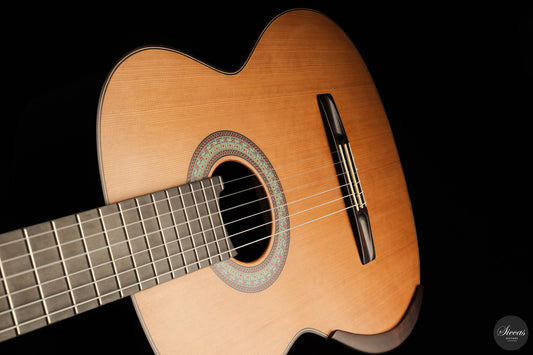
Sakurai produced instruments under two distinct identities. Guitars bearing only his name represent his personal vision and his most ambitious construction — the P.C., the Special, and the Maestro-RF models among them. The Maestro-RF incorporates a raised fingerboard that eases access to the upper register, a practical refinement aimed at professional performers. The Sakurai-Kohno line, by contrast, carries forward the heritage of his uncle's most respected designs and gives players access to the Kohno workshop's traditions at a wider range of levels. Both lines share the same Tokyo workshop, the same attention to tonewoods, and the same acoustic philosophy — but they serve different expressive purposes. Understanding the relationship between fan bracing and soundboard construction helps illuminate why Sakurai's modifications to the traditional fan pattern produced such a distinctive sonic signature: more uniform response, fuller projection, and a clarity that professional players found immediately useful on stage.
Notable Players and the Workshop's Continuing Legacy
The roster of guitarists who have performed on Kohno and Sakurai instruments reads as a partial survey of classical guitar's most celebrated names. Julian Bream and Sharon Isbin have both played instruments from the workshop, and active endorsers have included Oscar Ghiglia, Eduardo Fernández, and Shinichi Fukuda. These are players whose demands on an instrument are severe and whose choices carry real authority — their trust in the Tokyo workshop is a meaningful indicator of the guitars' quality at the highest performing level.
Sakurai spent fifteen years mentoring So Kimishima, who is on his mother's side a grandson of Masaru Kohno and has since developed his own guitar line within the same workshop. Kimishima received Sakurai's formal approval to launch his independent line in 2021, a gesture that represents both personal regard and a deliberate act of institutional continuity. The workshop continues to produce approximately three hundred guitars per year, a figure that reflects both the scale of international demand and the deliberate restraint that quality lutherie requires. Where other workshop traditions in Japan and Europe have fragmented or faded, the lineage from Kohno through Sakurai to Kimishima remains intact — one of the most coherent dynasties in contemporary classical guitar making.
Browse available Masaki Sakurai guitars → in the Siccas Guitars collection.