
Nicolas Lamoureux – French Luthier in the Grand Tradition
Nicolas Lamoureux is one of the most compelling voices to emerge from the French classical guitar making tradition in recent years. Working from a workshop in the heart of Corrèze, in the Haute Corrèze region of central France, he builds concert instruments that draw directly from the legacy of Robert Bouchet, Daniel Friederich, and Dominique Field — three pillars of the French school whose work shaped the sound of the modern classical guitar. His path to lutherie was unconventional, shaped by a decade in cinema and design, yet it is precisely that breadth of experience that informs both the rigour and the artistry of his instruments.
From Nancy to Paris — and Back to the Guitar
Lamoureux studied music and trained as a classical guitarist at the Nancy Conservatory in the late 1990s. After completing his studies, he turned toward his other passions — photography, cinema, animation, and architecture — and spent nearly a decade working as a 3D graphic designer in Paris, contributing to feature films, commercials, and architectural visualisation projects. It was a world of precision, visual composition, and uncompromising attention to detail: qualities that would later translate directly into his approach at the workbench.
During those Parisian years, he returned to the classical guitar as a player, and found himself increasingly drawn to the instruments themselves — not merely as tools for music-making, but as objects with distinct sonic personalities. Through collectors, books, concerts, and recordings, he immersed himself in the great tradition of classical guitar makers, studying how certain instruments seemed to transcend the merely functional and achieve something close to artistic completeness. His first handmade guitar — built while he was still working in design — was judged convincing by both professional guitarists and established luthiers. That reception was enough to set him on a new course.
Settling in Corrèze — The Mentors Who Shaped His Path
The decisive turn came through the encouragement and guidance of two figures: luthier Dominique Field and guitarist Thomas Norwood. Their advice led Lamoureux to leave Paris and establish himself as a guitar maker in Corrèze, a region of ancient forests and deep rural quiet that has proven a fitting environment for instrument-making of the most contemplative kind. Since 2017, his workshop in Neuvic d'Ussel has been his base, and it is here that each of his instruments takes shape through an entirely handmade process.
Dominique Field's influence is felt throughout Lamoureux's work — in the timbral sophistication he pursues, in the attention to dynamic response, and in a philosophy that prizes the guitar as what he describes as "a complete artistic object." Field's own instruments, with their extraordinarily refined tonal response, offered Lamoureux a living model of what was possible when technical mastery and aesthetic sensitivity were brought together at the highest level.
The French School — Bouchet, Friederich, and the F67
Lamoureux concentrates principally on concert instruments in the style of the French school, with Robert Bouchet and Daniel Friederich as twin touchstones. Bouchet, in particular, represents for him the guitar as "a complete artistic object" — an instrument in which construction quality, sonic character, and visual refinement are inseparable. Lamoureux has built meticulous copies of Bouchet's instruments, including a reproduction of the celebrated 1962 guitar (number 87), which reproduces such signature details as the ninety-degree fit of the sides into the neck and the distinctive transverse spruce bar beneath the bridge — a feature Bouchet himself adapted from a Lacôte guitar. The results have been described as achieving exceptional midrange balance alongside powerful trebles and bass with strong sustain: precisely the qualities that made Bouchet's originals so prized.
Friederich's spruce instruments from the 1970s hold a special place in Lamoureux's imagination — instruments he describes as having "a round sound, extraordinarily generous and of great homogeneity," combining lightness and power with the precision of a finely tuned mechanism. This admiration gave rise to his F67 series: concert guitars whose bracing is inspired by the instrument Friederich entered in the 1967 Liège guitar-making competition. The F67 is characterised by a powerful, balanced response with a round and fleshy attack — an instrument firmly rooted in tradition yet expressing its maker's own voice. To understand the broader context in which these instruments sit, it is worth exploring the fan-braced guitar tradition that underpins both Bouchet's and Friederich's structural thinking.
Beyond his original concert models, Lamoureux also builds copies of historical reference instruments — including guitars in the style of Torres and Esteso — demonstrating the breadth of his engagement with the full history of the instrument. His approach to these copies is scholarly as much as it is artisanal: he studies the originals with the same analytical eye he once applied to architectural visualisation, seeking to understand not merely what these guitars look like, but why they sound as they do.
Sound, Craft, and the Philosophy of Making
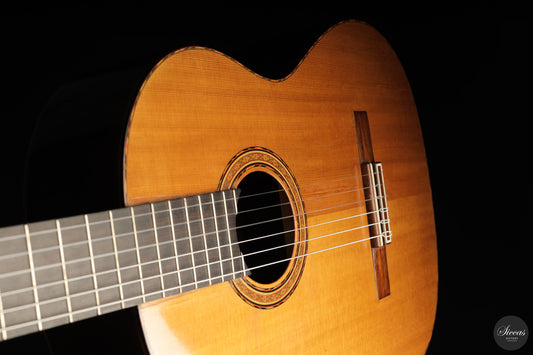
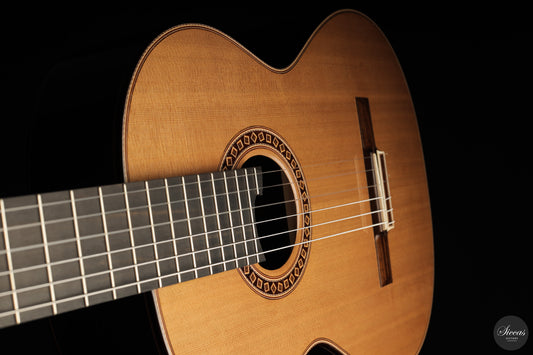
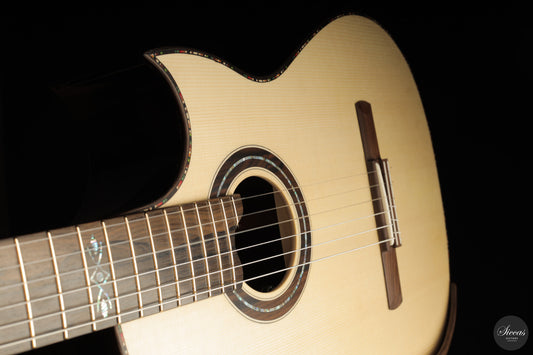
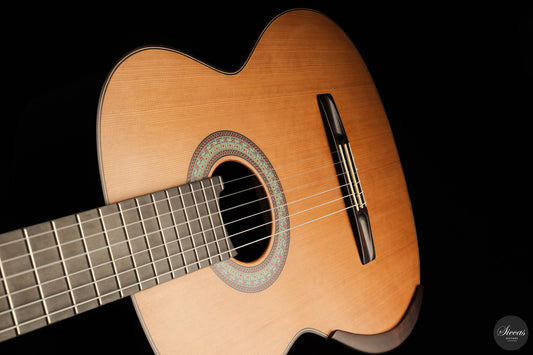
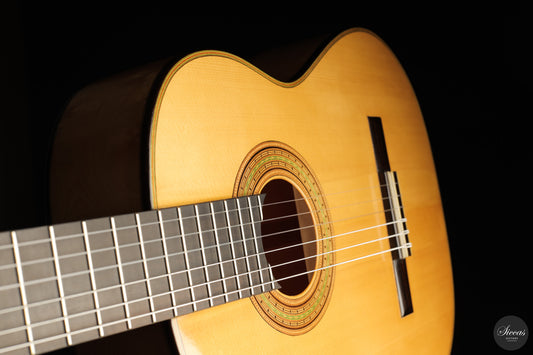
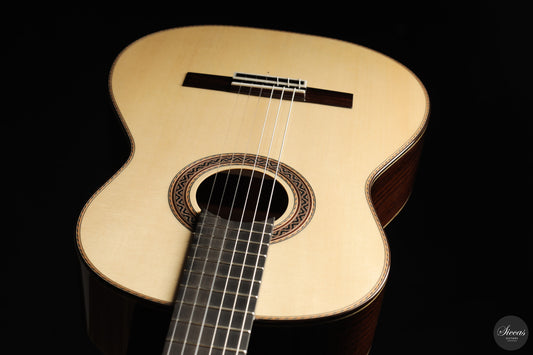
What distinguishes Lamoureux's work is a refusal to separate sound from aesthetics. His guitars are characterised by "a certain sobriety balanced with carefully crafted details" — notably in the rosette, the finishing, and the overall visual harmony of each instrument. He applies shellac varnish by hand, uses fan bracing refined through study of the French masters, and selects tonewoods — typically spruce tops with Indian rosewood or similar back and sides — with a player's ear as well as a craftsman's eye.
His production is intentionally limited: each guitar is a considered object, not a product. Instruments from his workshop have found their way into French conservatories and into the hands of professional musicians, a quiet validation of the serious musical purpose that animates his work. Though he has worked largely outside the competition circuit, preferring the workshop to the exhibition hall, his reputation has grown steadily through the quality of instruments that speak for themselves. The legacy of Robert Bouchet that runs through his work is one of the most direct living connections to that tradition available in contemporary lutherie.
Nicolas Lamoureux and the Living French Tradition
In a field where regional traditions can become formulaic, Lamoureux represents something rarer: a maker who has absorbed the French school deeply enough to build from within it rather than merely imitating it. His guitars carry the tonal philosophy of Bouchet and Friederich not as a constraint but as a foundation — one from which he develops instruments with genuine personality and musical authority. The decade he spent in cinema and design is not irrelevant to this: it gave him a trained visual intelligence, an understanding of structure and proportion, and perhaps most importantly, a patience for the kind of painstaking craft that produces results invisible to the untrained eye but immediately audible under the player's fingers.
Browse available Nicolas Lamoureux guitars → in the Siccas Guitars collection.