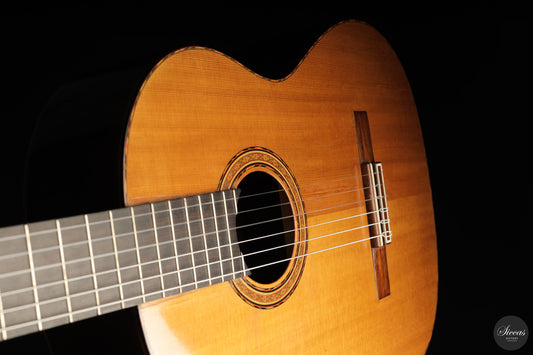
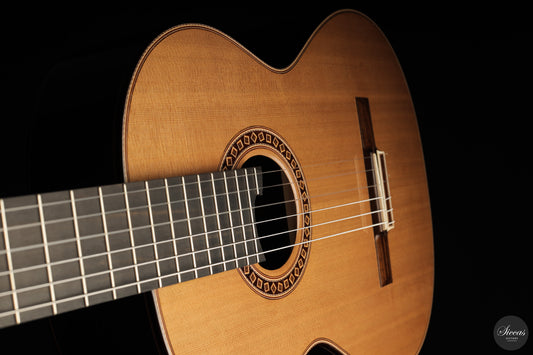
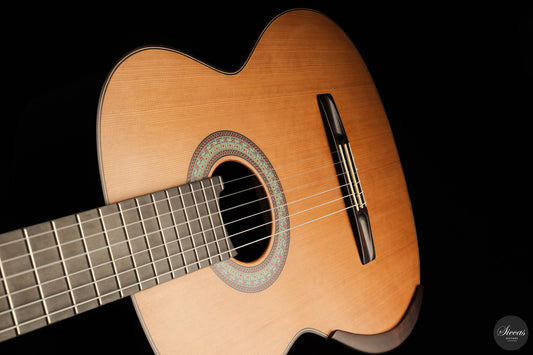
Ramin Fallah – A Voice Between Two Worlds
Ramin Fallah is one of the most compelling voices in contemporary classical guitar making — an Iranian-born luthier based in Istanbul whose instruments have earned the trust of concert professionals across Europe and North America. Since founding his workshop in 2008, he has built a reputation for guitars that blend traditional craftsmanship with thoughtful modern refinements, producing instruments with remarkable power, warmth, and tonal complexity. His work sits at a rare intersection: rooted in the great European lutherie tradition yet carrying a distinctive aesthetic sensibility that is entirely his own.
Background and the Path to Lutherie
Ramin Fallah began building guitars in 2008, establishing his workshop in Istanbul — a city that straddles two continents and has long been a crossroads of artistic traditions. His Iranian heritage and his adopted home in Turkey together inform a sensibility that reaches beyond any single regional school of guitar making. Like many of the most interesting contemporary luthiers, Fallah came to his craft through a deep love of the instrument itself, gradually developing his skills and voice through years of practice, study, and direct engagement with the needs of professional players. The classical guitar making tradition he works within spans centuries and continents, and Fallah has absorbed its fundamentals thoroughly while carving out a personal direction.
What distinguishes his development as a maker is a consistent openness to innovation alongside respect for proven acoustic principles. He has studied the tonal priorities that matter to serious concert guitarists — clarity, projection, sustain, balance across registers — and built his approach around satisfying these demands at the highest level. His workshop in Istanbul has become a place where traditional technique and personal vision converge, producing instruments that stand comfortably alongside the work of leading European makers.
Construction Philosophy and Signature Models
Fallah works primarily with spruce soundboards, pairing them with a wide range of back and side timbers including Amazon rosewood, Indian rosewood, granadillo, mulberry, wenge, and Persian walnut. This variety reflects both a curiosity about tonal possibilities and a sensitivity to the preferences of different players. Each instrument is individually voiced, and the tonal outcomes vary accordingly — from warm, singing guitars built around mulberry or Persian walnut to more projecting, articulate instruments built with rosewood or granadillo.
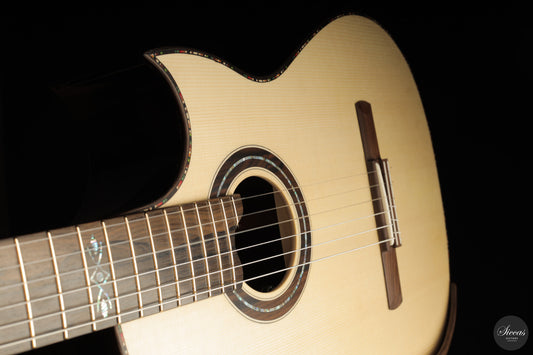
One of his most recognised contributions to the contemporary concert guitar is his C-Stage model. Designed specifically for the demands of live performance, the C-Stage incorporates a custom sound port on the bass-side upper bout, a feature that allows the player to hear their own tone more directly during performance without any loss of projection toward the audience. The model has attracted widespread attention among professional guitarists who require an instrument that performs with equal conviction on stage and in the recording studio. Construction details across the range are consistently high: French polish finishes, premium machine heads by makers such as Alessi, and precise structural work throughout.
Fallah's wife contributes to the visual identity of his instruments, adding ornamental details and inlay work that give each guitar a distinct artistic character. These flourishes — never merely decorative — reinforce the sense that each Fallah guitar is a considered object, made with care and intention from every angle. His approach to construction choices in fan-braced classical guitars draws on decades of accumulated knowledge about how top graduation, bracing geometry, and finish thickness interact to shape the final voice of the instrument.
Notable Players and International Recognition
Among the professional musicians who have chosen a Ramin Fallah guitar is Ardeshir Farah, the Grammy-winning Iranian-American guitarist best known for his work in the duo Strunz & Farah. Fallah has built a dedicated signature model for Farah, a collaboration that speaks directly to the kind of relationship between maker and player that defines the finest lutherie traditions — the instrument shaped by the specific musical demands and physical preferences of an individual artist. That a guitarist of Farah's standing, whose work fuses classical technique with flamenco, Latin, and Middle Eastern idioms, should choose a Fallah guitar is a meaningful endorsement of both the quality and the versatility of these instruments.
Fallah's guitars are distributed internationally through specialist dealers in North America and Europe, with Grand Salon de Guitare serving as his dedicated North American dealer. This kind of specialist distribution network is characteristic of makers whose instruments have earned a serious reputation in professional circles. Players and collectors in Europe have access to his work through leading dealers including Siccas Guitars, where his instruments appear regularly in the inventory alongside those of the world's most respected contemporary makers. In this regard, his standing within the current concert guitar world echoes the trajectories of established European figures whose reputations grew steadily through the quality of individual instruments reaching demanding players — a path not unlike that taken by makers such as José Luis Romanillos, who also built his reputation through the consistent excellence of hand-crafted work.
Aesthetics, Identity, and Tonal Voice
What emerges most clearly from encountering a Fallah guitar in person — or through the recordings made on his instruments — is a tonal personality that is both powerful and nuanced. His guitars tend toward a full, open sound with strong projection and a clarity that rewards careful listening. The tonal colour varies across the range: instruments built with Persian walnut or mulberry carry a slight warmth and darkness, while those built with Amazon rosewood or granadillo offer more brightness and definition. Across all of them, there is a common thread — a response that is generous without being loose, and a sustain that supports the kind of expressive legato playing that distinguishes the finest concert instruments.
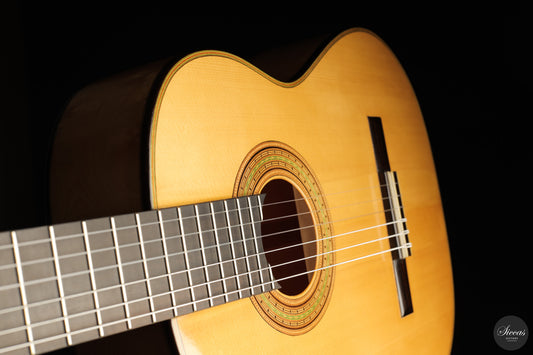
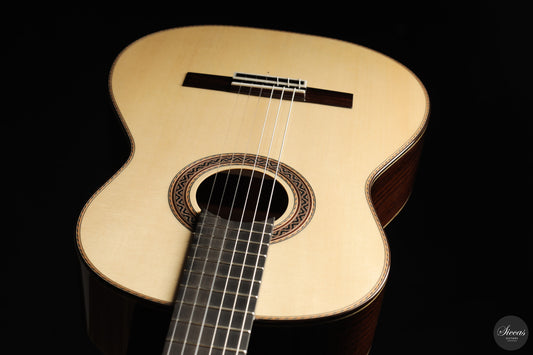
The aesthetic dimension of his work deserves attention in its own right. The geometric inlay work, the careful choice of binding materials, the elegantly finished headstocks — these details give a Fallah guitar a visual presence that is refined without being ostentatious. In this respect, his instruments reflect a sensibility that bridges Eastern and Western traditions of decorative craft, adding a layer of meaning to instruments that are already remarkable on purely acoustic grounds. For players drawn to guitars that carry a distinctive identity, a Fallah is a compelling choice. His work joins the broader conversation among contemporary makers who are expanding the range of what a classical guitar can look and sound like, while remaining faithful to the acoustic standards established by the great masters of the twentieth century — from Ignacio Fleta to Daniel Friederich — whose legacies continue to guide serious luthiers today.
Browse available Ramin Fallah guitars → in the Siccas Guitars collection.