
Stephen Eden – English Luthier of Exceptional Refinement
In the landscape of contemporary classical guitar making, Stephen Eden stands as one of Britain's most accomplished and quietly celebrated luthiers. Working from his workshop in Bexhill-on-Sea on the English coast, Eden has built a reputation that reaches far beyond his home country — his instruments are played by leading concert artists on stages around the world. What distinguishes him is not showmanship but precision: a relentless commitment to instruments that are as visually refined as they are sonically alive.
From Evening Classes to a Professional Workshop
Stephen Eden's path into lutherie began not with a childhood obsession but with a late discovery. He received his first acoustic guitar at the age of 18 and spent years as a passionate music enthusiast before the craft of making instruments captured his attention. In 2004, he enrolled in evening classes led by luthier Stephen Hill, and that experience proved transformative. The technical depth of guitar construction — its geometry, acoustics, and traditions — became a new calling.
Shortly after those first classes, Eden secured a two-year apprenticeship in the workshop of Pablo Requena, which he later described as an "old-style apprenticeship that offered knowledge rather than money." It was here that he acquired the hands-on foundation that would define his approach: meticulous joinery, a deep respect for the historical tradition of Spanish construction, and an understanding of how every structural decision affects the voice of a finished instrument. By 2008, he had set up his first workshop in his mother's newly converted garage — a modest beginning that would, within a few years, grow into a full-time professional practice. In 2013 he moved his workshop to his own home in Bexhill-on-Sea, where he continues to work today.
Influences and the Bench Copy Tradition
Eden draws inspiration from the defining figures of twentieth-century lutherie. The work of Antonio de Torres, Santos Hernández, Hermann Hauser, and Daniel Friederich forms the bedrock of his aesthetic and technical thinking. Rather than pursuing a single original voice, Eden has committed significant energy to the bench copy tradition — the painstaking recreation of historically important instruments that allows players to experience the tonal world of a specific maker at a specific moment in time.
His Friederich 1980 and Hauser II 1959 bench copies have attracted particular attention. These are not mere replicas: they are interpretive studies, informed by years of research and a thorough understanding of the originals' structural logic. Understanding what made those instruments exceptional — the bracing geometry, the plate thicknesses, the choice and preparation of tonewoods — and then reproducing that understanding with fresh materials is a discipline that demands both scholarship and skill. Eden's bench copies sit firmly within the wider tradition explored across the history of classical guitar makers, a lineage that connects every serious maker to the great instruments of the past.
Models and Construction
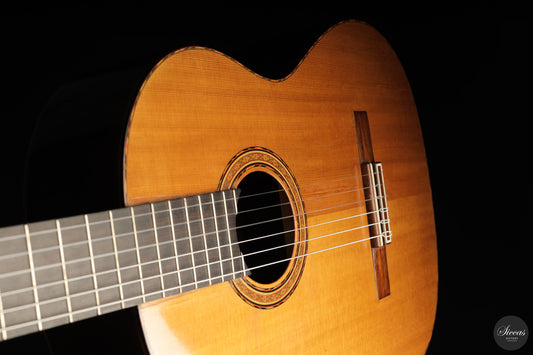
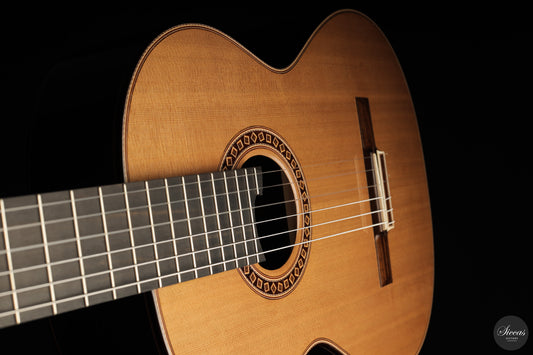
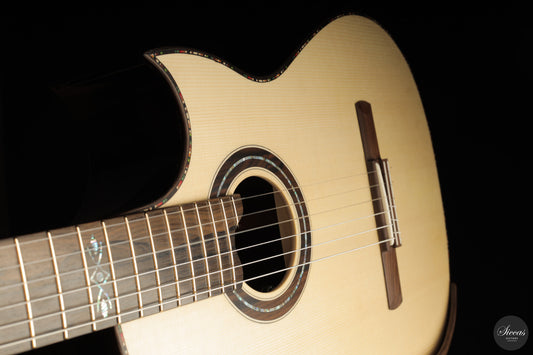
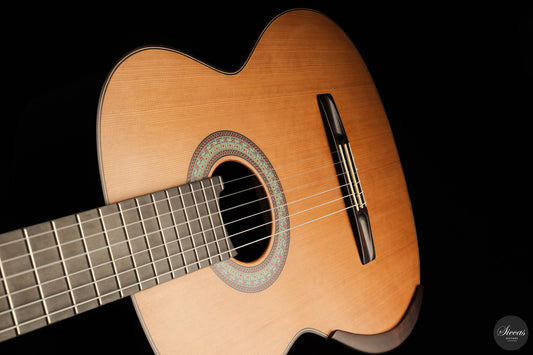
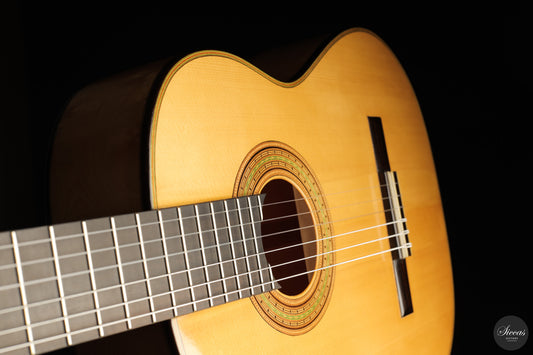
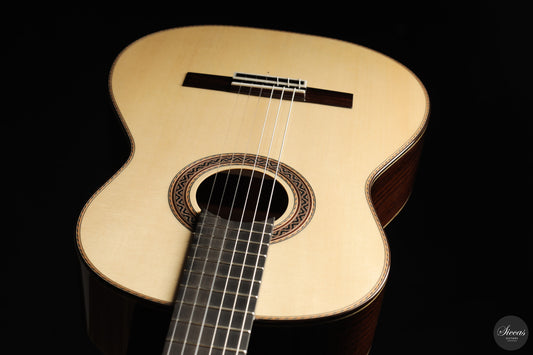
Eden builds a range of instruments aimed at different levels of player and purpose. At the accessible end sits the Cadenza model, developed in collaboration with Kent Guitar Classics, which has introduced his standards of craftsmanship to a broader audience. Above it are his Concert and Grand Concert models, which represent his own original voice within the Spanish tradition — fan-braced, French polished, and built with carefully selected tonewoods including cedar or spruce tops paired with Indian rosewood back and sides. For players who want to engage directly with historical lutherie, his top-tier Hauser and Friederich bench copies offer something rarer: a living dialogue with the great makers of the twentieth century.
Across all models, Eden's finishing standards are immediately apparent. The French polish is applied to a standard seldom seen outside the most established European workshops. His use of premium hardware — including Klaus Scheller and Rodgers tuning machines — reflects the same attention to detail that governs every stage of the build. The tonal character of his instruments is consistently described in terms of clarity and responsiveness: a singing treble register, a well-defined bass, and a dynamic sensitivity that rewards expressive playing. These qualities place his work in conversation with the broader evolution of the fan-braced classical guitar and its continuing refinement in contemporary hands.
Artists and International Reach
The roster of players who have chosen Stephen Eden guitars speaks directly to the quality of his instruments. Guitarists including Paul Gregory, Juan Martín, Sean Shibe, Ian Watt, Gaëlle Solal, Pavel Ralev, Bridget Mermikides, Raphaella Smits, and Mark Eden have all played his instruments at a professional level. That his guitars have found their way into the hands of such a diverse international group — from British recitalists to flamenco artists to international competition performers — reflects both the versatility of his making and the consistency of his results.
His instruments are distributed internationally, reaching players across every continent. Eden also runs guitar-making courses from his workshop, passing on the knowledge he gained through his own apprenticeship and years of independent practice. In this way he contributes not only instruments but also the continuation of the craft tradition itself — a role that links him directly to makers like Robert Bouchet, whose influence on successive generations of luthiers has been as significant as the guitars he left behind.
Legacy and Standing
Stephen Eden is, by his own account, a man of few words. His website offers no grand declarations, and his public profile is characteristically understated. What speaks for him are the instruments: consistently praised for their refinement, played by serious artists, and sought after by collectors and performers who know precisely what they are looking for. In a field where reputation is built slowly, instrument by instrument, Eden has earned his standing through work rather than self-promotion.
At Siccas Guitars, we have had the pleasure of offering several of his instruments to our clients, and the response has confirmed what the player community has long known: Stephen Eden builds guitars of genuine concert quality, instruments that honour the great tradition of European lutherie while bearing the unmistakable mark of a maker who has found his own way within it. For anyone seeking a world-class classical guitar from a living British luthier, his work deserves to be among the first considered.