
Sylvain Balestrieri – French Luthier in the Tradition of Bouchet and Friederich
Sylvain Balestrieri is one of the most thoughtful voices in contemporary French lutherie — a maker whose instruments carry the quiet authority of the great Parisian tradition while reflecting the analytical precision of a builder who leaves nothing to chance. Working from his workshop in Grenoble, France, he devotes himself entirely to a single concert model, producing a small number of instruments each year and maintaining a waiting list measured in years rather than months. His guitars are considered among the finest to emerge from France in the current generation.
Training and Formation
Balestrieri's path to lutherie began with a thorough formation as a classical guitarist. That foundation — the intimate understanding of what a player needs from an instrument under the fingers, in the concert hall, and across the full dynamic range of the repertoire — would prove invaluable to his later work as a builder. After completing his studies in classical guitar performance, he went to Paris and enrolled for two years at the École Normale de Musique de Paris, deepening his musicianship and his understanding of the instrument from both a performer's and a maker's perspective.
He then travelled to London, where he worked in some of the city's most respected repair and restoration workshops, including Andy's Guitar and Graham Noden. These years in London gave Balestrieri a practical mastery of construction techniques and a first-hand knowledge of historic instruments. Working on fine antique guitars — including instruments from the workshop of Robert Bouchet and other canonical makers — sharpened his sense of what acoustically excellent lutherie looks and feels like. It also gave him a deep respect for the original makers: in his restoration practice, he maintains that all interventions must be made "with a vision to highlight the tonal qualities of the original sound," never imposing modern preferences onto historical instruments.
In 2008, Balestrieri returned to France and established his workshop in Grenoble, where he has worked ever since. The city, set between the Alps and the Vercors plateau, provides a fitting environment for the kind of unhurried, meditative craft he practices.
The French Tradition as a Living Language
French lutherie occupies a very specific position in the history of the classical guitar. The lineage that runs from Robert Bouchet through Daniel Friederich and on to a small circle of contemporary builders is defined by an emphasis on refinement, tonal complexity, and a characteristic balance between warmth and clarity. Balestrieri explicitly situates himself within this lineage, drawing inspiration from Bouchet, Friederich, and the maker Dominique Field, whose comment that "Sylvain Balestrieri's craftsmanship is of the highest level and it is coupled with very tasteful artistry" speaks to the regard in which Balestrieri is held by his peers.
What distinguishes the French approach, and what Balestrieri embodies with particular conviction, is the marriage of artistic intuition and scientific rigour. In the spirit of Daniel Friederich — who brought an engineer's mindset to the guitar — Balestrieri measures the flexibility, weight, and density of each soundboard at multiple stages of construction, using this data to guide his decisions rather than relying on habit or guesswork. Tonewoods are selected with exceptional care, rigorously evaluated for the quality of their cut and their mechanical and acoustic properties, then stored for ten to forty years before they are used in an instrument. This commitment to seasoning — rare even among dedicated craft makers — means that the wood in a Balestrieri guitar has reached a stability and tonal maturity that shorter drying times simply cannot replicate.
Construction and the Single Concert Model
Balestrieri's philosophy of concentration extends to the instruments themselves: he builds one concert model, bringing all of his accumulated knowledge and skill to bear on a single form rather than diversifying across multiple designs. This focus allows him to refine his work with a depth that would be impossible if he were producing several different guitar types.
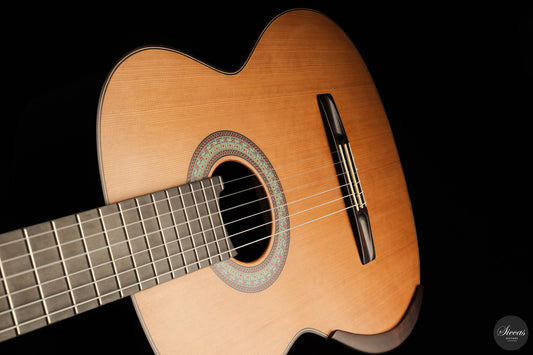
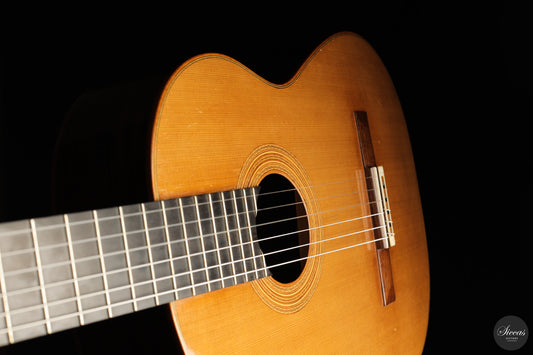
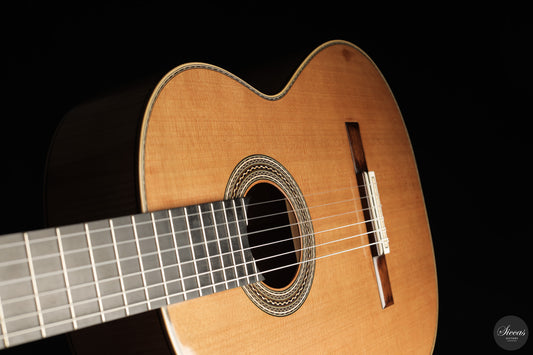
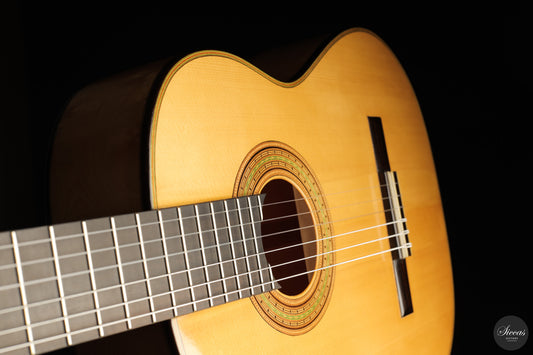
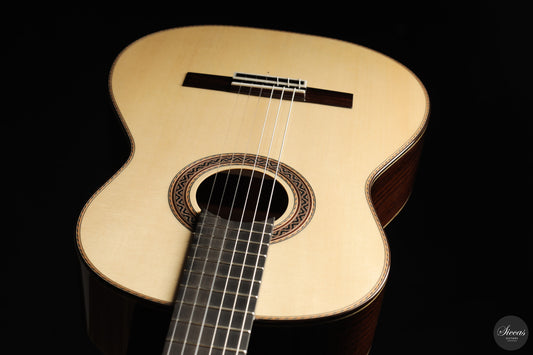
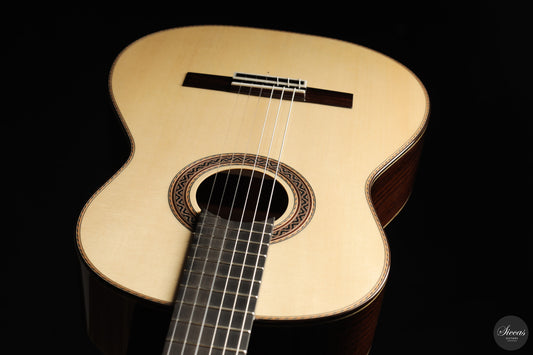
The guitar that emerges from this process is designed to meet the full demands of the modern concert stage. With a 650 mm scale length and a nut width of 52 mm, the instrument offers a playing experience that is immediately familiar to professional performers while delivering the projection and tonal complexity that large halls require. The top is made from Swiss spruce, North American Engelmann spruce, or red cedar — each selected individually for its resonant properties. Back and sides are Indian rosewood, chosen for its density and warmth, and the fingerboard is ebony. The neck is Honduran mahogany, reinforced with carbon fibre bars that improve structural stability without compromising the instrument's natural vibrational character.
The finish is French polish applied by hand and rubbed to a finish that enhances the beauty of the wood while allowing the soundboard to vibrate as freely as possible. Scheller tuning machines with brass plates and ebony knobs are fitted as standard — a choice that reflects Balestrieri's preference for components that are both functional and aesthetically coherent. Each instrument weighs approximately 1,850 grams and takes more than 200 hours of work to complete. The result is a guitar described by those who play it as possessing exceptional balance across the registers, with rich, clearly defined basses, a treble that combines brilliance and warmth, and a sustain that carries through the full arc of a phrase in the concert hall.
Beyond new construction, Balestrieri also undertakes the restoration of fine historic instruments. His work on pieces including a Louis Panormo guitar of 1827 and a mid-nineteenth century English romantic guitar demonstrates a range that encompasses both the Spanish-influenced tradition of early nineteenth-century building and the parallel English school — a breadth of knowledge that informs his own making in ways that are difficult to quantify but easy to hear. For those interested in the wider history of the romantic guitar, this intersection of historical restoration and contemporary making is a fascinating dimension of his practice, explored further in the history of the romantic guitar.
Place Among Contemporary French Makers
Within the broader landscape of contemporary classical guitar makers, Balestrieri occupies a position that is quietly but firmly its own. He is not prolific; he does not seek to build a large commercial presence. What he seeks, instrument by instrument, is the kind of perfection that only becomes possible when a maker has the courage to narrow their focus completely. The waiting list for a new instrument runs to approximately two years, and the annual output remains small by design. For players who have had the opportunity to try his work, that wait is considered entirely worthwhile.
His guitars have found their way into the hands of serious concert performers and discerning collectors alike, and the consistency of the response they provoke — admiration for the tonal sophistication, the responsiveness under the fingers, and the refinement of the construction — speaks to the maturity of a maker who, though still in the middle of his career, has already established a voice of genuine distinction in the world of concert lutherie.
Browse available Sylvain Balestrieri guitars → in the Siccas Guitars collection.