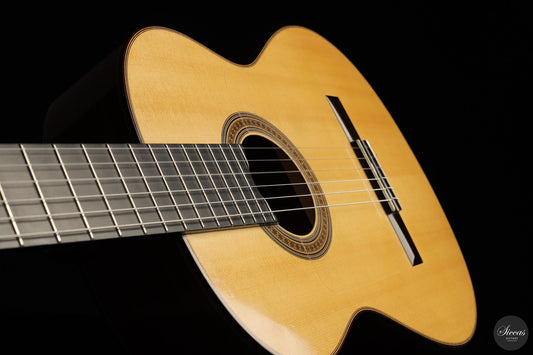
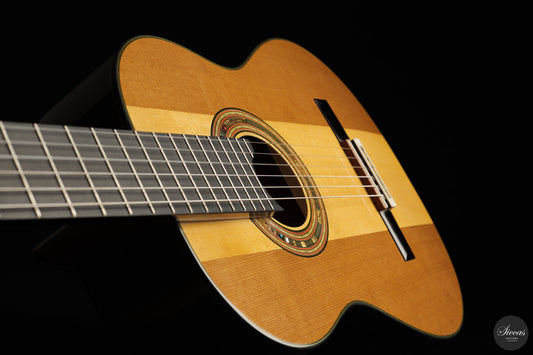
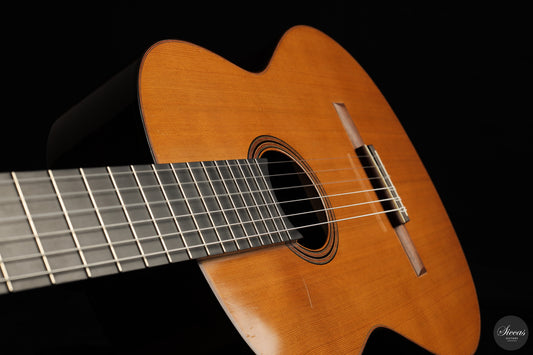
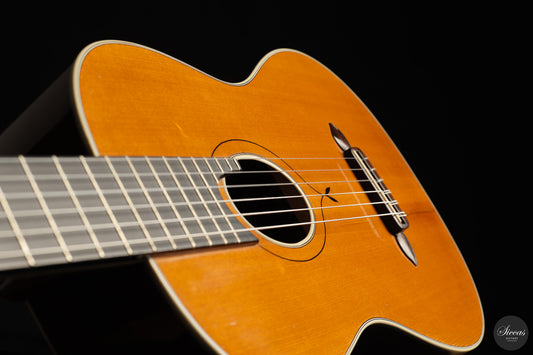
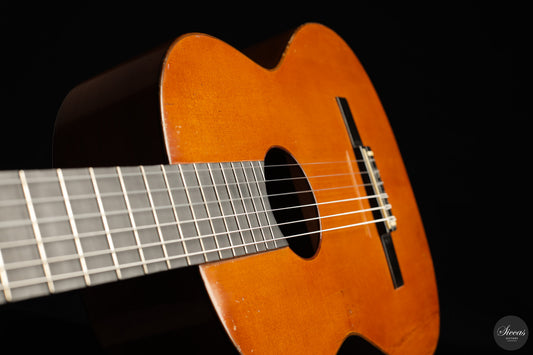
Evaluating a classical guitar without playing it may seem counterintuitive, yet experienced players, collectors, and professionals often form reliable assessments based on visual, structural, and contextual information. While direct playing remains irreplaceable, careful observation can reveal a great deal about an instrument’s potential, construction quality, and intended musical role.
Understanding the Maker and Provenance
The first step is identifying the luthier or workshop. A maker’s background, construction philosophy, and historical consistency provide essential context. Instruments by established builders tend to follow recognizable patterns in sound concept, materials, and execution.
Provenance also matters. Information about year of construction, previous ownership, and documented use by professional players can indicate how the instrument was positioned and maintained over time.
Examining Overall Proportions and Geometry
The general proportions of a guitar offer insight into its intended behavior. Body depth, lower bout width, and scale length often correlate with projection, balance, and response characteristics.
Symmetry and alignment are critical. A centered bridge, straight neck alignment, and evenly set fingerboard suggest careful construction and long-term stability.
Soundboard Quality and Visual Clues
The soundboard provides the most visible information. Even grain spacing, appropriate stiffness, and clean joint lines indicate thoughtful material selection. Excessively wide or irregular grain does not automatically imply poor quality, but consistency matters.
Subtle arching, controlled thickness transitions, and clean rosette integration suggest deliberate voicing rather than purely decorative work.
Bracing Indicators Through Observation
While internal bracing cannot be fully evaluated without inspection tools, certain indicators remain visible. Bridge shape, footprint size, and top stiffness around the bridge area can hint at the underlying structural concept.
Modern constructions such as lattice or double-top designs often show thinner tops and lighter visual mass, whereas traditional fan-braced guitars tend to present more visible structural weight.
Neck, Fingerboard, and Setup Indicators
The neck profile and fingerboard geometry provide valuable clues even without playing. Clean fretwork, accurate fret spacing, and a straight fingerboard plane suggest precision and predictability.
Nut and saddle workmanship also matters. Proper string spacing and clean slotting reflect attention to playability, even if final setup may be adjusted later.
Finish and Craftsmanship Details
Finish quality reveals much about a maker’s priorities. A thin, even French polish or carefully applied lacquer indicates controlled technique. Overly thick finishes can restrict vibration and often signal a production-oriented approach.
Details such as purfling joints, headstock transitions, and bridge carving reflect the level of handwork and refinement.
Material Selection Beyond the Soundboard
Back and side woods influence stability and long-term behavior. Well-matched rosewood sets, clean bending lines, and tight joints point to careful preparation.
Neck wood choice and reinforcement methods also matter, especially for long-term reliability under string tension.
Contextual Evaluation Through Documentation
High-quality photographs, detailed descriptions, and measured specifications help complete the picture. Trusted dealers often provide information about weight, action targets, and tonal orientation.
Recordings, even though indirect, can offer additional context when interpreted cautiously. They reveal tendencies rather than absolute sound.
Limits of Visual Evaluation
No visual assessment replaces direct interaction. Touch, resistance, and immediate response can only be judged through playing. However, careful evaluation can narrow choices and reduce uncertainty.
For collectors and buyers working remotely, these methods form a practical framework for informed decision-making.
Evaluating With Experience and Perspective
Learning to evaluate a classical guitar without playing it develops over time. The more instruments one encounters, the more patterns become recognizable.
For dedicated players and professionals, visual and contextual evaluation becomes a complementary skill, allowing efficient selection and deeper understanding of how craftsmanship translates into musical potential.