
Alejandro Sanz and the Spanish Guitar
Alejandro Sanz was born Alejandro Sánchez Pizarro in Madrid in 1968. He grew up in a household where music was present from an early age, and he began playing the guitar as a child. By his teenage years the instrument had become the central tool of his songwriting, and that relationship has remained unchanged across a career spanning more than three decades. Sanz has sold over 25 million albums, won more Grammy Latin awards than any other Spanish artist, and performed for audiences across Europe, Latin America, and the United States. The nylon-string guitar runs through the entire catalogue.
He has spoken plainly about the role of classical guitar in his formation. In multiple interviews he identified the instrument as the foundation of his playing and his approach to composition. The nylon string produces a warmth and a softness of attack that steel-string and electric guitars do not replicate, and Sanz built his harmonic vocabulary on that sound. The flamenco tradition, which shares the same instrument while treating it differently in terms of rhythm and technique, also left a clear mark on his playing. His guitar parts tend to use rasgueado-influenced strumming alongside more delicate melodic lines, drawing from both classical and flamenco idioms without being reducible to either.
The Nylon String in Latin Pop
Latin pop has always had a complicated relationship with the guitar. In the 1990s, when Sanz was establishing himself, the dominant production trend pushed toward synthesizers, programmed drums, and electronic textures. Acoustic instruments were either left out entirely or buried in the mix as decoration. Sanz resisted that direction. His debut album, Viviendo Deprisa, released in 1991, placed the acoustic guitar prominently. The production was spare enough that the nylon string remained audible as a structural element rather than an afterthought.
This was not a minor stylistic choice. The nylon string carries specific cultural and sonic associations. Its softness of tone requires a different approach to arrangement: other instruments must be balanced carefully around it, since the guitar cannot project over a loud rhythm section the way a steel-string can. Choosing it as the main harmonic instrument means committing to a certain dynamic range and a certain kind of intimacy in the sound. Sanz made that commitment early and maintained it even as his production values grew more sophisticated and his budgets increased.
Albums like 3 (1995) and Más (1997) reached enormous audiences across the Spanish-speaking world while keeping the acoustic nylon-string guitar at the center of the arrangements. Más in particular became one of the best-selling Spanish-language albums of the decade. The ballads on that record depend on the guitar in the same way that a string quartet depends on the cello: it anchors the lower harmonies while the voice and other instruments move above it. This is a classical approach to texture, applied in a pop context.
Classical Guitar as a Compositional Foundation
Sanz composes at the guitar. The songs begin on the instrument before any production decisions are made, and the harmonic structures he favors reflect the idiosyncrasies of the nylon-string fretboard. Classical guitar technique encourages a particular kind of voice leading: because the right hand must manage both melody and accompaniment simultaneously, the player tends to develop an ear for counterpoint and inner voices that piano-based composition does not automatically produce.
The chord voicings in Sanz's songs show this influence. He favors open-string resonance and positions that give harmonics space to sustain, which is characteristic of how classical guitarists think about chord construction. A pianist building a chord chooses from many possible voicings across the full keyboard range; a guitarist is constrained to what the left hand can physically hold on six strings, and those constraints produce specific sounds. The characteristic sound of Sanz's recordings, the mid-range warmth, the open ringing quality of the accompaniment, comes directly from those constraints.
This compositional approach links him to a broader tradition. Francisco Tárrega, the 19th-century guitarist who systematized the classical guitar repertoire and technique, developed much of the harmonic language that later became standard in Spanish popular music. The arpeggiated accompaniment figures, the particular resolution of certain chord progressions, the use of the capo to shift key while preserving open-string voicings: these are all elements that passed from the classical tradition into flamenco and then into Spanish popular song. Sanz absorbed them through the guitar itself.
Flamenco Influence and Its Limits
Flamenco and classical guitar share the same instrument but diverge sharply in technique and function. Classical technique prioritizes clean individual-note production, fixed right-hand position, and the interpretation of written scores. Flamenco technique prioritizes rhythmic precision, percussive strumming patterns called rasgueados, and a kind of expressive flexibility in timing that classical interpretation normally avoids.
Sanz grew up in Madrid, not in Andalusia, and he is not a flamenco guitarist. The flamenco influence in his playing is filtered through the broader tradition of Spanish popular music, which has absorbed certain flamenco elements without adopting the full technical and cultural framework. What remains is a rhythmic approach to strumming that is more percussive than classical playing typically allows, and a comfort with certain modal harmonies, particularly the Phrygian inflections of Andalusian cadences, that give Spanish pop its characteristic sound.
This distinguishes him from guitarists working strictly within the classical tradition, while connecting him to figures like the great classical guitarists who also navigated the relationship between flamenco and classical technique. Andrés Segovia, who spent decades establishing the nylon-string guitar as a serious concert instrument, came from Andalusia and brought a flamenco-inflected expressiveness to classical performance even while insisting on rigorous technique. Sanz operates in a different genre, but the cultural negotiation between these two guitar traditions is comparable.
The Grammy Latin Record
Sanz has won 26 Grammy Latin awards, which as of this writing is the record for a Spanish artist. He has also won three regular Grammy awards, including Best Latin Pop Album on multiple occasions. These awards span from the early 2000s through the 2020s, indicating a career that has maintained both commercial and critical standing across a long period.
The Grammy Latin organization covers a wide range of genres, from regional Mexican music to urban Latin to pop. Sanz has consistently been categorized in the Latin pop field, but his guitar playing places him closer to the acoustic singer-songwriter tradition than to the electronic production that defines much contemporary Latin pop. His longevity in a genre that cycles through trends rapidly is partly attributable to the stability of the acoustic guitar as his central instrument: it ages differently than synthesizer textures, which date quickly.
Collaborations and Cross-Genre Work
Sanz has collaborated with artists across genres, including Alicia Keys, Shakira, and various Latin American musicians working in rock and cumbia. These collaborations have sometimes required him to adapt his approach: working with an artist like Keys, whose production is piano-centered and soul-influenced, means the guitar moves to a supporting role rather than carrying the harmonic foundation.
Within his own projects, however, the nylon string remains primary. His collaborations with other guitarists have often been with artists who share a Spanish or Latin American guitar tradition. The instrument functions as a shared language in these contexts, a set of techniques and harmonic conventions that musicians from different countries within the Spanish-speaking world have in common.
This is not incidental. The Spanish guitar, meaning the nylon-string classical and flamenco guitar, is one of the few instruments that has maintained continuous presence across Spanish-speaking popular music from the 19th century to the present. The piano, the violin, the brass instruments of marching bands and salsa orchestras: these have all played important roles in Latin music. But the guitar is the thread that runs through almost every genre, from the concert works of Agustín Barrios to the singer-songwriter tradition to reggaeton, where even in a genre built on digital production, acoustic guitar samples and live guitar parts remain common.
Instrument Choice and Sound
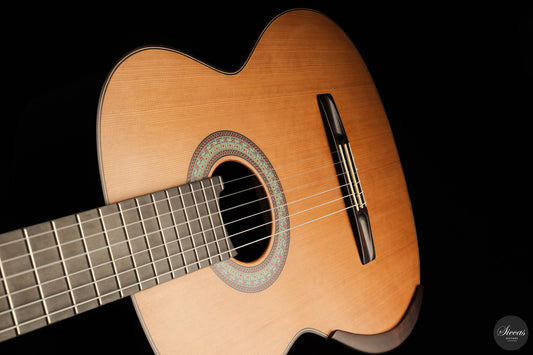
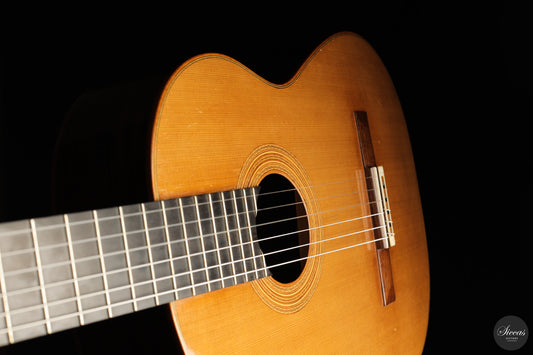
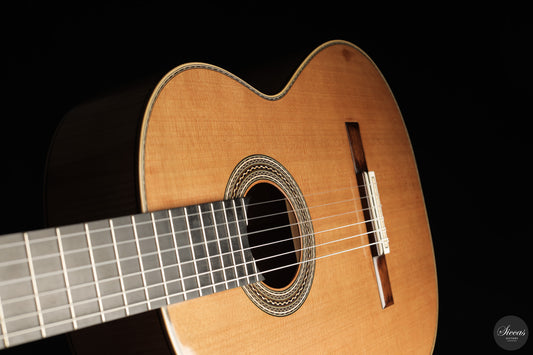
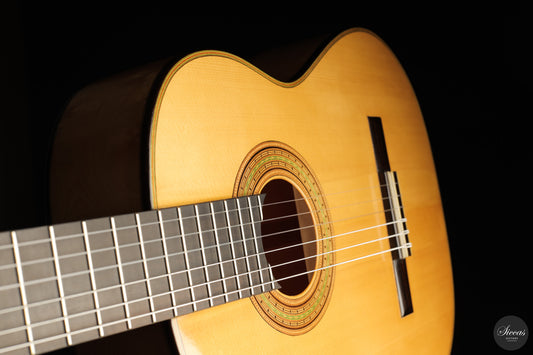
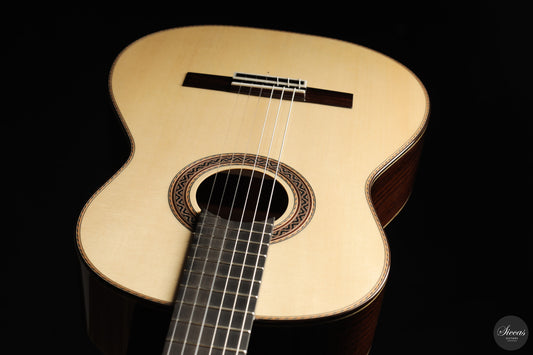
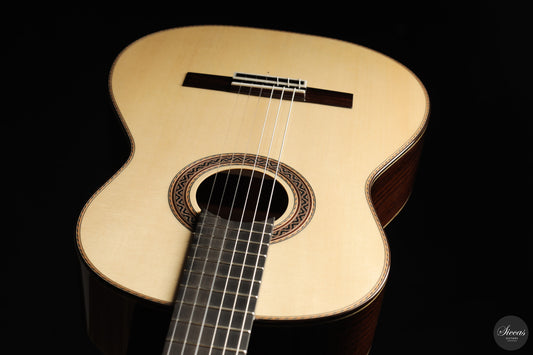
Sanz has used various nylon-string guitars over the course of his career. Spanish luthiers have historically produced some of the most important classical and flamenco guitars, and Spanish artists with his level of resources typically have access to instruments built by established makers. The specific guitars he has used in recording sessions and on stage are not extensively documented in publicly available sources, but the characteristic sound of his recordings reflects the acoustic properties of high-quality cedar-top or spruce-top nylon-string instruments.
Cedar tops tend to produce a warmer, darker tone with quicker response under the right hand, making them suitable for fingerstyle playing and the kind of intimate ballad accompaniment that appears throughout Sanz's catalogue. Spruce tops are brighter and project more strongly, which suits ensemble playing where the guitar must cut through a fuller mix. The recorded sound of his albums suggests primarily cedar-top instruments, though studio processing makes definitive assessment impossible from recordings alone.
For listeners interested in exploring the classical guitar tradition that underlies his playing, a broad selection of classical guitars is available at various price points, from student instruments to concert-level guitars built by Spanish and international luthiers. The acoustic properties that define the nylon-string sound, the warmth, the sustain, the characteristic attack, are present across this range, though the refinement increases significantly with the quality of the instrument.
Spanish Guitar in the Pop Context
Using a classical guitar as the primary instrument in a commercially successful pop career requires adapting the instrument to contexts it was not designed for. The classical guitar repertoire, from Tárrega through the 20th-century concert works associated with the famous classical guitar pieces, was built around solo performance or chamber music. Pop recording places the guitar in a different functional role: it must coexist with drums, bass, vocals, and various other instruments, often in a much denser acoustic environment than classical performance permits.
Sanz solved this problem partly through arrangement choices and partly through production technique. His recordings use the guitar in ways that respect its acoustic limitations: the arrangements leave space around the guitar part, the reverb and compression are applied to give the instrument presence without artificially altering its character, and the other instruments are balanced to sit alongside rather than over the guitar. This is a production philosophy as much as a performance choice, and it has produced a consistent sonic identity across his catalogue.
The Spanish guitar in pop music is sometimes treated as exotic flavor, used briefly to signal cultural identity before receding into a standard electronic arrangement. Sanz treats it as a structural instrument, the element the music is built from rather than decoration applied to a pre-existing structure. That distinction accounts for why his guitar playing sounds like the foundation of the music rather than an addition to it.
Legacy and Influence
Sanz's influence on subsequent Spanish-language pop is difficult to measure precisely, but his commercial success in the 1990s demonstrated that acoustic guitar-centered pop could reach mass audiences without compromising the instrument's acoustic character. Artists working in Spanish-language markets after him had evidence that this approach could work at scale.
His consistent use of the nylon-string guitar across three decades also keeps the instrument visible in pop contexts where it might otherwise have disappeared. The acoustic guitar's role in popular music has generally shifted toward steel-string instruments over the past fifty years, driven partly by the greater volume and projection of steel strings and partly by the association of steel-string playing with rock and folk traditions that have dominated global pop. In Spanish-language music, however, the nylon string has retained a stronger presence, and artists like Sanz are part of the reason.
For listeners coming to the Spanish guitar tradition through Sanz's music, the wider repertoire of the classical guitar offers a substantial body of work built on the same instrument and drawing from related harmonic traditions. The connection between acoustic and classical guitar traditions, and how nylon-string playing differs from steel-string technique and sound, is worth understanding for anyone who wants to explore further. Sanz represents one point in a much longer history of the guitar in Spanish musical culture, a history that includes flamenco masters, classical concert performers, and now Latin pop on a global scale.