
Classical Guitar in Film Music: The Hidden Voice of Cinema
Few instruments carry the emotional weight of a classical guitar. A single note can stop time. A melody can open a wound you forgot you had. And in the hands of the right composer, classical guitar becomes something more than a soundtrack — it becomes the film itself.
From the sun-bleached landscapes of Spaghetti Westerns to the intimate grief of wartime dramas, classical guitar film music has shaped how we feel at the movies for decades. This is not background noise. This is storytelling at its most direct.
Why Classical Guitar Works So Well in Film
There is something about the classical guitar that does not lie. Unlike orchestral strings or synths, it carries the physical signature of a human being — the slight breath between notes, the warmth of gut or nylon against wood, the almost imperceptible imperfection that makes it real.
For composers, that quality is irreplaceable. When a scene demands emotional truth rather than emotional spectacle, classical guitar delivers. It does not swell or overwhelm. It sits beside you and speaks quietly.
Its other great strength is cultural specificity. The instrument carries centuries of Spanish, Latin American, and Mediterranean tradition. A few bars of guitar can transport an audience to Andalusia, to a Brazilian favela at carnival, or to a dusty village square without a single establishing shot.
And yet it is also universal. The sound crosses cultural lines in a way few instruments manage. Audiences who have never heard a piece of classical guitar repertoire in their lives respond to it instinctively. Something in the timbre reaches past learned taste into something older.
Narciso Yepes and Forbidden Games (1952)
If there is a single moment that defined classical guitar's place in cinema, it may be René Clément's Forbidden Games (Jeux Interdits). The Spanish guitarist Narciso Yepes composed and performed the film's haunting score, built around a piece that would become one of the most recognized guitar themes in film history.
Yepes was not yet internationally famous when he took on the project. The film, which follows two children constructing a private cemetery for animals in the shadow of World War II, needed music that could carry grief without sentimentality. The guitar — intimate, unadorned, fragile — was the only instrument that made sense.
The result won the film a global audience and introduced millions of moviegoers to classical guitar as a serious cinematic voice. Yepes went on to become one of the foremost classical guitarists of the twentieth century, but Forbidden Games remains the work that brought him to the world's attention. The theme is still played today, still teaches, still moves.
The Deer Hunter and Cavatina (1978)
Stanley Myers's "Cavatina" is perhaps the most well-known piece of classical guitar film music in the English-speaking world. Performed by guitarist John Williams — the British classical guitarist, not the Star Wars composer — it appeared in Michael Cimino's The Deer Hunter and became inseparable from the film's devastation.
"Cavatina" was not written for the film. Myers composed it earlier, and it existed as a standalone piece before Williams arranged it for guitar. But the pairing with The Deer Hunter gave it a new life and a new weight. The melody's fragile beauty against the film's violence created a tension that the score could not have achieved any other way.
John Williams's performance — precise, controlled, and deeply feeling — demonstrated what a skilled guitarist can do with relatively simple material. There are no fireworks in "Cavatina." There is only presence. That is enough.
Ennio Morricone and the Western Guitar
Ennio Morricone's scores for Sergio Leone's Spaghetti Westerns are among the most immediately recognizable film music ever written. And at the heart of many of them is the guitar.
Morricone understood that the guitar carried a mythology. In the context of the American West as reimagined through Italian cinema, the instrument was both historically plausible and emotionally loaded. It spoke of loneliness, of open space, of a world where men settled things with silence before they settled them with violence.
His approach was often to strip the guitar back — sparse chords, single lines, long silences between notes — and let the space do the work. The guitar in a Morricone score does not fill the room. It occupies the room. That distinction matters enormously.
The influence of Morricone's guitar writing on film music is difficult to overstate. Every composer who has since reached for a guitar to evoke dusty roads or moral ambiguity is working in a tradition he helped create.
Gustavo Santaolalla: Guitar as Emotional Architecture
Argentine musician Gustavo Santaolalla represents a more recent chapter in the story of guitar in film. His scores for Ang Lee's Brokeback Mountain and Alejandro González Iñárritu's Babel each won the Academy Award for Best Original Score — back to back, in 2006 and 2007.
Both scores rely heavily on guitar. Santaolalla plays the ronroco, a small Andean stringed instrument related to the guitar, alongside standard acoustic and classical guitars. The result is a sound that is intimate without being small, regional without being exotic.
In Brokeback Mountain, the guitar theme for Jack and Ennis is one of the most emotionally precise pieces of film music in recent memory. It does not tell you how to feel. It creates a space in which feeling becomes possible. That is a very different, and much harder, thing to achieve.
Santaolalla also composed the acclaimed score for the video game and television series The Last of Us, where his guitar work carries the same quality: intimate, time-worn, achingly human. In a medium more often associated with orchestral bombast, his guitar scores stand apart.
Black Orpheus and the Brazilian Guitar Tradition (1959)
Marcel Camus's Black Orpheus (Orfeu Negro) brought Brazilian popular and classical guitar to a worldwide audience. The film's score, featuring music by Luiz Bonfá and Antônio Carlos Jobim, was built around the guitar in ways that reflected the instrument's centrality to Brazilian musical culture.
Bonfá's "Manhã de Carnaval" — morning of carnival — became one of the film's defining pieces, its melody rising with the warmth and melancholy that defines so much of the best Brazilian guitar music. The film introduced Bossa Nova to international listeners and demonstrated that the guitar, in the right cultural context, could carry an entire world.
The legacy of Black Orpheus in film music history is considerable. It showed that non-European guitar traditions could anchor a major international film and reach audiences far beyond their geographic origin.
The Concierto de Aranjuez on Screen
Joaquín Rodrigo's Concierto de Aranjuez is one of the most performed pieces in the classical guitar repertoire, and its second movement — the famous Adagio — has appeared in film and television more times than most people realize. One of its most powerful appearances came in Mark Herman's Brassed Off (1996), where it underscores a scene of profound personal and political loss.
The choice was not incidental. The Adagio of the Concierto carries a quality of restrained grief that is almost impossible to manufacture. Rodrigo composed it reportedly after a personal tragedy, and whatever the biographical truth, the music carries that weight. Used in film, it arrives pre-loaded with feeling.
The piece is also closely associated with Miles Davis's jazz reimagining on Sketches of Spain, which means it carries both classical guitar resonance and jazz associations simultaneously — making it unusually flexible as a cinematic tool. If you want to explore the piece further, our article on the most famous classical guitar pieces covers it in depth.
Talk to Her, Frida, and Cultural Guitar
Pedro Almodóvar's films have long used guitar — both classical and flamenco — as a carrier of cultural identity and emotional truth. In Talk to Her (2002), guitar music threads through the narrative in ways that comment on love, obsession, and the stories we tell ourselves.
Julie Taymor's Frida (2002) similarly used guitar as a marker of Mexican cultural authenticity, deploying the instrument to ground an otherwise stylized biography in something earthy and real. In both cases, the guitar was not decorative. It was doing structural work.
This is perhaps the deepest truth about classical guitar in film: it is almost never merely atmospheric. When a composer reaches for the guitar, they are usually reaching for something specific — a cultural register, an emotional texture, a level of intimacy that no other instrument quite provides. The flamenco guitar tradition and the classical tradition feed each other in these contexts, and the boundary between them in film scoring is often deliberately blurred.
The Guitar as Character
In the most interesting uses of classical guitar in film, the instrument stops being a score and starts being a presence. It becomes associated with a character, a place, a recurring emotional state.
When the guitar re-enters, the audience responds not just to the music but to what the music has come to mean over the course of the film. This is the highest use of any musical theme in cinema — and the classical guitar, with its capacity for variation within consistency, its ability to sound the same melody in a dozen emotional registers, is particularly suited to it.
Composers who understand this — Santaolalla, Morricone, Myers, Yepes — use the guitar not as a tool for scoring emotions but as a tool for structuring them. They give the audience a musical object to carry through the film, to return to, to recognize. And when the film is over, that melody stays.
Classical Guitar at Siccas Guitars
The guitars that produce the sounds described in this article are instruments of exceptional craftsmanship. The tone that Narciso Yepes drew from his guitar, the intimacy that Santaolalla achieves on his ronroco, the warmth of a Morricone guitar line — all of these emerge from the relationship between a skilled player and a well-made instrument.
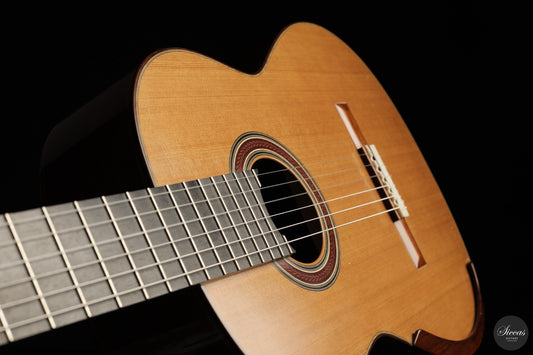
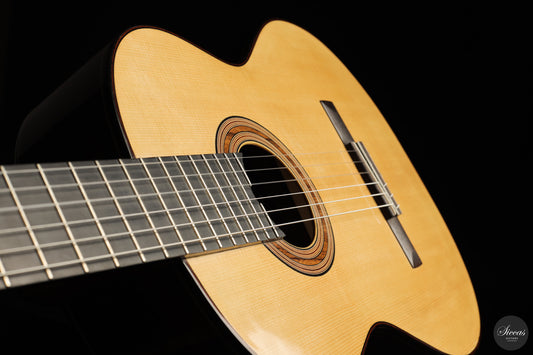
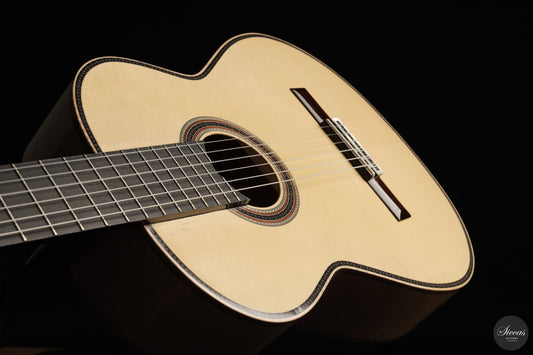
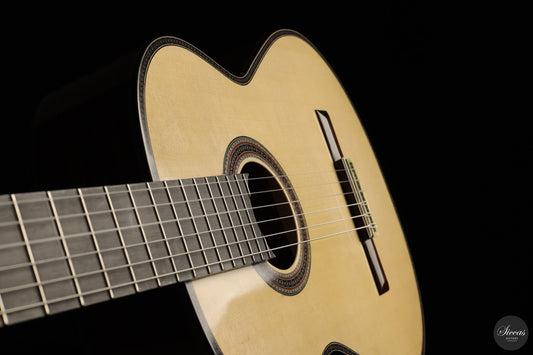
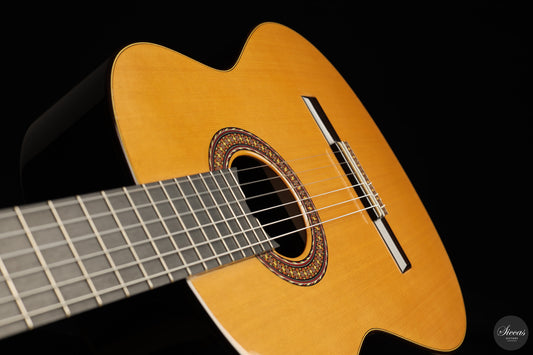
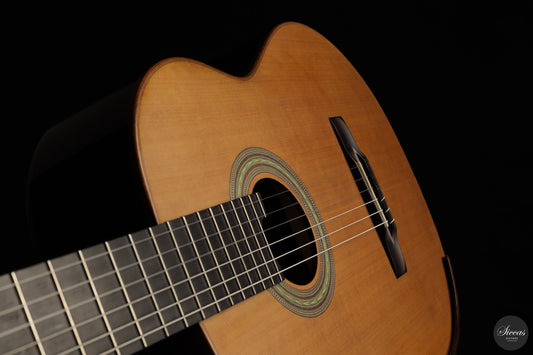
At Siccas Guitars, we specialize in exactly these instruments. Whether you are drawn to the bright projection of a spruce-top guitar or the warmer response of a cedar-top, whether you are looking for your first serious classical guitar or adding a professional instrument to your collection, our range covers the full spectrum of the luthier's art.
If you are curious about how different tonewoods affect the kind of sound these composers worked with, our spruce vs. cedar comparison is a good place to start. And if you are just beginning your own journey with the instrument, our guide on how long it takes to learn classical guitar may help you understand what lies ahead.
The guitar in cinema is not a relic. It is a living tradition, and the instruments being made today by the world's finest luthiers are the ones that will carry it forward. Explore our full collection of classical guitars and find the instrument that speaks to you.