
Most left-hand problems on the classical guitar come from one root cause: too much tension. In this lesson at Siccas Guitars, guitarist Matthew McAllister shares advice on the left hand. Here are the core principles to take away and practise.
Why the Left Hand Makes or Breaks Your Classical Guitar Technique
The left hand is the engine of classical guitar technique. It determines intonation, clarity, legato, speed, and — crucially — your long-term physical health as a player. Unlike steel-string acoustic or electric guitar, classical guitar left-hand technique follows specific conventions developed over centuries: thumb behind the neck, fingers curved, nails kept short on the fretting hand, and pressure kept to a minimum. These are not arbitrary rules; each exists because it enables something — cleaner tone, greater reach, less fatigue, more speed.
If you are coming from another guitar style, some of these habits will feel unfamiliar at first. That is normal. The goal of this guide is to give you a clear, principle-based map of classical guitar left-hand technique so that every hour of practice moves you in the right direction. For context on how the classical guitar differs structurally from acoustic guitars, see our overview of acoustic vs classical guitar key differences.
Relaxation: The Foundation of Everything
The left hand should work with the minimum effort that produces a clean note, and no more. Excess pressure and a clenched hand cause fatigue, slow you down, and can lead to injury over time. The first habit to build is noticing tension — and releasing it. Between phrases, between notes, even mid-passage.
This sounds simple, but it is the single most important thing you can do. Tension is cumulative. A tight thumb leads to a locked wrist, which leads to a rigid forearm, which limits everything above it. Experienced players learn to scan the entire left arm for tension as a matter of routine. You can start doing this from your very first lessons.
A useful exercise: play a single note, hold it, and ask yourself where you feel tension. Release it without losing the note. Do this on every note in a slow scale. You will be surprised how much unnecessary contraction is happening — and how much easier the guitar becomes once you let it go.
Thumb Position on Classical Guitar
The thumb sits behind the neck, roughly opposite the middle fingers, acting as a light counter-support rather than a clamp. This is one of the most consistently taught principles in classical guitar technique and one of the most commonly violated by self-taught players.
A thumb that creeps over the top of the neck — a habit common in folk and rock styles — restricts the spread of the fingers, limits your ability to place fingers perpendicular to the frets, and puts strain on the wrist. On classical guitar, the thumb stays behind the neck not because of tradition alone, but because it genuinely enables better hand function.
Key points on thumb position:
- Roughly behind the second or third finger, not anchored at one fixed point
- Contact point at or near the tip, not the side or base of the thumb
- Light, not gripping — the thumb supports, it does not squeeze
- Mobile — it should shift position as the hand moves up and down the neck
- The wrist should drop slightly away from the neck, allowing the fingers to arch over the strings naturally
When the thumb is correctly placed, the hand opens up. Stretches become easier, the fingers can act independently, and the risk of overuse injury drops significantly.
Finger Placement: Where to Press and How Hard
On classical guitar, the fingers of the left hand press the strings down just behind the fret — not on top of it, and not far back in the middle of the fret space. Pressing close to the fret is important because it minimises the distance the string has to travel before it is stopped cleanly, which means less pressure is required for a clear note.
The fingers should be curved, with the fingertip making contact at roughly a right angle to the string. Flat fingers — where the pad rather than the tip presses the string — are one of the most common sources of unintentional muting on adjacent strings. Curved fingers allow each fingertip to occupy its own space cleanly.
A practical check: look at your left hand while playing a simple chord or scale. Ask:
- Are the fingers pressing close to the fret?
- Are the knuckles forming an arch rather than collapsing flat?
- Is each fingertip clearly separated from the adjacent strings?
- Are the nails on the left hand trimmed short enough not to interfere with string contact?
On left-hand nails: nail-free playing on the fretting hand is standard in classical guitar. Even a millimetre of nail will prevent the fingertip from pressing at the correct angle and will cause the finger to tilt, which raises the pressure needed and often mutes neighbouring strings. Keep the left-hand nails trimmed to the fingertip.
Fingers Perpendicular to the Frets
One of the defining markers of classical guitar left-hand technique is the orientation of the fingers relative to the frets. Ideally, the fingers approach the strings at a roughly perpendicular angle — that is, pointing toward the frets rather than running parallel to the strings. This is what allows the fingertips to press cleanly without touching adjacent strings.
Achieving this angle depends on the wrist and elbow position. The wrist should come slightly forward (away from the body of the guitar), which rotates the hand so the fingers naturally approach the frets from a more vertical angle. The elbow drops slightly away from the body to facilitate this. Together, these adjustments produce the characteristic classical left-hand position that looks very different from how most folk or rock players hold the neck.
This takes time to develop, especially if you have played other guitar styles. Work on it slowly, with a mirror or video feedback, until it becomes natural.
Economy of Movement
Fast, fluent playing is built on small movements. Keep the fingers close to the strings rather than lifting them high. Prepare the next finger while the current note sounds. Avoid unnecessary motion. Efficiency — not force — is what creates speed.
This is sometimes called the principle of economy of movement, and it applies at every level of technique. A beginner lifting their fingers two centimetres off the strings every time they release a note is doing ten times the work of an experienced player whose fingers hover just above the strings, ready to fall. Over the course of a five-minute piece, those wasted movements add up to thousands of unnecessary contractions.
Practical applications of this principle:
- When shifting position, move the hand as a unit, not one finger at a time
- When releasing a note, let the finger simply rise rather than pulling it away
- When preparing a chord, place all fingers simultaneously rather than one by one where possible
- Use guide fingers (keeping one finger in contact with the string during a shift) to reduce movement and maintain orientation
Barre Technique: Full and Half Barre
The barre — where the first finger lies flat across multiple strings — is one of the most technically demanding aspects of classical guitar left-hand technique, and one of the most important. It appears constantly in the repertoire and requires its own systematic approach.
There are two main types:
Full Barre
The first finger covers all six strings at a given fret. The key challenge is achieving even pressure across all strings without excessive force. Rather than pressing hard from the front, a full barre works best when the wrist is positioned correctly (slightly forward), allowing the finger to lean slightly toward the nut rather than pressing flat. The bony part of the finger — away from the joints — makes the most reliable contact. You may need to adjust the angle of the first finger slightly to find the position where all six strings ring clearly.
Half Barre
The half barre covers two, three, or four strings with the first finger while the other fingers play above it. This is extremely common in classical technique and is often easier than a full barre because less surface area needs to speak. The same principles apply: lean slightly, use the correct part of the finger, keep pressure minimal.
Common barre errors to address:
- Pressing too hard, which causes fatigue and buzzing on the strings you are not trying to barre
- Placing the finger exactly on a joint, which produces dead notes — shift the finger slightly to avoid this
- Lifting the elbow too high, which reduces the mechanical advantage of the first finger
- Neglecting to keep the other fingers curved and close to the strings while the barre is held
Common Left-Hand Problems and How to Fix Them
Thumb too high or wrapped over the neck
This is by far the most common issue, particularly for players coming from other guitar styles. The fix is to consciously bring the thumb down behind the neck and check its position regularly in a mirror. It will feel strange at first because the muscles involved are weak. Be patient — the new position will become natural within weeks of consistent practice.
Fingers pressing flat rather than curved
Flat fingers are usually caused by weak finger independence or insufficient awareness of hand position. Slow-motion practice of scales — watching the hand closely — helps. Ensure the wrist position gives the fingers room to arch. If the wrist is too close to the neck, the fingers cannot curve properly.
Buzzing notes despite firm pressure
If you are pressing reasonably hard but still getting buzz, check the finger placement first — you are probably pressing too far from the fret rather than close to it. Also check whether a left-hand nail is preventing full contact with the string.
Pain or fatigue in the hand or wrist
Pain is a signal to stop and reassess. Most pain in the classical guitar left hand is caused by excess tension, poor wrist position, or practicing too long without breaks. Work in focused sessions of 20–30 minutes, take breaks, and if pain persists, consult a teacher or physiotherapist. Playing through pain is counterproductive and potentially injurious.
Slow chord changes
Slow chord changes are almost always a preparation problem. You are waiting until the last possible moment to think about the next chord. The solution is to plan one chord ahead at all times, to analyse which fingers stay in place or move the least between chords, and to practice transitions in isolation — just the movement between two chords — until the motion is automatic.
Matthew McAllister on Left-Hand Fundamentals
Matthew McAllister's tutorial at Siccas Guitars covers the core left-hand principles in a focused, practical format. His approach emphasises minimum tension, correct thumb placement, and the development of efficient habits from the start — exactly the principles covered in this guide. Watching a professional guitarist demonstrate these concepts in real time is one of the most effective ways to internalise them.
How to Practise Left-Hand Technique Effectively
Knowing the principles is one thing; building them into reliable habits requires deliberate practice. Here is a framework that works:
Slow practice with awareness
Work at a tempo where you can observe your hand continuously. Use a mirror, or record short videos of your hand from above and from the side. Look for the specific issues described above. Slow practice is not just for learning notes — it is the primary tool for building correct technique.
Isolate the problem
Do not practice a whole piece hoping the difficult passage will fix itself. Extract the bar or phrase that is giving you trouble. Practice just those two or three notes or that one chord change, repetitively, until the motion is automatic.
Build tempo gradually
Once a passage is clean at a slow tempo, increase tempo in small increments. A metronome is essential here. The goal is to raise tempo while maintaining exactly the same quality of hand position and minimum pressure. If quality breaks down, drop the tempo.
Connect left and right hands
Left-hand technique cannot be fully separated from right-hand technique. The sound you hear depends on both. Practice with the right hand in its correct position so that you are always training the coordination between the two. For a comprehensive approach, pair this work with attention to your right-hand positioning and tone production.
If you are mapping out a broader learning journey, our guide on how long it takes to learn classical guitar gives a realistic picture of what to expect at each stage. And if you want to hear how left-hand mastery sounds in the hands of the greats, our collection of famous classical guitar pieces is a good place to start.
The Guitar Matters Too
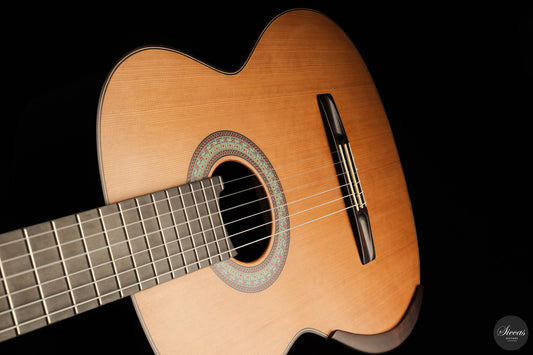
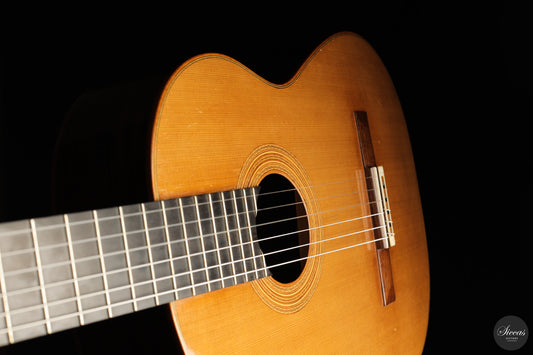
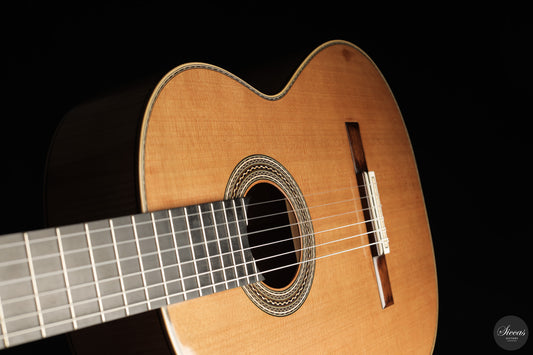
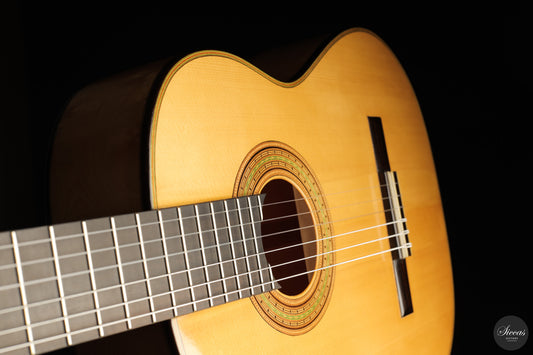
Left-hand technique is inseparable from the instrument you play. A guitar with a very high action (string height) forces you to press harder, which encourages tension and bad habits. A well set-up classical guitar — with appropriate action, good intonation, and a neck width suited to your hand — makes correct technique significantly easier to achieve.
Cedar-top guitars often have a slightly more immediate response that can be forgiving for developing players; spruce tops tend to reward more developed technique with greater dynamic range. For a deeper look at how top wood affects playability and tone, see our comparison of spruce vs cedar classical guitars.
If you are looking for an instrument to support your technique development, our full range of classical guitars includes instruments at every level. For players ready to invest in a concert-level instrument, the double-top guitars in our collection represent some of the finest left-hand-responsive instruments available today.
FAQ
Where should the left thumb go on classical guitar?
Behind the neck, roughly opposite the second or third finger, relaxed and acting as light support. It should not grip over the top of the neck. Keep it mobile — it moves with the hand rather than anchoring in one place.
Should my fingers be curved on classical guitar?
Yes. The fingertips should make contact at roughly a right angle to the string, with the knuckles forming an arch. Flat fingers tend to mute adjacent strings and require more pressure to produce a clean note.
How hard should I press the strings on classical guitar?
Only as hard as needed for a clean note. A useful test: find the lightest pressure that still produces a clear tone and stay there. Most beginners press far harder than necessary.
Why do classical guitarists keep their left-hand nails short?
Nails on the fretting hand prevent the fingertip from making clean contact at the correct angle. Even a small amount of nail causes the finger to tilt, which requires more pressure and often mutes adjacent strings. Nail-free playing on the left hand is standard practice.
What is a barre chord on classical guitar?
A barre is where the first finger lies flat across multiple strings at a single fret. A full barre covers all six strings; a half barre covers two to four. Barre chords are fundamental to classical guitar and appear throughout the standard repertoire.
How do I stop buzzing notes on classical guitar?
First check that your finger is pressing close to the fret, not in the middle of the fret space. Then check that your left-hand nails are fully trimmed. If both are correct, the issue may be insufficient pressure or a setup issue with the guitar's action.
How do I play faster on classical guitar?
Through economy of movement and relaxation, not through force. Keep fingers close to the strings, prepare movements in advance, and build tempo gradually with a metronome. Speed is a by-product of efficient technique, not of trying harder.
Can I learn classical guitar left-hand technique on my own?
You can make substantial progress with good resources, but a teacher — even occasionally — is very valuable because bad habits are easy to develop and hard to see in yourself. Video recordings of your own hand are a good substitute when a teacher is not available.
For further reading on the classical guitar world, including profiles of the players who have shaped the instrument's technique, visit our profiles of great classical guitarists. And if you are still deciding whether classical guitar is the right instrument for you, our guide to acoustic vs classical guitar covers the key differences in detail.
Browse our classical guitars · Famous classical guitar pieces