What gives the track its irresistible character is its construction: a repeated, syncopated melodic phrase over a driving rhythmic foundation. There is very little harmonic complexity — the power comes entirely from groove, repetition and attitude. Those are precisely the qualities that translate well to the guitar, and in particular to classical guitar technique, where the separation of bass and melody voices allows a single player to recreate both the rhythmic drive and the recognisable hook simultaneously.
Tutorial: Karlijn Langendijk on Siccas Guitars
The tutorial on the Siccas Guitars YouTube channel is presented by guitarist Karlijn Langendijk, who walks through the arrangement step by step with clear fingering guidance and tempo breakdowns. The video is designed to be beginner-friendly while still giving more advanced players useful technical pointers — particularly on how to handle the syncopated rhythm cleanly at speed.
If you are working through the arrangement for the first time, watch the full video before picking up your guitar. Understanding the overall shape of the piece — where the phrases repeat, where variations occur, and how the rhythm is subdivided — will save you considerable time when you begin practising hands-on.
Why the Ghostbusters Theme Works on Classical Guitar
At first glance, a 1984 pop hit and a classical guitar might seem like an unlikely pairing. In practice, the arrangement is a natural fit for several reasons:
The Hook Sits Naturally in the Hand
The recognisable riff is built on a compact set of notes that can be arranged comfortably across a small area of the fretboard. This means you are not jumping across positions or stretching awkwardly — the phrase sits in the hand in a way that feels idiomatic once you have the fingering sorted. Classical guitar technique, with its precise right-hand finger independence, is especially well suited to bringing out the melodic line clearly above the bass and rhythm.
Thumb and Fingers Handle Both Voices
The hook is built on a syncopated, repeated phrase with a driving bass line — exactly the kind of texture that sits naturally on the guitar, where the thumb handles the low strings while the fingers carry the melodic content. This division of labour is one of the core techniques in classical guitar playing, and working on this arrangement will reinforce that fundamental skill in a context that is immediately rewarding.
Character Over Delicacy
This is not music that demands a refined, whispery tone. The Ghostbusters Theme needs conviction and rhythmic authority. That is actually liberating: you can dig in, project, and play with genuine physical commitment without worrying about nuance. For players who sometimes find classical repertoire overly demanding of perfection, a piece that rewards energy and drive can be a refreshing change of pace.
Instant Audience Recognition
Very few pieces in the pop canon are as immediately recognisable as this theme. Two notes in, anyone who grew up in the 1980s or has seen the film will know exactly what you are playing. That instant recognition makes it an ideal piece for informal performances, open mics, or simply entertaining friends — the reaction is guaranteed.
How to Approach the Arrangement
Start with the Rhythm
Before worrying about notes, internalise the rhythm. Clap or tap it. The hook's energy comes entirely from the way the notes land slightly off the beat — this syncopation is the whole point, and if the rhythm is vague or uneven, the piece loses its character completely. A metronome is your best friend here: set it slow, get the placement of each note precise, then gradually increase the tempo.
Separate the Voices
Practise the bass line alone, then the melody alone, before combining them. This is standard classical guitar practice for any polyphonic piece, and it applies equally here. Once each voice is secure in isolation, putting them together becomes significantly easier because your hands know exactly what they are supposed to be doing independently.
The Call and Response
If your arrangement includes the vocal call-and-response pattern — the quiet question followed by the loud, driving answer — lean into that contrast. The dynamic difference is what gives the passage its theatrical quality. A flat, uniform dynamic level throughout will make the piece feel lifeless. Play the question softly and the answer with full conviction.
Tempo and Groove
Keep the tempo firm and steady. This is groove-based music: a slight rush or drag in the rhythm is far more damaging here than it would be in a Romantic-era piece where rubato is expected. Once you have the groove locked in at a slower tempo, work it up gradually. Do not play it fast until it sounds right slow.
Difficulty Level
Beginner to intermediate. The core hook is genuinely approachable for players who have mastered basic right-hand finger independence and can maintain a steady pulse. The main technical challenge is not the notes themselves but getting the syncopation tight and convincing. Fuller arrangements with more complex accompanying bass lines and rhythmic variations raise the technical demand into intermediate territory, but the essential version of the piece is well within reach for a dedicated beginner. It is also a reliable crowd-pleaser at any level — audiences respond to the recognition, not the technical execution.
Choosing the Right Guitar
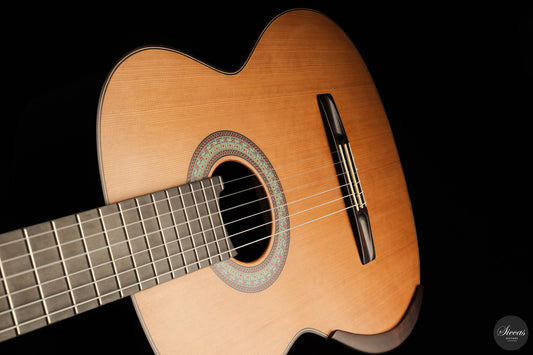
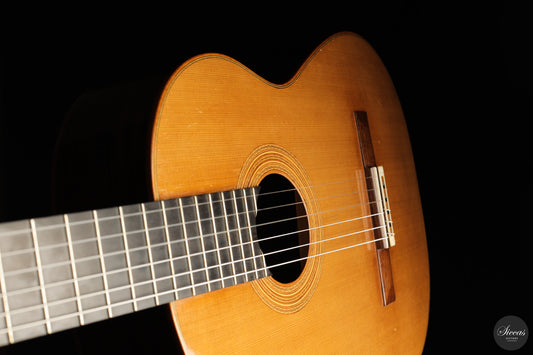
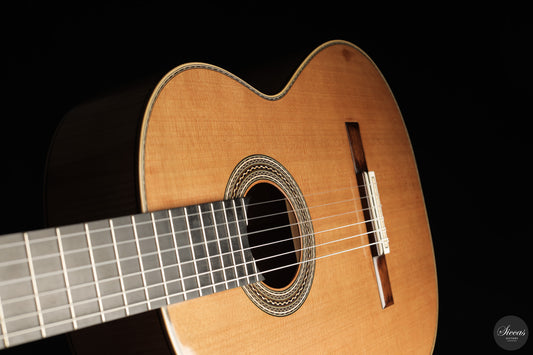
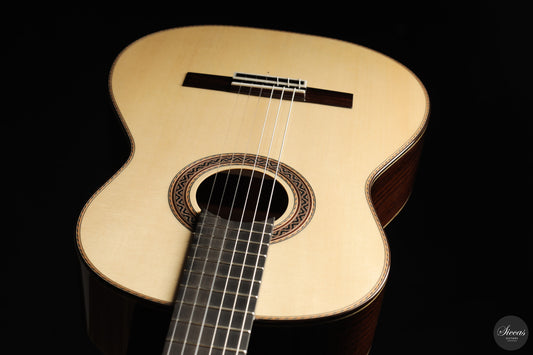
Because this arrangement is about rhythm and projection rather than tonal subtlety, it works well on a wide range of instruments. That said, a guitar with clear note separation and good sustain in the bass will help the two-voice texture come through cleanly. Both spruce-top and cedar-top instruments are suitable — spruce tends to give a more immediate, projecting attack that suits the assertive character of this piece, while cedar offers a warmer, rounder tone.
If you are curious about how top wood choice affects the sound of arrangements like this, our guide on spruce vs cedar classical guitars covers the tonal differences in detail. For a broader look at the instrument, acoustic vs classical guitar explains why the classical guitar's construction and technique make it uniquely suited to single-player arrangements of this kind.
Browse our full selection of classical guitars if you are considering an upgrade, or explore our range of double-top guitars for instruments with exceptional projection and dynamic range.
Taking Your Playing Further
The Ghostbusters Theme is a great entry point into a wider world of pop and film music arranged for classical guitar. Once you are comfortable with this piece, you might enjoy exploring the broader catalogue of famous classical guitar pieces — many of which share the same characteristic of a strong, immediately recognisable melody that rewards clear voicing and rhythmic precision.
If you are relatively new to the instrument, our guide on how long it takes to learn classical guitar gives a realistic picture of the journey ahead, with practical advice on how to structure your practice for steady progress. And if you want inspiration from the masters, our overview of great classical guitarists is a good starting point for discovering players whose technique and musicianship will give you something to aspire to.
FAQ
Who wrote the Ghostbusters Theme?
The Ghostbusters Theme was written and performed by Ray Parker Jr. It was released in 1984 alongside the Ivan Reitman film of the same name and won a Grammy Award for Best Pop Vocal Performance, Male, in 1985.
Is the Ghostbusters Theme hard on guitar?
The basic hook is beginner-friendly. The main challenge is getting the syncopation tight and maintaining a steady, convincing groove throughout. Fuller arrangements with more complex bass lines are intermediate-level, but the core riff is well within reach for a dedicated beginner.
Can I play the Ghostbusters Theme on classical guitar?
Yes. The syncopated riff and driving bass line are a natural fit for classical guitar technique, where the thumb and fingers can handle both voices simultaneously. The Siccas Guitars tutorial by Karlijn Langendijk walks through a beginner-friendly arrangement step by step.
What position is the Ghostbusters riff played in on guitar?
The recognisable riff can be arranged in various positions on the fretboard. The tutorial on the Siccas Guitars channel covers the specific fingering in detail — watch it through before starting to practise so you understand the layout before you pick up the guitar.
What kind of guitar is best for pop arrangements like this?
A classical guitar with clear note separation and a firm attack works well. Spruce-top guitars tend to project more assertively, which suits the rhythmic character of the piece. Browse our classical guitar collection for a range of options at different price points.