
Have Yourself a Merry Little Christmas on Classical Guitar
Few songs carry the emotional weight of "Have Yourself a Merry Little Christmas." Written by Hugh Martin and Ralph Blane in 1943, it premiered in the MGM musical Meet Me in St. Louis, performed by Judy Garland. The song was not an instant hit — in fact, Garland reportedly found the original lyrics too bleak and pushed Martin to revise them. The revised version became one of the most recorded Christmas songs in history.
On classical guitar, the song finds a second life. The nylon string removes any trace of sentimentality-by-formula and replaces it with something quieter and more direct. The warm sustain of a cedar or spruce top carries the melody without forcing it. What makes classical arrangements of this song work is precisely what makes the song itself work: restraint.
The History of the Song
Hugh Martin composed the music and wrote the lyrics together with Ralph Blane for the 1944 film Meet Me in St. Louis (the film was shot in 1943 and released in November 1944). Judy Garland sang the song as a lullaby to her younger sister in the film — a scene that becomes one of the emotional cores of the entire story.
The original lyrics contained the line "Until then we'll have to muddle through somehow," which Garland found too gloomy. Martin rewrote it to "Hang a shining star upon the highest bough," the version most people know today. A third version was written later by Frank Sinatra's request in 1957, changing "someday soon we all will be together" to "from now on our troubles will be out of sight" — a more optimistic reading suited to a postwar American audience.
The song belongs to that specific category of mid-century American popular song that works by implication rather than declaration. Its emotional power comes not from what is said but from what is held back. The verse acknowledges uncertainty and distance; the chorus offers comfort without false promise. That tension is part of why the song endures.
By the 1960s it had been recorded by Frank Sinatra, Ella Fitzgerald, Tony Bennett, and dozens of others. Today it appears on virtually every classical Christmas album as well, a measure of how far it has traveled from its original cinematic context.
Why Classical Guitar Suits This Song
Most Christmas standards were written for voice and piano. Translating them to solo guitar requires decisions about which element leads — melody, harmony, or bass line. With "Have Yourself a Merry Little Christmas," the melody is strong enough to carry the piece on its own, which means a good arrangement can let the harmony breathe rather than filling every beat.
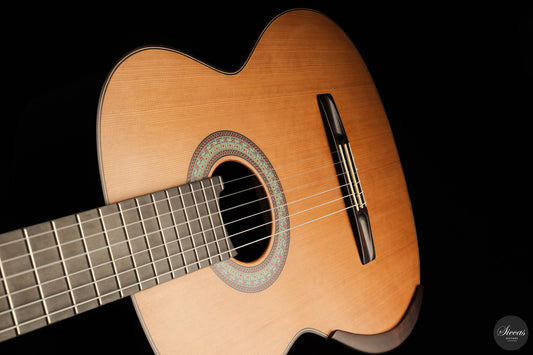
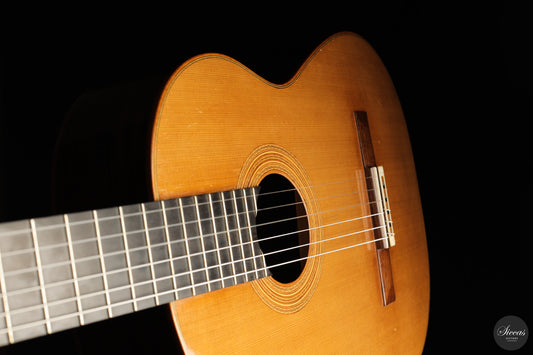
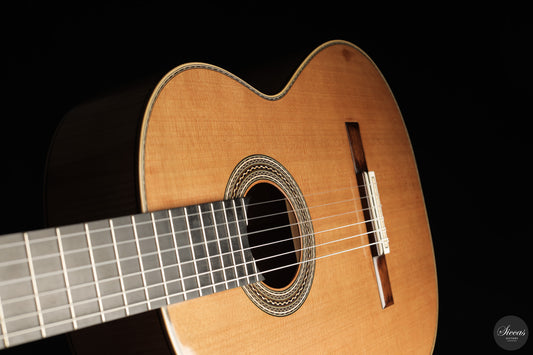
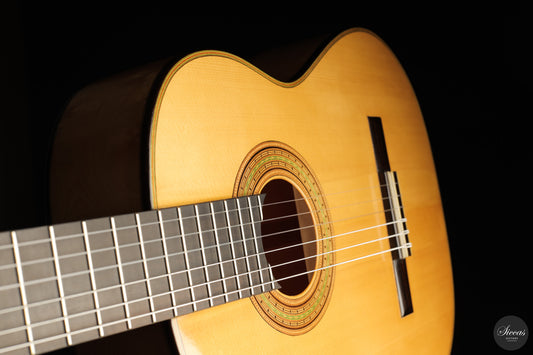
Nylon strings produce a rounder, warmer tone than steel strings, which changes how the song reads emotionally. On a steel-string acoustic, the song can feel nostalgic in a somewhat glossy way. On a classical guitar — especially an instrument built with cedar and lattice bracing, or spruce and traditional fan bracing — the same notes feel more intimate, more interior.
The guitar also allows for a slower, more deliberate tempo without losing rhythmic clarity. A pianist working through the song at a slow tempo has to choose between sparse texture and florid ornamentation. A guitarist can hold a sustained bass note through a full measure while the melody moves above it, creating a kind of natural two-voice counterpoint that suits the song's reflective quality.
Arpeggiated accompaniment patterns work especially well here. Rather than block chords, breaking the harmony across the beat creates movement without urgency — exactly the character the song needs. This technique also gives each note space to ring, which is where a well-made classical guitar earns its keep.
Technical Aspects of the Classical Guitar Arrangement
Most classical arrangements of this song are set in G major or F major, keys that sit comfortably on the guitar and allow for open string resonance on the tonic. A G major arrangement lets the low open G string anchor the bass through large sections of the piece, while the melody sits in a comfortable range on the upper three strings.
The primary technical challenge is maintaining the legato quality of the melody against a moving inner voice or bass line. This requires precise right-hand control — the melody finger must produce a slightly louder, more sustained tone than the accompanying voices. Classical technique handles this through deliberate differentiation of touch: the nail stroke for melody notes, a softer pad-and-nail contact for inner voices.
The chromatic passing tones in the harmony require careful fingering in the left hand. The song's chord progression moves through some non-diatonic chords — particularly the descending inner voice in the bridge section — that need clean half-barres and precise thumb positioning to avoid unwanted muting.
Vibrato on sustained melody notes adds warmth without distorting the pitch. On nylon strings, horizontal (lateral) vibrato is standard; it produces a subtle pitch oscillation that reads as expressiveness rather than intonation problem. The key is consistency — not every long note needs vibrato, but the choice should be deliberate.
Dynamics matter more in this song than in many others. The song's structure moves through two full verses and a bridge. A flat dynamic reading makes the bridge feel like more verse rather than a turn. Building slightly through the second verse and then pulling back for the bridge creates the internal contrast that keeps the listener's attention through six or seven minutes of mostly slow, lyrical playing.
The Classical Guitar in Context: Repertoire and Tradition
Christmas music occupies an interesting position in the classical guitar's repertoire. The instrument has a long tradition of sacred and devotional music — from Renaissance lute arrangements of liturgical pieces to the Spanish baroque guitar's role in church music. Arranging secular Christmas standards for classical guitar draws on a different tradition: the parlor guitar, the salon recital, the domestic music-making of the nineteenth and early twentieth centuries.
Guitarists like Francisco Tárrega wrote numerous short character pieces and arrangements of popular melodies — not as lesser works, but as demonstrations of the guitar's expressive range in a domestic setting. The same impulse drives Christmas arrangements today. A well-played arrangement of "Have Yourself a Merry Little Christmas" shows what the instrument can do in a context that most listeners already know emotionally, which makes the guitar's specific qualities easier to hear.
The classical guitar repertoire includes many pieces that share the reflective, inward quality this song requires — the slow movements of Giuliani's concertos, the nocturnes of Sor, the andantes of Agustín Barrios. Playing Christmas music on classical guitar is not a departure from the instrument's serious tradition; it is an extension of the same capacity for intimate expression.
Bach's music for lute and keyboard, when arranged for guitar, shares something with the best Christmas arrangements: both require the player to make a complete musical world from a single instrument, without the support of ensemble texture or the obvious drama of a concerto. That discipline — making something whole from limited means — is what classical guitar does best.
Choosing the Right Guitar for This Repertoire
Not every classical guitar serves this music equally well. The song rewards instruments with clear treble definition and warm, sustained bass. A guitar that is overly bright in the upper register will make the melody feel sharp rather than singing. A guitar with weak bass sustain will let the harmonic foundation drop out between beats, breaking the legato illusion the arrangement depends on.
Cedar tops generally produce more immediate warmth and a rounder initial attack, which suits the intimate character of this song. Spruce tops tend toward more projection and a longer sustain that can work well if the room is large — but in a smaller space, the cedar's softness is usually preferable.
For players looking at classical guitars suited to this kind of lyrical playing, the key factors are consistent string response across all six strings, good bass-treble balance, and low action that allows comfortable left-hand shifts without buzz. A guitar that requires force to produce tone will always sound effortful in slow, expressive music.
Scale length also matters. A standard 650mm scale suits most arrangements of this song. Slightly shorter scale lengths (640mm or less) can ease the left-hand stretches in some fingerings and allow a lighter touch for the same dynamic level, which helps with the pianissimo passages the song often calls for.
Playing the Song: Practical Notes for Guitarists
Tempo is the first decision and usually the hardest. The song is easy to play too slowly. A common error is conflating slow tempo with expressiveness — the two are not the same. At a very slow tempo, the phrase lengths expand until the harmonic rhythm loses momentum and the listener loses the thread of the melody. A moderate walking tempo (around 60–66 bpm for the quarter note) gives the song space without sacrificing forward motion.
The introduction, if you add one, should establish the harmonic world before the melody enters. A brief arpeggio figure on the tonic chord — two or four bars — sets the register and gives the audience time to settle. Starting directly with the melody is also legitimate, but the abruptness requires a very confident entrance.
The bridge section ("Someday soon we all will be together") is where most arrangements either lift or fall flat. If the dynamic and textural contrast is already used up in the second verse, the bridge has nowhere to go. Holding something back — a slightly softer dynamic, less ornament, thinner texture — gives the bridge its proper weight as the emotional center of the song.
The final verse can then bring everything back with more presence: fuller tone, perhaps some added bass movement, and a final phrase that ends with a long, sustained tonic. A brief ritardando in the last two bars is idiomatic here — this is one of the places where slowing down is expected, not a sign of lost tempo.
For players working on classical guitar technique more broadly, this song is useful practice for right-hand tonal differentiation, left-hand legato shifts, and dynamic shaping over a long phrase. It asks for exactly the skills that distinguish clean classical playing from merely correct playing.
The Song's Place in the Christmas Canon
Among the great classical guitarists, Christmas recordings have generally occupied a separate category from their concert work — something made for the season, enjoyed and set aside. That separation has softened in recent decades. Recordings of Christmas music now appear regularly alongside serious recital programs, and the boundary between "seasonal" and "serious" repertoire has become less meaningful.
"Have Yourself a Merry Little Christmas" sits at the thoughtful end of the Christmas standard repertoire. It does not rely on the bright, marchlike energy of "Jingle Bells" or "Deck the Halls." Its emotional register is closer to something like the slow movement of a Romantic character piece — reflective, a little melancholy, finally consoling. That profile makes it particularly well-suited to classical guitar, an instrument whose expressive range runs in exactly that direction.
The song has now been performed for over eighty years. In that time it has been arranged for virtually every instrument and ensemble. The classical guitar version is not a novelty — it is a natural fit, and one that reveals the song's construction more clearly than many louder, more orchestrated readings. On nylon strings, stripped of everything but melody, harmony, and bass, the song's quality as a composition becomes audible in its own right.
Recording and Performance Contexts
The song works in several performance contexts on classical guitar. In a solo recital setting, it makes a strong encore — familiar enough to feel like a gift to the audience, substantial enough to end a program with real musical weight. In a recording context, the intimacy of close-mic placement suits the song well: the natural resonance of the guitar body and the breath of the room become part of the sound, adding presence without reverb processing.
In a duo or small ensemble setting, the guitar takes naturally to a supporting role as well. A flute-guitar duo, for instance, can divide the melodic and harmonic material so that each instrument has distinct function. The guitar's harmonic clarity and the flute's legato sustain complement each other without competing.
For players preparing the song for a live performance, the practical advice is straightforward: memorize it, play it slowly enough to hear what you are doing, and resist the temptation to ornament every phrase. The song's simplicity is not a problem to be solved — it is the point. The classical guitar is well-equipped to honor that.