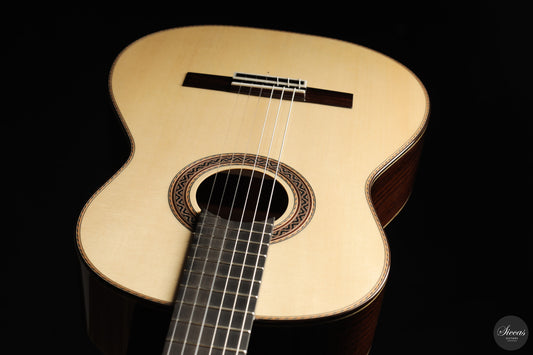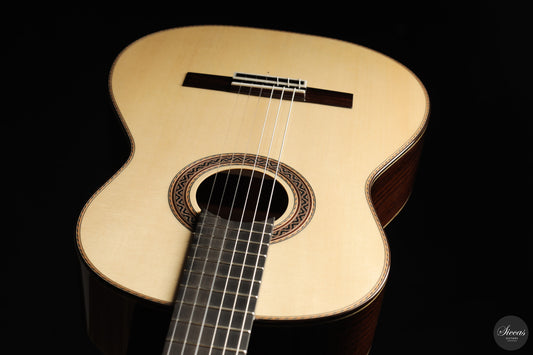

How Is a Classical Guitar Made?
A fine classical guitar looks simple — a wooden box with six strings. But inside that box is the result of dozens of precise steps, deep material knowledge, and — in a master's workshop — hundreds of hours of patient, skilled work. Understanding how a classical guitar is made helps explain why great instruments sound the way they do, and why they cost what they cost.
Step 1: Choosing the Wood
Everything begins with tonewood selection, and this is where a maker's knowledge and taste first become apparent. The materials of a classical guitar are largely standardised by tradition, but within each category there is enormous variation in quality.
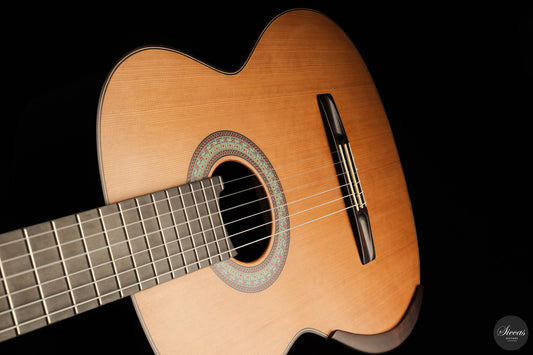
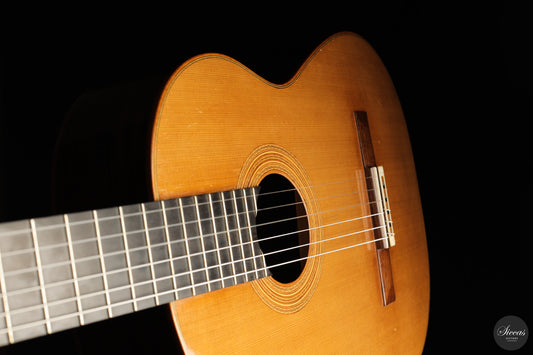
- Soundboard (top): Spruce or cedar, split and book-matched so the grain runs symmetrically on either side of the centre seam. The top is the acoustic engine of the instrument; its stiffness, density, and internal resonance properties largely determine the guitar's voice. Makers typically reject the majority of tops they examine, looking for the right combination of stiffness, evenness of grain, and tap-tone response.
- Back and sides: Traditionally rosewood (Brazilian or Indian), though maple, mahogany, cypress, and many other species are used. The back and sides form the resonating box and contribute to the guitar's tonal character — rosewood typically gives a warm, complex sound; cypress (used in flamenco guitars) gives a brighter, drier response.
- Neck: Cedar or mahogany, strong and stable enough to resist the tension of six strings.
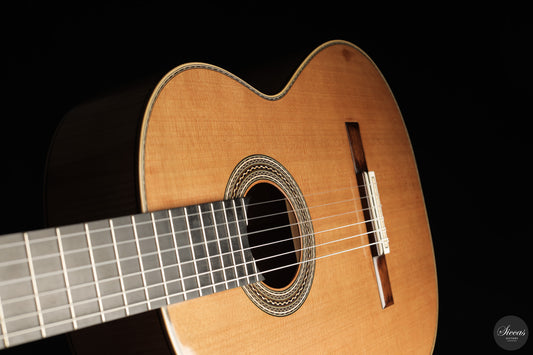
- Fingerboard and bridge: Traditionally ebony — hard, dense, and durable — or rosewood.
All these woods are stored and dried for years, sometimes decades, before use. The drying (seasoning) stabilises the wood's moisture content so the finished guitar will not crack or warp as humidity changes.
Step 2: The Soundboard
The soundboard is the most critical structural element. The maker first joins the two halves along the centre seam, then thins the top to the correct graduation — typically around 2.5 to 3 mm across most of the surface, thinner at the edges. This process is largely done by hand with planes and scrapers, with the maker tapping the plate repeatedly and listening to the sound it produces. Graduation is an art: the maker adjusts thickness in different zones to achieve the right stiffness-to-mass ratio for the sound they are aiming for.
Step 3: Fan Bracing
The underside of the soundboard is reinforced with a system of light wooden struts. The standard design for classical guitars is fan bracing — a pattern of seven struts fanned out from the area below the soundhole toward the lower bout. This design was perfected by Antonio de Torres (1817–1892) and remains the foundation of classical guitar construction. The fan braces control how the top flexes and vibrates; their placement, height, and stiffness are critical variables that the maker adjusts by ear.
Modern variations include the lattice bracing system — a grid of carbon fibre or spruce replacing the traditional fan — which allows a thinner, lighter top with more power and projection. Double-top construction uses two very thin layers of wood sandwiching a lightweight core material. These modern approaches can produce very different tonal characteristics from the traditional fan-braced design.
Step 4: Bending the Sides
The sides are thin strips of wood, typically 2–2.5 mm thick, that must be bent into the guitar's distinctive waist and curve. This is done by dampening the wood slightly and pressing it against a heated bending iron — a metal tube heated to a temperature that allows the wood fibres to relax and take a new shape. The bending requires skill and care: too little heat and the wood resists; too much and it scorches or splits.
Step 5: Building the Box
The sides are fitted into a mould, held in shape by internal blocks at the head and tail, and lined with thin strips of wood (kerfing or linings) that increase the gluing surface for attaching the top and back. The top is glued to the sides; then the back is fitted and glued to close the box. The result is the resonant cavity that amplifies the string vibrations.
Step 6: The Neck and the Spanish Heel
The classical guitar's neck-to-body joint traditionally uses the Spanish heel construction, in which the neck is carved from a single block that includes the heel — the curved junction where neck meets body. In this method, the top and sides are built directly onto the neck block while the instrument is being assembled, creating an integrated structure rather than a bolted joint. This approach is one of the distinctive features of the Spanish guitar tradition and is believed to contribute to the instrument's characteristic resonance and feel.
The fingerboard is then glued to the neck, fretted with precisely spaced metal frets, and the completed neck-body assembly is shaped and refined.
Step 7: Binding and Purfling
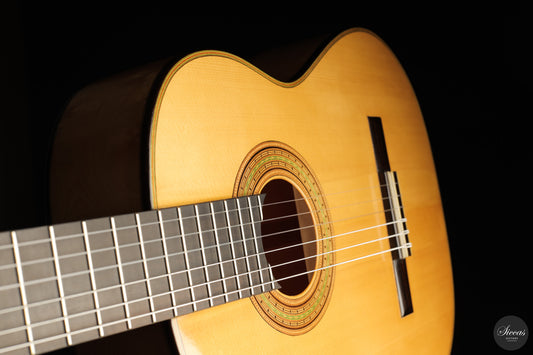
The edges of the body are bound with thin strips of wood or plastic that protect the joint between the top, back, and sides. More elaborate guitars often include purfling — decorative strips of contrasting woods — around the edges and the soundhole. This work requires precision and patience; the binding channels must be cut to exact dimensions, and the binding material must fit cleanly at every corner and curve.
Step 8: French Polish
The finishing of a fine classical guitar typically involves French polish — the application of many thin coats of shellac dissolved in alcohol, applied with a small pad and rubbed into the wood's surface in circular motions. The process is slow: a complete French polish may involve 20 to 40 or more applications, each allowed to dry before the next. The result is a finish thinner than any spray lacquer, hard and lustrous, that allows the wood to vibrate freely. French polish is the traditional finish of the Spanish guitar and remains the standard for fine handmade instruments.
A master guitar, built by hand with French polish, may represent 80 to 300 hours of work or more, spread over weeks or months. This is a large part of why fine handmade classical guitars cost what they do.
Step 9: Setup
The final stage is the setup: fitting the nut and saddle, setting the action (string height) precisely, checking the intonation, and making sure the guitar plays comfortably at all positions. A well-set-up guitar plays in tune across the whole neck and responds evenly to different levels of touch. This last stage, though less visible than the preceding ones, is what makes the guitar playable rather than merely beautiful.
FAQ
How long does it take to build a classical guitar?
A master luthier may spend 80 to 300 hours or more on a single instrument, typically spread over several weeks or months, especially when French polish is applied by hand.
What is fan bracing?
A pattern of seven light wooden struts arranged in a fan shape under the soundboard. Perfected by Antonio de Torres in the 19th century, it controls how the top vibrates and is the basis of the traditional classical guitar sound.
What is the most important part of a classical guitar?
The soundboard and its internal bracing. The top's stiffness, mass, and resonance properties largely determine the instrument's voice.
What is French polish?
A finish made by applying many thin layers of shellac dissolved in alcohol by hand. It is thinner than spray lacquer and allows the wood to vibrate freely, improving tone and ageing naturally with the instrument.
Why do classical guitars cost more than other types?
Fine classical guitars are largely or entirely handmade, requiring hundreds of hours of skilled work and carefully selected, seasoned tonewoods. The French polish process alone can take several weeks.
Famous classical guitar pieces → · Browse our classical guitars · Great classical guitarists