How to Practice Classical Guitar Effectively
Every classical guitarist — whether a complete beginner or an advancing student — eventually faces the same question: am I practising the right way? Putting in hours at the instrument is not automatically the same as making progress. The quality of your practice, the methods you use, and the structure of your daily routine matter far more than raw time spent. This guide breaks down the most effective strategies for practising classical guitar, drawn from proven pedagogical principles that great players and teachers have relied on for generations.
Why Practice Strategy Matters More Than Hours
There is a widespread belief that progress on a musical instrument is simply a function of time: the more hours you log, the better you become. Research and the lived experience of professional musicians tell a more nuanced story. Unfocused repetition reinforces mistakes just as reliably as it reinforces correct technique. If you run through a passage at full speed while making the same fingering error every time, you are not learning to play it correctly — you are learning to play it incorrectly, with great consistency.
The goal of structured practice is to make every repetition count. Forty-five minutes of fully concentrated, purposeful work will almost always produce better results than three hours of distracted noodling. This is not a comfortable truth for players who judge themselves by time at the instrument, but accepting it is the first step toward genuine improvement.
The Foundation: Slow Practice
If there is one single principle that underpins effective classical guitar practice, it is this: practise slowly enough that you can play everything correctly every time. A widely used guideline is to begin new passages at roughly 50% of the target tempo. At half speed, your fingers have time to find the correct position, your fretting hand has time to prepare the next chord, and your mind has time to process what is happening before it happens.
Slow practice is not simply a crutch for beginners. Advanced players returning to a difficult piece after time away, or working through technically demanding passages, rely on exactly the same principle. The underlying reason is straightforward: motor learning — the process by which your nervous system encodes physical movements — requires accurate repetition. Speed comes naturally once the movement pattern is correctly established. Trying to rush that process by practising at full tempo before the pattern is secure is one of the most common and costly mistakes guitarists make.
Use a metronome. Set it to a tempo at which you can play a passage without any errors, then increment the tempo in small steps — typically two to four beats per minute — only after you can play the passage cleanly several times in a row at the current speed. This approach is slower in the short term and dramatically faster in the long term.
Sectional Practice: Isolate, Then Integrate
Running through a piece from beginning to end is satisfying but rarely the most efficient use of practice time. Most of the gains come from identifying the specific bars or transitions that are causing problems and working on them in isolation.
When you encounter a difficult passage, extract it from its context. Play just those two or four bars, slowly and correctly, many times. Once you can play the isolated section reliably, expand the context: add the bar before it, then the bar after it, then connect it to the surrounding phrases. This approach — isolate, practise, then reintegrate — ensures that the difficult material actually improves rather than being glossed over in the run-through.
Pay particular attention to transitions. The moment of moving from one position to another, or from one chord to the next, is often where the difficulty lies. Practise the last note of one section and the first note of the next as a micro-exercise, drilling just that join until it is smooth.
Mental Practice: Improving Without the Instrument
Mental practice — visualising the physical movements of playing without actually holding the instrument — is a legitimate and well-documented technique used by professional musicians and athletes alike. Sitting quietly, closing your eyes, and imagining yourself playing through a passage engages many of the same neural pathways involved in physical practice.
For classical guitarists, mental practice is particularly useful for memorisation work, for working through technical passages when the hands are fatigued, or for preparation before a performance. Try to make the mental image as detailed and vivid as possible: feel the string under the fingertip, hear the sound in your inner ear, see the position of the left hand on the fingerboard. The more specific and sensory-rich the visualisation, the more effective it tends to be.
A Structured Daily Practice Routine
A well-organised practice session typically moves through several distinct phases, each with a specific purpose. The following structure provides a reliable framework that can be adapted to the time available on any given day.
Warm-Up: Scales and Arpeggios (10 Minutes)
Begin every session by warming up the hands gradually. Scales and arpeggios serve this purpose perfectly: they are technically demanding enough to engage the muscles and mind, but familiar enough that you can focus on the quality of sound and the evenness of tone rather than learning new material. Play slowly, listen carefully to the balance between the fingers, and pay attention to any tension in the hands or arms. If something feels uncomfortable, stop and shake out the hands before continuing.
The warm-up phase is also an opportunity to work on right-hand tone production — the angle of the fingers, the balance between flesh and nail, the point of contact on the string. These details shape every note you play, and the beginning of a session, when the mind is fresh, is an ideal time to attend to them.
Technique Exercises (15 Minutes)
After warming up, dedicate time specifically to technique: scales at increasing tempos, slur exercises, right-hand arpeggio patterns, or any specific technical challenge that is present in your current repertoire. This is different from the warm-up in that you are actively pushing the technical frontier — working at the edge of your current ability rather than consolidating what is already comfortable.
Keep a record of what you work on and at what metronome marking. Progress in technique exercises can be slow and easy to miss without documentation, and seeing the numbers move upward over weeks is genuinely motivating.
Repertoire Work (30 Minutes)
The largest portion of practice time goes to the pieces themselves. Within this block, use the sectional practice approach described above: identify the most difficult passages first, work them in isolation, then return to playing longer sections to integrate what you have practised.
Resist the temptation to always start at the beginning of a piece. If you always begin at bar one, you will always know the opening well and the ending less well. Instead, rotate where you begin, and make sure every section of every piece receives attention.
For players working on the classical repertoire, this is the time to engage with the music interpretively as well as technically. How does this phrase want to breathe? Where is the harmonic tension and release? Players like Andrés Segovia and Julian Bream shaped the modern classical guitar tradition in part through their deep engagement with musical interpretation, not just technical execution.
Sight-Reading (5 Minutes)
End each session with a short sight-reading exercise: take a piece of music you have never seen before and play through it at a comfortable tempo without stopping. Sight-reading is a skill that develops independently of repertoire learning, and five minutes a day adds up significantly over months and years. Choose material that is slightly below your current technical level so that the challenge is the reading itself, not the execution.
Keep a Practice Journal
A practice journal is one of the most underused tools available to guitarists at every level. After each session, spend two or three minutes writing down what you worked on, what improved, and what still needs attention. Note the metronome markings you used for specific passages and exercises. Record any technical observations — a tension you noticed, a tone quality you were pleased with, a fingering you changed.
Over time, the journal becomes an invaluable record of your progress and a planning tool for future sessions. It also introduces an element of accountability: when you know you will be writing down what you accomplished, you are less likely to drift into aimless playing.
Record Yourself to Hear Objectively
The experience of playing and the experience of listening are genuinely different. When you are playing, your attention is divided among technique, memory, expression, and the physical sensations of the instrument. When you listen back to a recording of yourself, you hear what an audience hears — the actual sound, without the internal experience of producing it.
Recording yourself regularly, even on a simple smartphone, reveals things that are almost impossible to notice while playing: uneven tempo, tone imbalances between voices, small memory hesitations, phrases that feel expressive but sound flat. Use these recordings diagnostically, not as a source of self-criticism, but as data that informs where to direct your practice.
Choosing the Right Instrument for Serious Practice
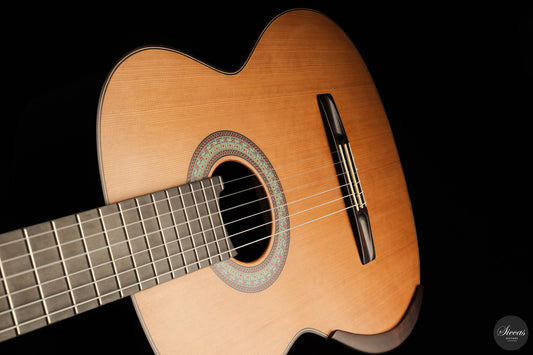
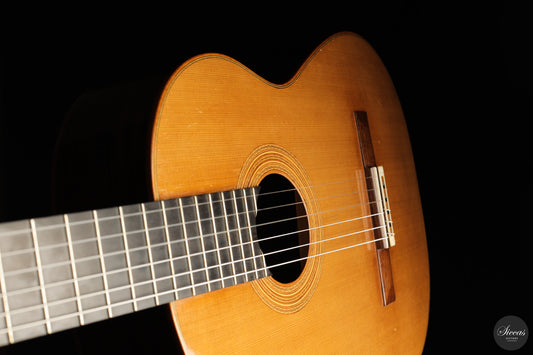
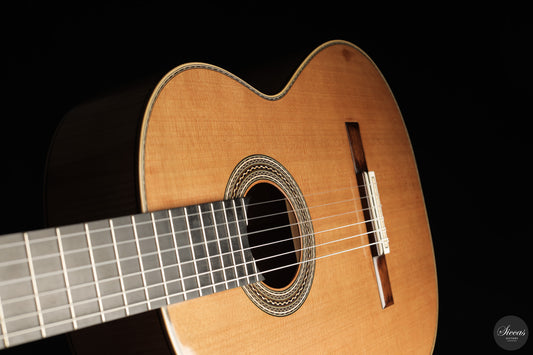
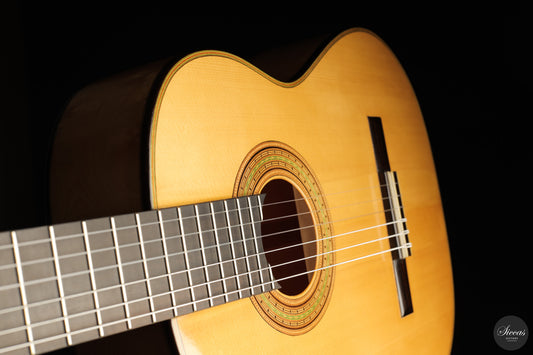
Effective practice requires an instrument that responds honestly to your technique. A guitar with high action, poor intonation, or a dull tone gives you unreliable feedback and makes it harder to develop a refined touch. If you are serious about your practice, investing in a quality classical guitar is one of the most productive decisions you can make.
At Siccas Guitars, you will find a carefully curated selection of classical guitars across a range of price points, including specialist options like double-top guitars and instruments with spruce or cedar tops, each with distinct tonal characteristics suited to different playing styles and repertoires. If you are unsure which top wood suits you, our detailed comparison of spruce vs cedar classical guitars is a useful starting point.
Beyond Technique: Building Musical Understanding
Technical facility is the means, not the end. Effective practice ultimately serves musical expression, and developing as a musician means engaging with the repertoire as music, not just as a sequence of technical problems to solve.
Listen widely to recordings of the pieces you are learning. Study the scores of works you are not currently playing. Explore the lives and contexts of the composers whose music you perform — understanding the world Francisco Tárrega inhabited, for example, enriches your understanding of why his music sounds the way it does. Read about famous classical guitar pieces and their histories.
If you are relatively new to the instrument, you may find our guides on how long it takes to learn classical guitar and the easiest classical guitar pieces for beginners a helpful complement to the practice strategies outlined here.
Summary: The Principles of Effective Practice
Effective classical guitar practice rests on a small number of principles that, consistently applied, produce reliable results. Practise slowly enough that every repetition is correct. Use sectional practice to target specific difficulties rather than running through whole pieces. Incorporate mental practice, especially for memorisation. Follow a structured daily routine that moves from warm-up through technique work to repertoire and sight-reading. Keep a practice journal and record yourself regularly. And always remember that quality of attention matters more than quantity of time.
Progress on the classical guitar is cumulative. Each well-practised session builds on the last, and the habits you establish now — good or bad — will shape your playing for years to come. Practise with intention, listen carefully, and enjoy the process.